Tag Archives: outdoors

Libra the Bateleur

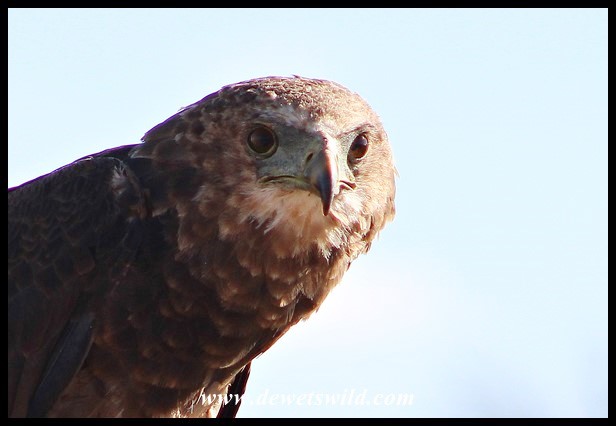
Libra is an immature Bateleur that was badly injured after being hit by a vehicle. So badly injured in fact, that a vet advised she be euthanised. The dedicated staff at the Dullstroom Bird of Prey and Rehabilitation Centre decided neverthless to give saving her life their best shot, and today Libra is finding her wings again, so to speak. Libra’s a very shy youngster – reminiscent of a child hiding behind her mother when meeting a stranger – and the way she has bonded with her caregiver Magdali will melt your heart.

As a registered NGO receiving no government support, the Dullstroom Bird of Prey and Rehabilitation Centre relies heavily on donors, sponsors and the visiting public to fund their very important work. Their tiny staff compliment is responsible for the rehabilitation of between 80 and 200 birds of prey every year, all of them injured by or negatively impacted in another way by humans, and then releasing them back into the wild when they’ve recovered sufficiently. If you can’t visit them in person, please visit their website and, if you are able to, assist them in their efforts by making a donation (monetary or in kind).

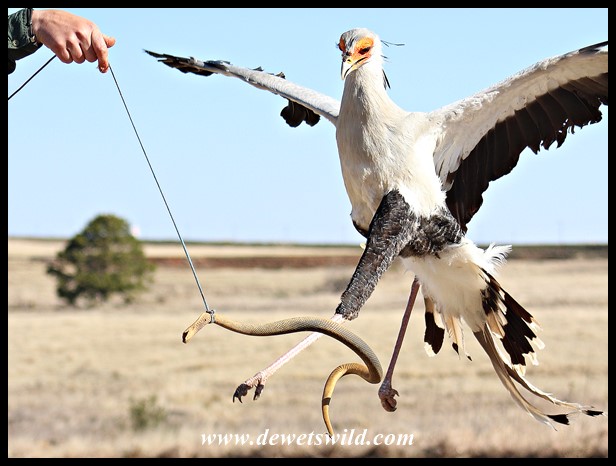
Rooney the Secretary Bird

Rooney the Secretary Bird was snatched from his nest as a chick, with the intention to be raised to adulthood and then killed for his body parts to be used in superstitious rituals. Thankfully the authorities could confiscate him before these cruel plans were brought to fruition and he now resides at the Dullstroom Bird of Prey and Rehabilitation Centre. Being imprinted on humans, Rooney wants nothing to do with other secretary birds and cannot be released back into the wild. If you are a sports lover Rooney’s name will quickly make sense to you when you see his powerful kicks (though he directs these to the head of a rubber-cobra rather than a football).

As a registered NGO receiving no government support, the Dullstroom Bird of Prey and Rehabilitation Centre relies heavily on donors, sponsors and the visiting public to fund their very important work. Their tiny staff compliment is responsible for the rehabilitation of between 80 and 200 birds of prey every year, all of them injured by or negatively impacted in another way by humans, and then releasing them back into the wild when they’ve recovered sufficiently. If you can’t visit them in person, please visit their website and, if you are able to, assist them in their efforts by making a donation (monetary or in kind).

Ginger the Lanner Falcon

Ginger the Lanner Falcon is one of the Dullstroom Bird of Prey and Rehabilitation Centre‘s success stories – she arrived at the centre having been shot through the wing, but has recovered so wonderfully that she is set to be released back into the wild before the end of the year! For now she is given regular flying exercise and sometimes the visiting public are lucky enough to witness her practice sessions, like we were when we visited recently.

As a registered NGO receiving no government support, the Dullstroom Bird of Prey and Rehabilitation Centre relies heavily on donors, sponsors and the visiting public to fund their very important work. Their tiny staff compliment is responsible for the rehabilitation of between 80 and 200 birds of prey every year, all of them injured by or negatively impacted in another way by humans, and then releasing them back into the wild when they’ve recovered sufficiently. If you can’t visit them in person, please visit their website and, if you are able to, assist them in their efforts by making a donation (monetary or in kind).


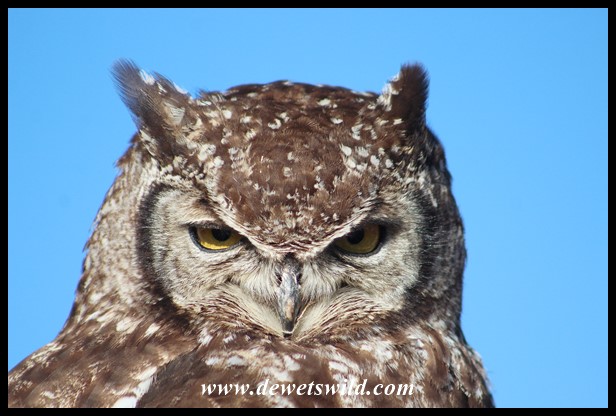
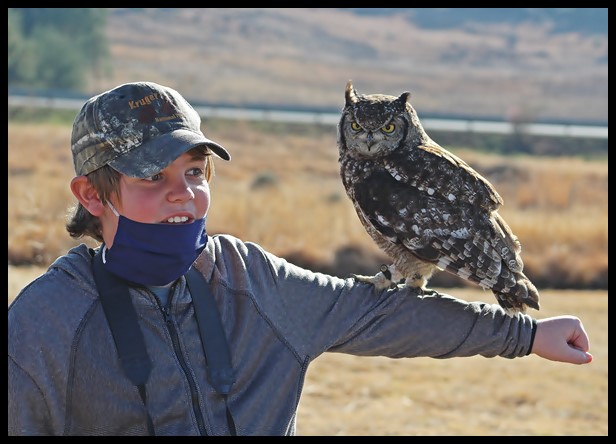
Daphne the Spotted Eagle-owl

Daphne is the sweetest Spotted Eagle-owl you could ever hope to meet (though her table manners leave a lot to be desired). She has lived at the Dullstroom Bird of Prey and Rehabilitation Centre all her life. The tree her parents were incubating Daphne in was chopped down and, miraculously, Daphne’s egg was the only one of the clutch that didn’t shatter. The egg was brought to the rehab centre and, on detecting a heartbeat in the egg, they decided to hatch it and raise the chick by hand. While she is imprinted on humans and cannot be released, Daphne’s dear personality is just the ticket to dispel any ill-conceived superstition visitors may hold about owls. She’s a true ambassador for all owl-kind.

As a registered NGO receiving no government support, the Dullstroom Bird of Prey and Rehabilitation Centre relies heavily on donors, sponsors and the visiting public to fund their very important work. Their tiny staff compliment is responsible for the rehabilitation of between 80 and 200 birds of prey every year, all of them injured by or negatively impacted in another way by humans, and then releasing them back into the wild when they’ve recovered sufficiently. If you can’t visit them in person, please visit their website and, if you are able to, assist them in their efforts by making a donation (monetary or in kind).

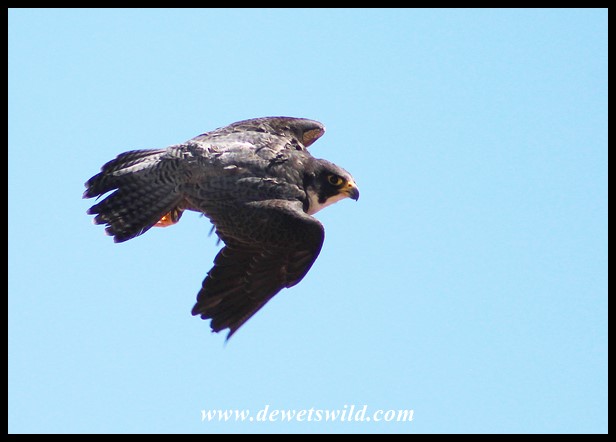
Charlie the Peregrine Falcon

Charlie is a Peregrine Falcon that lives at the Dullstroom Bird of Prey and Rehabilitation Centre. He was raised by a falconer and imprinted on humans, which is why he cannot be released. Charlie is 13 years old now – quite old for a bird his size – but still possesses the incredible speed and agility his species is known for.

As a registered NGO receiving no government support, the Dullstroom Bird of Prey and Rehabilitation Centre relies heavily on donors, sponsors and the visiting public to fund their very important work. Their tiny staff compliment is responsible for the rehabilitation of between 80 and 200 birds of prey every year, all of them injured by or negatively impacted in another way by humans, and then releasing them back into the wild when they’ve recovered sufficiently. If you can’t visit them in person, please visit their website and, if you are able to, assist them in their efforts by making a donation (monetary or in kind).


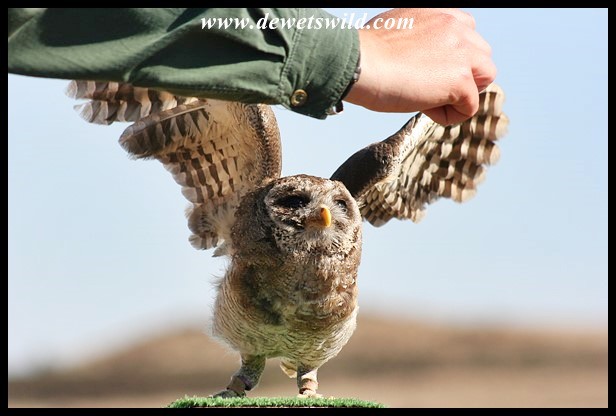
Vinkel the Wood Owl

Vinkel is a little Wood Owl that lives at the Dullstroom Bird of Prey and Rehabilitation Centre. When he was a little chick he fell out of his nest. Well-meaning humans picked him up and tried to hand-raise him, feeding him a mix of minced meat and – shockingly – cotton wool; a horribly incorrect tip they found on the internet, supposedly meant to simulate the hair and feathers that owls normally ingest and then regurgitate as owl pellets. As a result, little Vinkel’s growth was stunted and he imprinted on humans, meaning that he can never be released into the wild – thankfully he made it to Dullstroom in time for his life to be saved. I think it is also necessary to mention at this point that any little bird found out of its nest is best returned to it or as close as can be to its parents if at all possible – it is not true that the parent birds, of any species, will reject a chick because it “smells” of human.

As a registered NGO receiving no government support, the Dullstroom Bird of Prey and Rehabilitation Centre relies heavily on donors, sponsors and the visiting public to fund their very important work. Their tiny staff compliment is responsible for the rehabilitation of between 80 and 200 birds of prey every year, all of them injured by or negatively impacted in another way by humans, and then releasing them back into the wild when they’ve recovered sufficiently. If you can’t visit them in person, please visit their website and, if you are able to, assist them in their efforts by making a donation (monetary or in kind).

Chewy the Harrier-Hawk

Chewy is an African Harrier-Hawk that lives at the Dullstroom Bird of Prey and Rehabilitation Centre. Like Magdali, one of the centre’s duo of passionate managers, Chewy exchanged big city living for the romance of the countryside when she was sent to Dullstroom as a gift from the Lory Park Sanctuary in Johannesburg. Chewy’s quite a talkative lady, and treated us to a very interesting display of her flying and foraging abilities.

As a registered NGO receiving no government support, the Dullstroom Bird of Prey and Rehabilitation Centre relies heavily on donors, sponsors and the visiting public to fund their very important work. Their tiny staff compliment is responsible for the rehabilitation of between 80 and 200 birds of prey every year, all of them injured by or negatively impacted in another way by humans, and then releasing them back into the wild when they’ve recovered sufficiently. If you can’t visit them in person, please visit their website and, if you are able to, assist them in their efforts by making a donation (monetary or in kind).

Dullstroom Bird Of Prey and Rehabilitation Centre

This past Sunday Joubert and I had the immense privilege of visiting the Bird of Prey and Rehabilitation Centre a stone’s throw away from the small and historic town of Dullstroom on the Mpumalanga Highveld. Tripadvisor rates it as the foremost attraction in Dullstroom – no small feat considering Dullstroom’s fame among local and international visitors alike as a mecca for outdoor enthusiasts where visitors are spoiled for choice.

With tourism being the lifeblood of the picturesque town, restrictions on travel imposed in recent months, however necessary to curb the spread of COVID-19, had a devastating effect on the local economy. As a registered NGO receiving no government support, the Dullstroom Bird of Prey and Rehabilitation Centre relies heavily on donors, sponsors and the visiting public to fund their very important work. Their tiny staff compliment is responsible for the rehabilitation of between 80 and 200 birds of prey every year, all of them injured by or negatively impacted in another way by humans, and then releasing them back into the wild when they’ve recovered sufficiently. Only non-indigenous birds, those whose injuries are too severe to permit a fully self-sufficient life in the wild or those that are hopelessly imprinted on humans remain at the centre permanently. The love and passion these people have for their job is absolutely inspiring. If you can’t visit them in person, please visit their website and, if you are able to, assist them in their efforts by making a donation (monetary or in kind). The way Libra, an immature Bateleur that was severely injured by a vehicle a year ago, seeks comfort from handler Magdali Theron in the picture below will leave you in no doubt just how vital the work of the Dullstroom Bird of Prey and Rehabilitation Centre is.
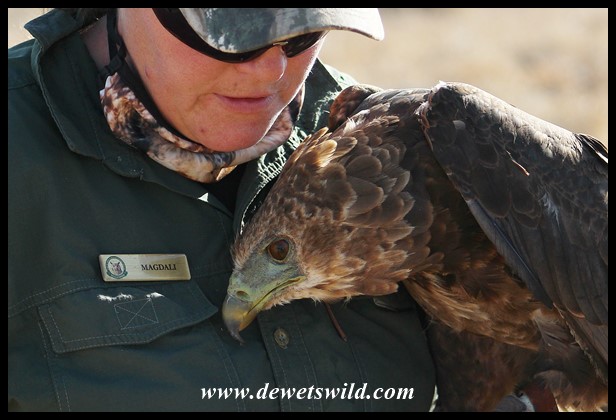
Libra and Magdali

Apart from the fact that it was our first chance to escape from South Africa’s heavily industrialised Gauteng Province in almost six months or that we were able to marvel at the most majestic birds of prey from close quarters, the trip was both long-awaited and memorable for another reason: being tutored by accomplished wildlife photographer Hannes Rossouw in the art of taking photographs of birds in flight. Thanks to Hannes’ unending patience and skill as an educator we hope we’ll be able to have many more images like these gracing the pages of de Wets Wild in future.

As you can imagine, after spending most of the daylight hours at the centre, we came back to Pretoria with hundreds of photo’s. In the coming days we will be using those images to tell you the stories of ten of the Dullstroom Bird of Prey and Rehabilitation Centre’s most charismatic residents. And be sure to look out for Joubert’s images in the mix; under Hannes’ expert tutelage his photographic skills have become even more impressive (I know, I am biased).
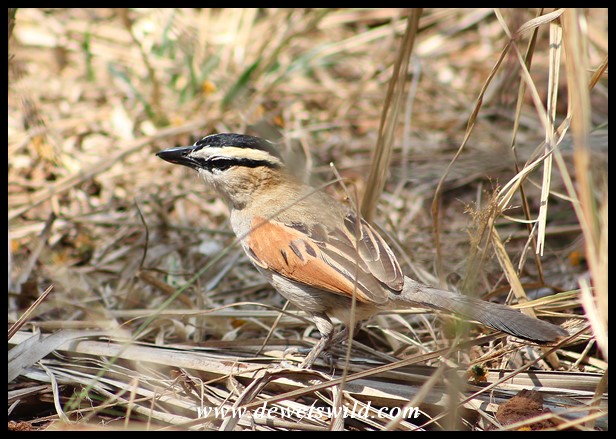
Black-crowned Tchagra

Tchagra senegalus

The Black-crowned Tchagra is a shy bird of the shrike-family that inhabits wetter savanna and woodland-type habitats and feeds mainly on insects and other small prey, which occasionally includes lizards, snakes and frogs. They are also quick to utilise well-planted parks and gardens.

Black-crowned Tchagras form monogamous, territorial pairs, nesting in cup-shaped constructions they build together in bushes and trees during an extended breeding season that spans most of spring, summer and autumn. The female takes most of the responsibility for incubating the clutch of 1-4 eggs over a two-week period, with the chicks fledging when only two weeks old but staying with their parents for quite some time after. Fully grown Black-crowned Tchagras weigh around 50g and measure about 21cm in length.

In South Africa, Black-crowned Tchagras are found from the Eastern Cape, through most of Kwazulu-Natal and into Mpumalanga, Limpopo, Gauteng and North West. They’re also widely distributed over sub-Saharan Africa, with isolated populations along the Barbary Coast of North Africa and the southern reaches of the Arabian Peninsula. The IUCN lists the species as being of least concern.

You might enjoy this short video of a Black-crowned Tchagra singing its melodious song:

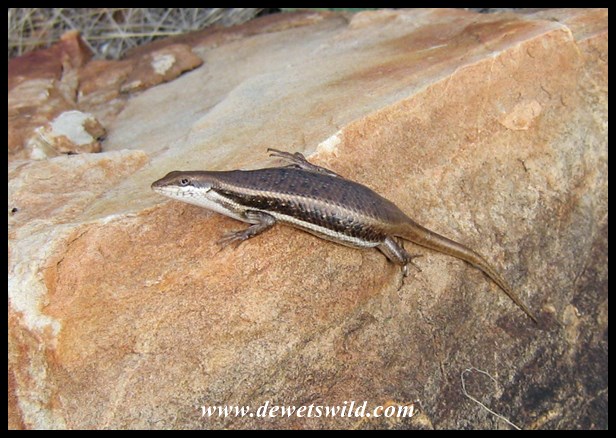
Variable Skink

Trachylepis varia

The Variable Skink is a lizard found in grassland and savanna habitats, and especially rocky areas there-in, and distributed (in South Africa) from the coastal Eastern Cape through Kwazulu-Natal, the Free State and Gauteng to the North West, Mpumalanga and Limpopo. They feed on insects and other invertebrates. Females give birth to as many as 10 babies in the summer months. They grow quickly; maturing at about 8 months of age (when they measure around 6cm in length, tail excluded) with a life expectancy of only about two years, or even less.