Tag Archives: outdoors

A memorable encounter with Elephant bulls near Tihongonyeni

South Africa’s Kruger National Park is renowned for wonderful encounters with African Elephants, and our quick visit last week proved no exception. We were based in the Mopani region of the Park, where mopane shrubs and trees dominate the plains and elephants congregate in their numbers near permanent water sources, like the Tihongonyeni waterhole. It was on our way to Tihongonyeni late one morning that these two bulls decided to make use of a flimsy shadow cast over the road by a big tree to rest their tired legs. Every time we ventured closer to try and sneak past on the verge of the road, the bull nearer to us would give a warning step or two in our direction, trunk outstretched, and so I’d back up again. Eventually we waited half-an-hour before the two eventually allowed us, with a shake of the head and a toss of the trunk as if they’d grown tired of our meekness and just wanted to be rid of us, to pass them.

Here’s a short video of an encounter we’ll remember fondly when passing that way again in future.
Returning to familiar favourites and finding new treasures in the Lowveld

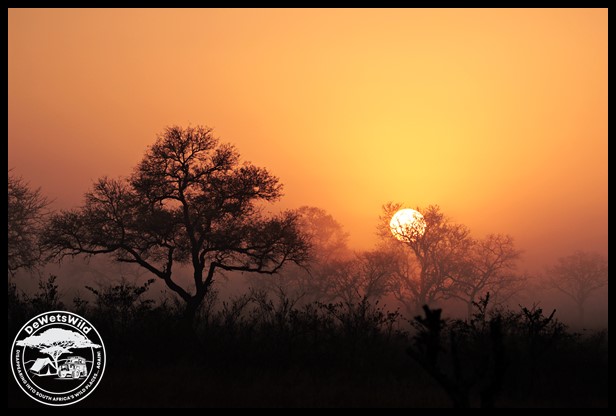
I have just returned from a visit to the Lowveld and in particular the Kruger National Park and Manyeleti Game Reserve with Hannes Rossouw Photography. The following photographs are just a little appetiser of what you can look forward to in the next few posts on DeWetsWild.


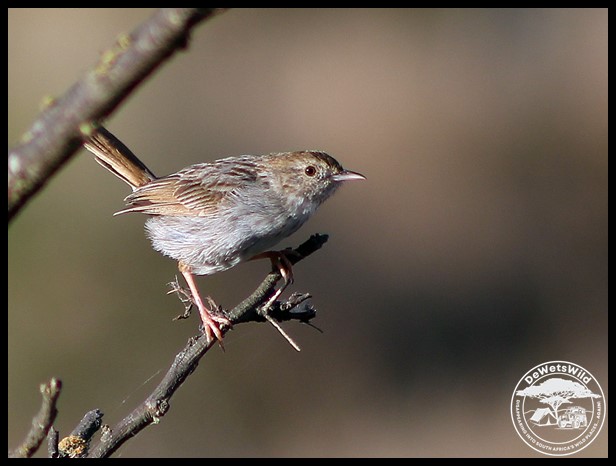
Grey-backed Cisticola

Cisticola subruficapilla

Grey-backed Cisticolas are found only in the southwest of South Africa (Eastern, Northern and Western Cape and southern Free State) and in Namibia. It inhabits the Fynbos and Karoo biomes, living on insects snatched from the ground or from leaves. They’re commonly encountered either singly, in pairs or small family groups.

Grey-backed Cisticolas form monogamous, territorial pairs and breed from mid-winter to summer. They build ball-shaped nests with a side-entrance, usually placed low in a shrub and often incorporating parts of it in the construction. Clutches of 2-5 eggs are incubated for about two weeks, with the chicks leaving the nest a similar length of time after hatching. Fully grown they weigh about 11g and measure around 12cm in length.

The IUCN assessed the Grey-backed Cisticola as being of least concern.

Large-billed Lark

Galerida magnirostris

A rather nondescript bird, perfectly camouflaged to blend in with the barren substrates they favour, the Large-billed Lark is a bird of the fynbos and Karoo biomes. They forage on the open ground, feeding on seeds and insects, and are particularly fond of ploughed fields and overgrazed pastures. They’re usually seen in pairs.

Large-billed Larks are territorial and form monogamous pairs that breed from mid-winter to mid-summer, building cup-shaped nests at the base of a grass tuft or low shrub in which both partners incubate clutches of 2-4 eggs for a little over 2 weeks. While the chicks are in the nest the parents are fearless about protecting them against predators and humans alike. Fully grown they weigh around 48g and measure about 18cm in length.

The Large-billed Lark is found only in the Western, Eastern and Northern Cape Provinces as well as the southern Free State, Lesotho and extreme southern Namibia. The IUCN considers it to be of least concern.

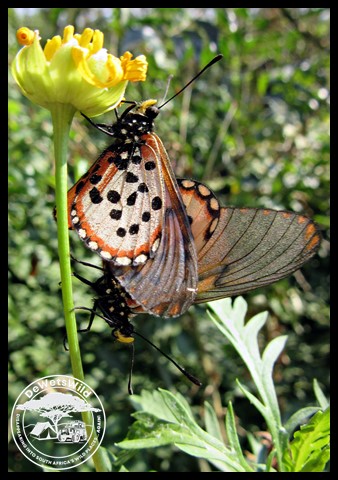
A window into the life cycle of the Garden Acraea

The Garden Acraea is by far the most numerous butterfly in our little garden, and as I type this there’s at least a dozen of them flitting around the plumbago and Cape honeysuckle shrubs in my field of view. This year I’ve paid even more attention than usual to them and been rewarded with a window into their fascinating life cycle.

Two Garden Acraeas mating

In April we started noticing large numbers of caterpillars in their final instar moving around the garden, with some of them even finding safe refuges on the patio furniture and security bars in front of the windows where they could start their metamorphosis.

It took several months for them to shed their last caterpillar “skin” to reveal the hard chrysalis inside which they were transforming. Sadly some of the pupae dropped from their safe havens, but I could save a few from marauding ants and put them in a jar on my desk where I could keep a close eye on them.

It didn’t take anywhere near as long – only a few weeks – for the adult butterflies to start emerging.

Soon their wings were unfurled and they could take flight in the same garden where they started their lives.

One of the pupaes I kept in a jar on my desk taking on the wide world outside

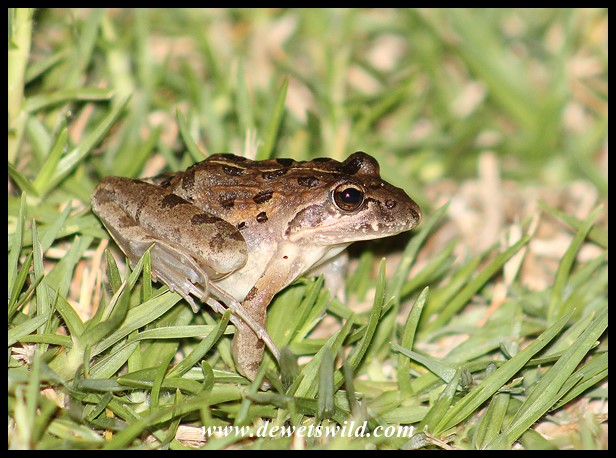
Clicking Stream Frog

Strongylopus grayii

The Clicking Stream Frog’s call is a good impersonation of a human tongue click, hence the common name. They’re small frogs, measuring at most 5cm in length, found only in South Africa, Lesotho and Eswatini (Swaziland) and ranging from our west coast, through the Little Karoo and Garden Route, through most of the Eastern Cape and Kwazulu-Natal and then to the higher lying regions of Mpumalanga and Limpopo. They are particularly common in the south-western corner of the country that receives most of its rainfall in winter. They’re regularly found in or near ponds and small dams as well as shallow streams, and so tolerant of poor water quality that they’ll even breed in flooded refuse pits.

Clicking Stream Frogs lay their eggs in moist spots next to the water’s edge. Females can produce up to 350 eggs. In wet weather the tadpoles may emerge within 5 days of the eggs being laid and then scramble to the water, but in dry weather the eggs could remain viable for up to 2 months. It takes 3 to 6 months for the tadpoles to go through the full metamorphosis to adult frog form.

Swee Waxbill

Coccopygia melanotis

The Swee Waxbill occurs only in South Africa (it is absent from the dry western and open central parts of the country), Lesotho and eSwatini (Swaziland) with a tiny, isolated population in South-central Zimbabwe. The IUCN considers it to be of least concern.

Swee Waxbills are omnivores, feeding mostly on grass seeds and tiny insects. They’re most commonly found on the edges of and clearings in forests and woodlands and will venture into well-planted gardens from time to time, becoming quite unafraid of humans. They’re usually seen in pairs or small groups, getting their name from the soft contact calls they make while moving around.

Swee Waxbills breed from mid-spring to late summer. Monogamous pairs work together to construct their oval-shaped grass nest, usually placed high in a tree or other dense vegetation. Clutches of up to 9 eggs are incubated by both parents over a 2 week period. The chicks leave the nest when they’re about 3 weeks old and remain with their parents for a similar time thereafter before dispersing. They’re tiny birds and fully grown weigh less than 8g.

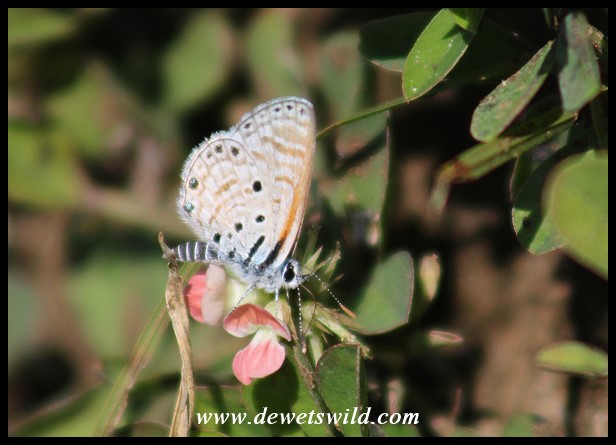
Topaz Spotted Blue Butterfly

Azanus jesous

The Topaz Spotted Blue occurs commonly through most of South Africa, being absent only from the drier western reaches of the country, and inhabits a wide range of habitats where they gather in numbers around flowering thorn trees or to drink from puddles. Adults, with a wingspan of less than 3cm, can be seen throughout the year though their numbers peak in summer. The larvae feeds on several different kinds of thorn trees (Acacia sensu lato and Dichrostachys).

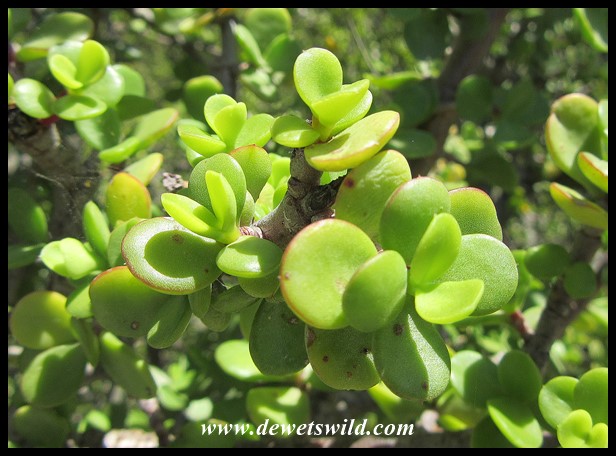
Spekboom

Portulacaria afra

The Spekboom (“Bacon Tree”) is a succulent shrub or small tree of up to 5m tall that occurs naturally from the Little Karoo, through the Eastern Cape – where it is the dominant plant species in parts of the province, like the Addo Elephant National Park – and Kwazulu-Natal and into the Lowveld of Mpumalanga and Limpopo. It grows best on warm, rocky slopes. It is listed as being of least concern in the Red List of South African Plants.

Spekboom is browsed heavily by game (including elephants) and livestock, and humans too use the leaves in salads or as medicine for skin conditions and other ailments. Easily grown from cuttings, Spekboom is a popular garden plant and widely established in many parts of the world. In recent years the Spekboom’s incredible ability to sequester carbon dioxide from the atmosphere coupled with its ease of propagation has received much attention as a possible mitigating measure against climate change.

Orange-breasted Sunbird

Anthobaphes violacea

The striking Orange-breasted Sunbird is a nectar and insect-feeding bird that is endemic to South Africa’s fynbos biome, and as such occurs only in the Western Cape and western-most portions of the Eastern Cape coast. They’re mostly associated with natural stands of Protea and Erica plants, and will only occasionally visit gardens with flowering Aloe plants.

Orange-breasted Sunbirds are usually seen singly or in pairs, but they may on occasion congregate in enormous numbers at a rich food source. They may breed throughout the year, though there is a peak in nesting activity between autumn and spring. It takes the female about 3 weeks to construct the oval-shaped nest, with a side-entrance in a densely-leafed shrub, using soft materials and spider web. While the male defends the pair’s territory, the female is also solely responsible for incubating the clutch of 1 or 2 eggs for about two weeks, though both parents feed the chicks on invertebrates brought back to the nest until they fledge at approximately 3 weeks of age. The youngsters become independent about two to four weeks later. Fully grown they measure about 16cm in length but weigh only 9g.

The IUCN classifies the Orange-breasted Sunbird as being of least concern, while noting that their population is probably declining due to loss of habitat to invading alien plants.