iSimangaliso Wetland Park, South Africa’s first World Heritage Site, is named after the isiZulu word meaning “Miracle” and “Wonder”. Our recent visit to the Park just reminded us again what an appropriate name that is.
Having visited the Western Shores in December last year, we focused our attention during our June visit on the Eastern Shores section of the Park, a diverse area lying between the Indian Ocean in the east, Lake Saint Lucia in the west, St. Lucia town and the lake’s estuary to the south and incorporating the popular destinations of Mission Rocks and Cape Vidal, where we stayed for three nights. The sunrises and sunsets alone made the trip worthwhile!

Sunrise on the Eastern Shores

Sunrise on the Eastern Shores

Sunrise on the Eastern Shores

Sunrise on the Eastern Shores

Sunset on the Eastern Shores

Sunset on the Eastern Shores

Sunrise on the Eastern Shores

Sunrise on the Eastern Shores, iSimangaliso Wetland Park

Sunset on the Eastern Shores
As always, the game and bird-viewing on the Eastern Shores could only be described as splendid, but the Park is clearly not escaping the ravages of the drought that has Kwazulu-Natal Province in a firm choke hold, and none of the pans close to the roads held any water. Indeed a stark contrast to the lush oases of reeds and waterlilies these waterholes normally are, complete with hippos, crocodiles and wading birds in residence. Even the Mfazana Pans, where there’s a brilliant photographic hide, was little more than an almost-dry puddle of mud.

African stonechat (male)

Denham’s bustard

Yellow-throated Longclaw

Burchell’s coucal

Plains zebra

Plains zebra

Plains zebras

Plains zebra

Baboon in repose

Kudu bull

Kudu family

Kudu cow

Kudu bull standing proudly on the crest of a grassy dune

Buffalo bull

Blue wildebeest

Tsessebe

Red Duiker

Cloud cisticola

Brown-hooded kingfisher

Southern Banded Snake Eagle
We seem to have extraordinary luck with finding leopards here and this trip was no exception, with no less than four sightings of these beautiful cats. A late afternoon sighting of a serval, a much smaller but also spotted cat, being chased by a group of lapwings as it crossed a burnt field, was a very pleasant surprise. Unfortunately we didn’t see anything more than a footprint of iSimangaliso’s spotted hyenas during this visit. On the other side of the scale, a tiny snake, the variegated slug eater, was a first-ever encounter for us and one we’ll remember just as long as any of the leopard sightings.

Leopard south of Cape Vidal

Spotted hyena track

Serval running from lapwings

Leopard after dark

Leopard sighting on the Grassland Loop on the Eastern Shores of Lake St Lucia – 15th June 2015

Variegated slug eater
We can never spend enough time at this wonderful place, and you’ll understand that we were not at all pleased that our long weekend flew past in the blink of an eye. Time to start making plans for the next visit then…
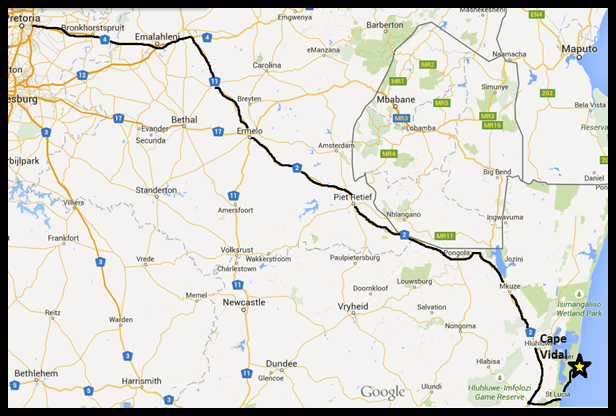
The Bhangazi gate into the Eastern Shores of Lake Saint Lucia lies roughly 640km South-East of Pretoria.
(Drawn using Google Maps)
-28.007210
32.480689


 DeWetsWild