
South Africa observes the “National Invasive Species Week” in October annually. Hosted by the Department of Forestry, Fisheries and the Environment, the campaign focuses on creating awareness among the South African public about the threats non-native species pose to our ecosystems. In this edition of de Wets Wild, we’ll be focusing on a handful of the introduced bird species found in our country.
Common Myna – Acridotheres tristis
The Common Myna was introduced to South Africa from India and Sri Lanka between 1900 (Durban) and 1938 (Johannesburg), and has become one of the most common urban birds in almost all the cities and towns in the north-east half of our country with newly established populations also noted in Cape Town, Port Elizabeth and elsewhere – no wonder it is considered one of the 100 worst invasive species, not only in South Africa but the world over. Very worryingly, they now seem to have thrown off their urban shackles and are increasingly being recorded in several of our national parks as well. Common Myna are highly intelligent and quite aggressive and easily outcompete several indigenous kinds of birds for nests and food, even destroying their eggs and killing their chicks. They carry foreign diseases and parasites that afflict not only other birds but also humans.


Common Starling – Sturnus vulgaris
Another species considered to be among the 100 worst invasive species on the planet is the Common Starling, which first arrived in South Africa (Cape Town) in 1897, having been introduced from England by Cecil John Rhodes, himself a controversial figure. Not only is it responsible for immense damage to crops and orchards, but it too outcompetes native birds for resources like nests and food. While the distantly related Common Myna has taken control of the north-east of our country, it seems this member of the starling family has claimed the south-west of South Africa, especially the Western and Eastern Cape, and is staging its invasion of the rest of the country from there.
Thankfully two other species Rhodes tried to establish at the Cape of Good Hope, the Common Chaffinch and Grey Squirrel, while still resident in and around Cape Town, have not become as entrenched in South Africa as the Common Starling.


House Sparrow – Passer Domesticus
Today, the House Sparrow occurs in virtually every corner of South Africa – if there are people permanently settled anywhere, you can be sure there are House Sparrows too. It would appear that they first arrived in Durban from India around 1880, from whence they rapidly spread throughout South Africa and to our neighbouring countries – it is estimated that there are 8,000 of them in the various rest camps of the Kruger National Park alone! Thankfully they are not a major threat to any indigenous bird species nor are they a pest to agricultural interests, rarely being found far from human habitation.


Lovebirds – Agapornis species
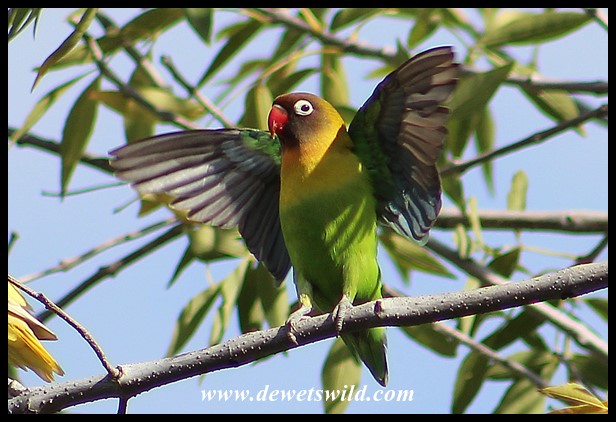
Africa and Madagascar is home to nine species of Lovebird – a family of small parrots – but only one, the Rosy-faced Lovebird, occurs naturally in South Africa; in a tiny corner of the Northern Cape along the border with Namibia. Lovebirds are very popular in the pet trade, and it is probably due to escapees that feral populations of Lovebirds have become established in Pretoria and a few other locations in South Africa. Many of the Lovebirds now flying wild around our suburb have features in common with the Rosy-faced, Black-cheeked, Fischer’s, Lilian’s and Yellow-collared Lovebirds, but they are probably all hybrids of these and other kinds.


Rose-ringed Parakeet – Psittacula krameri
Rose-ringed Parakeets are native to the Indian subcontinent and a band stretching through Africa from Senegal to Ethiopia. Being popular in the pet trade escapees have established feral populations in various parts of the world, including South Africa, where large populations are found in Durban, Johannesburg and Pretoria. Thankfully a population that occurred around Sodwana in what is today the iSimangaliso Wetland Park seems to have died out. In large flocks Rose-ringed Parakeets can be a serious pest in orchards, and they displace native hole-nesting birds from prime habitat.


Rock Dove – Columba livia
The Rock Dove, also known as the Common Pigeon, arrived in South Africa along with the first Dutch settlers in 1652 and soon became feral when they escaped domesticity. While today they are found in virtually every town and city in the country, their reliance on human habitation for food and nesting sites means that they are seldom encountered in our protected areas. Nevertheless they can be a serious nuisance and disease carrier.


Indian Peafowl – Pavo cristatus
The beautiful peacock is another bird that made its way to South Africa as an ornamental many decades ago. While they were purposefully released on Robben Island, some of these birds escaped from farms and zoos and free-ranging populations can now be found widely in South Africa and especially in and around major urban centres.


Carolina Wood Duck – Aix sponsa
While they do occasionally venture from their native North American haunts and have reached parts of Europe on these forays, it is much more likely that the occasional Carolina Wood Ducks seen in the wild in South Africa escaped from captivity. It would seem that no feral populations have yet become settled in the country.


Mallard – Anas platyrhynchos
The exotic Mallard, and its domesticated descendants, started invading South African wetlands around the 1980’s after escaping from farms and the collections of bird fanciers. They’re now found widely across the country with the biggest populations in and around the larger towns and cities. The Mallard poses a confirmed risk of crossbreeding with our indigenous African Black Duck and Yellow-billed Duck, diluting the genetic purity of these native species.


What is interesting is that these species are not problematic in their natural habitats and ranges, and only get their “bad rap” due to humans introducing them to places they don’t belong. In the same way some species that are native to South Africa have become invasive in other parts of the world – the blue kurper (Mozambique tilapia) for instance also counts among the 100 worst invaders in the world.
 DeWetsWild