Apus affinis
In South Africa, the Little Swift is a resident bird that has actually experienced a population boom and rapid range expansion in the last century, thanks to its propensity to use buildings and other human-made structures for breeding. As a result, the IUCN considers it to be of least concern. It occurs all over South Africa, and also most of sub-Saharan Africa, the Mediterranean coast of North Africa. pockets of the Middle East and much of India.
Little Swifts are not at all picky about their habitat though they do require easy access to a water supply and usually avoid high altitude terrain. Little Swifts will often form mixed flocks with other swifts and swallows, hunting for a wide range of flying insects.
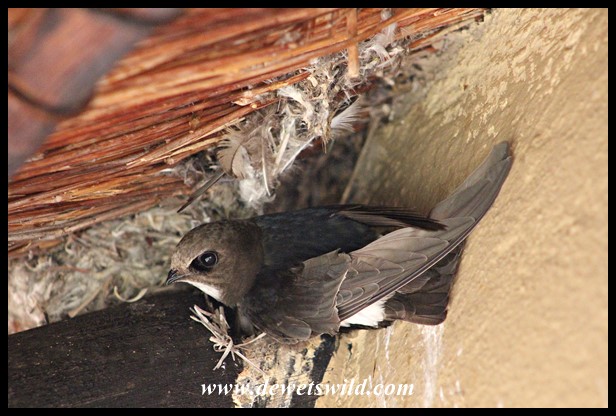
As mentioned already, Little Swifts build their nests, often in colonies of up to 30 monogamous pairs, in shelter provided by man-made structures like buildings, bridges and silos, though naturally they would utilise rocky overhangs and cliffs for the purpose. These nests are untidy conglomerations of feathers and plant material glued together with saliva and often used for several consecutive years. They breed in spring and summer, with both parents sharing the duty of incubating the clutch of 1-4 eggs over a 3-4 week period. The chicks stay in the nest until they’re almost 6 weeks old, but become independent very quickly thereafter. Fully grown Little Swifts weigh around 25g and measure only about 13cm in length.
As beautifully elegant as they are in the air, Little Swifts are almost entirely helpless when they are unfortunate enough to end up on the ground, which seems to happen surprisingly often when they swoop after prey close to the ground; their short legs and long wings make it almost impossible to launch from the ground.

Little Swifts

Little Swift hanging upside down at its nest

Little Swift that dove too low and then struggled to get airborne again

Little Swift that dove too low and then struggled to get airborne again

Little Swift reinforcing a nest

Little Swift

Little Swift nests in the roof of the gate building at Nylsvley

Little Swift

Little Swift nests

Little Swift

Little Swift (photo by Joubert)

Little Swift (photo by Joubert)



 DeWetsWild