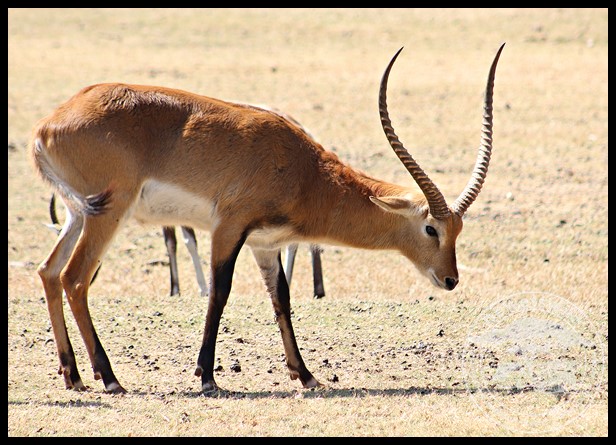
Today, on Endangered Species Day, we feature another African mammal that isn’t indigenous to South Africa.
Kobus leche
The Southern Lechwe is one of the most water-loving antelopes in the world, living on seasonally flooded plains, in seasonal marshes and permanent wetlands and never further than a couple of kilometres from permanent water, needing to drink 2 to 3 times per day. They prefer open grassy areas and avoid dense cover. Lechwes feed on grasses (aquatic and otherwise), the fresh shoots and new leaves of reeds and to a lesser degree on other water-living plants or leaves from shrubs, and will even feed in water up to 60cm deep.
Lechwe herds, usually numbering around 3 dozen individuals but occasionally into the hundreds and even thousands, are loose associations of females and their young, moving across the territories of mature males. Rams that are unable to establish and hold territories gather in bachelor herds that occupy the fringes of the territories. Lechwes are most active in the early morning and late afternoon, resting up on high ground near the water at night and during the heat of the day. They’re great swimmers and when threatened will rush into the water to evade predators.
Lechwe ewes isolate themselves on dry ground in dense vegetation to give birth to single lambs at any time of year, though there’s a distinct peak in births during the rainy season, following a 7.5 month gestation period. The lamb remains hidden near where it was born for around 3 weeks, with the ewe returning twice a day to suckle it. Even when they’ve rejoined the herd the lambs spend more time with each other than with their mothers. Lambs wean at about 5 months of age and have a life expectancy of about 10 years in the wild. Rams are much more strongly built than the ewes, and weigh around 30kg more at 110kg. Both sexes stand around 1m high at the shoulder, the rams usually being only a few centimetres taller.
The Southern Lechwe occurs naturally only in isolated pockets of Botswana, Angola, Zambia and the DRC. The IUCN recognizes five contemporary subspecies, one of which is already extinct while the other four are all of conservation concern:
- Robert’s Lechwe (K. l. robertsi) occurred in north-east Zambia but went extinct in the 20th century.
- Upemba Lechwe (K. l. anselli) numbers less than a thousand and occurs in the southern DRC. It is considered to be critically endangered due to poaching.
- Kafue Lechwe (K. l. kafuensis) are considered endangered. It occurs naturally only on Zambia’s Kafue Flats and number approximately 20,000.
- Between 33,000 and 36,000 adult Black Lechwe (K. l. smithemani) is found naturally only in Zambia’s Bangweulu Swamp. This subspecies is considered to be vulnerable.
- Red, or Common, Lechwe (K. l. leche) has the widest distribution, from Angola to Botswana’s Okavango. They are listed as near-threatened and number between 50,000 and 60,000 mature individuals.
Fossil records indicate that in recent pre-history a close relative of the Southern Lechwe, the Cape Lechwe (Kobus venterae), occurred in central South Africa. Today, game farmers in this area have imported Red and Kafue Lechwe’s to their properties where they are bred mainly for hunting.


 DeWetsWild