
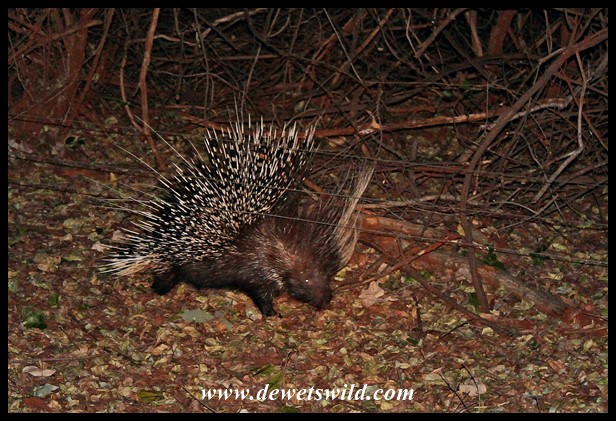
Hystrix africaeaustralis
The Cape Porcupine is Africa’s biggest rodent and one of the largest rodents on earth. Females are slightly bigger than males and may weigh up to 24kg.
Cape Porcupines are strictly nocturnal and only very rarely seen during daylight – usually as a result of being molested by predators or humans. They’re commonly encountered singly or in pairs, though families of up to 14 (more usually about 6) may share a tunnel system, which they often also have to share with a wide range of other animals taking shelter there. These other animals often come off the worse for the encounter with the prickly neighbours though. Cape Porcupines may occupy tunnels dug by other animals, like the aardvark, but they are just as adept at digging for themselves. They’ll also hide in caves and in dense vegetation if need be. In a family only the two dominant Porcupines will breed, with the female giving birth just once a year to a litter of 1 or 2 young (sometimes up to 4) after a three month gestation, usually during the period of highest rainfall. They have a life expectancy of up to 20 years.
Porcupines can’t “shoot” their quills as is often believed, but they will rush backwards into an attacker with often horrific consequences. Nevertheless they’re a favourite prey item for all Africa’s large carnivores.
The Cape Porcupine occurs though almost all of Africa south of the equator and can be found in every province of South Africa, which is indicative of their ability to adapt to almost any habitat. They feed mainly on bulbs, roots, tubers and bark and will not shy away from vegetable patches and orchards. The IUCN considers the Cape Porcupine to be of least concern despite being hunted for food and as a pest over much of its range.


 DeWetsWild