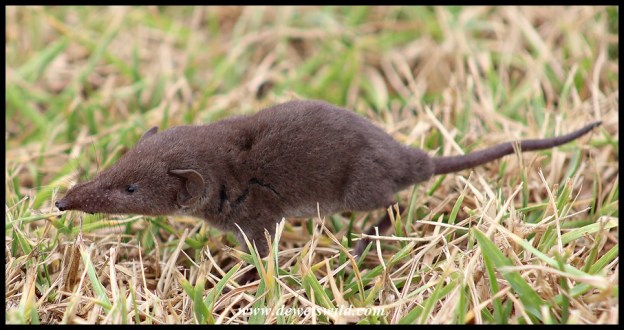
Crocidura flavescens
One of the real highlights of our visit to the Wilderness section of the Garden Route National Park was an encounter with a rarely seen small mammal: a Greater Red Musk Shrew.
Although it is tiny, weighing only about 30g, the Greater Red Musk Shrew is one of the biggest members of the shrew-family occurring in South Africa. We found the shrew next to a reed bed along the Touw River – typical habitat for the species, although they do occasionally venture into gardens and houses. Greater Red Musk Shrews are insectivores, feeding on a wide range of insects, worms and other invertebrates, and like other shrews have a relatively enormous appetite needing to consume at least half its own weight on a daily basis.
These cute creatures are mostly nocturnal, so we count ourselves very lucky seeing one in daylight (although heavily overcast) and out in the open. By day they hide in grass-nests built slightly above ground level in dense grass cover.
Females give birth to up to 7 young after a gestation of only a month, mainly in the summer months. The babies follow their mother around from 6 days old by forming a “train” nose-to-tail with their siblings. Like other shrews they live extremely fast-paced lives – the young are weaned at only 3 weeks old, reaching sexual maturity when they’re 2-3 months old and then have a life expectancy of maximum 18 months!
The IUCN considers the Greater Red Musk Shrew to be of least concern in conservation terms. It is almost endemic to South Africa, occurring all along our coast from Namaqualand to Maputaland and into extreme southern Mozambique and also along the Drakensberg through Lesotho and eSwatini to the escarpment in Mpumalanga.



Joubert photographing the Greater Red Musk Shrew at Wilderness
 DeWetsWild