
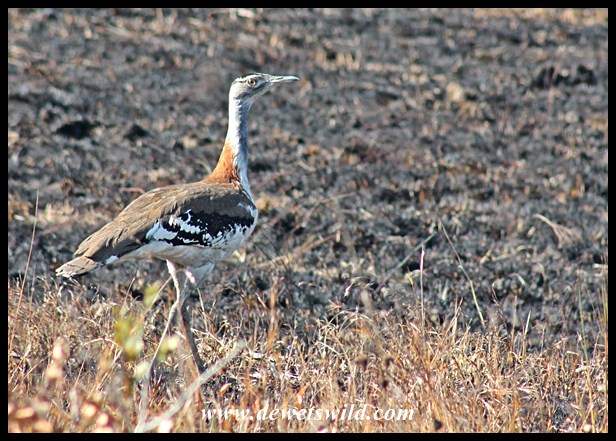
Neotis denhami
Denham’s Bustard is a large bird inhabiting open high-rainfall grasslands and heathland where it feeds on plant material (fruit, grass, flowers, seeds, etc), invertebrates and small vertebrates (snakes, frogs, rodents, chicks of ground-nesting birds, etc). They’re attracted to recently burnt areas for the easy pickings available. Adult males weigh around 8kg, females approximately half that. Their wingspan may measure as much as 2m. They’re usually seen singly or in small groups but occasionally congregate in flocks numbering a few dozen.
The breeding season for Denham’s Bustards stretch through the months of spring and summer. Males breed with as many females as they can, and play no parental role. Females lay only 1 or 2 eggs which are incubated for almost 4 weeks. The eggs are laid on bare ground surrounded by concealing vegetation. Newly hatched chicks are precocial and, while initially fed by their mother will soon start pecking up their own food. The chicks can fly when they’re about 2 months old, but remain with their mother for an extended period of time.
Numbers of Denham’s Bustard are declining throughout its range and it is considered to be near-threatened, despite its wide distribution across sub-Saharan Africa. This is mostly due to hunting and loss of habitat, and collisions with vehicles, power lines and fences also take a toll locally. In South Africa, where the subspecies known as Stanley’s Bustard (N. d. stanleyi) is endemic, the biggest populations are to be found in the Eastern and Western Cape, though they’re also found in lower numbers in Kwazulu-Natal, extreme eastern Free State, Mpumalanga and Limpopo, with a total population size for our country probably lower than 5,000 mature individuals.


 DeWetsWild