Crocodylus niloticus
One of Africa’s most dangerous animals, the Nile Crocodile is also by far the largest and one of the most widespread reptiles found on the continent. Adults measure on average around 3.5m long , but the largest accurately recorded specimen (from Tanzania) had a length of 6.45m and weighed 1090kg!

Nile Crocodile

Crocodile at the Sabie Bridge

Nile crocodile

Lurking crocodile

Nile crocodile

Crocodile camouflage

Bold crocodile near Olifants

Monster crocodile on the bank of the Luvuvhu

Crocodile

Nile crocodile

Nile Crocodile

Nile Crocodile at the Wildlife Centre

Baby Nile Crocodile

Huge Nile Crocodile slipping into the Mfabeni swamp

Nile Crocodiles
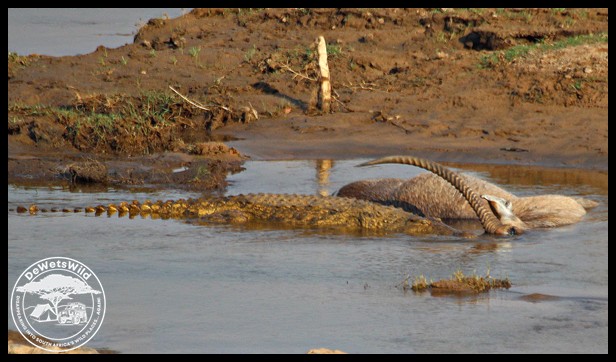
Nile Crocodiles inhabit rivers, marshes, lakes, lagoons and estuaries, and even venture out to sea at times. From hatching crocodiles are entirely carnivorous, feeding at first on small fish, insects, crustaceans and frogs. Fish also make up about ¾ of the diet of adult Nile Crocodiles, though they are capable of drowning animals up to the size of an adult buffalo when the opportunity presents itself! Such a large meal can sustain the crocodile for many weeks. When a meal is too large to swallow in one gulp, Nile Crocodiles will take a large bite and then spin their bodies in the water to tear a mouthful of flesh from the carcass. We’ve also seen Nile Crocodiles using their bodies and tails to trap schools of fish against the bank and pick off their hapless prey one at a time.

Nile Crocodile

Nile Crocodile (photo by Joubert)

Nile Crocodile

Nile Crocodile (photo by Joubert)

Nile Crocodile

Nile Crocodile at the mouth of Lake St. Lucia

This Nile Crocodile lays claim to the pool in front of the Sweni Wilderness Trail Camp

Crocodiles lining the bank of the Orpen Dam

Crocodiles next to Orpen Dam

Enormous Nile Crocodile (photo by Joubert)

Huge Nile Crocodile at the Lower Sabie causeway

Nile Crocodile at Biyamiti Weir (photo by Joubert)

Crocodile Trio

Nile Crocodiles

Nile Crocodile

Nile Crocodile

Nile Crocodile using its body to trap fish against the bank (photo by Joubert)

Nile Crocodile (photo by Joubert)

Nile Crocodile (photo by Joubert)

Nile Crocodile

Nile Crocodile
Often living in close proximity to sizable human populations, it is no surprise that Nile Crocodiles are responsible for hundreds of human deaths annually, especially when people are directly reliant on waters inhabited by crocodiles for their daily needs (fetching drinking water, fishing, washing clothes, bathing, etc).

Big adult Nile Crocodiles sharing a piece of shoreline

Basking Nile Crocodile

Crocodile lazing on a rock in the Vurhami stream

This crocodile may seem fast asleep, but if anything ventures into the water he’ll be quick to react.

Crocodile in the Sabie

Swimming crocodile

Crocodiles at Lake Panic

Crocodile and hippo sharing the Shingwedzi

Crocodile feeding on hippo carcass in the Nwanetsi River near Satara

Crocodile feeding on hippo carcass in the Nwanetsi River near Satara

Crocodile feeding on hippo carcass in the Nwanetsi River near Satara

Crocodile feeding on hippo carcass in the Nwanetsi River near Satara

Crocodile feeding on hippo carcass in the Nwanetsi River near Satara

Crocodile feeding on hippo carcass in the Nwanetsi River near Satara

Crocodile feeding on hippo carcass in the Nwanetsi River near Satara

Crocodile feeding on hippo carcass in the Nwanetsi River near Satara

Crocodile feeding on hippo carcass in the Nwanetsi River near Satara

Nile Crocodile

Nile Crocodile

Nile Crocodile
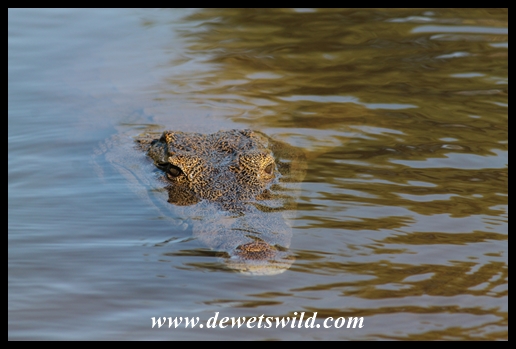
At times, Nile Crocodiles can congregate in huge numbers, especially when water resources dwindle during the dry season or at a favourite nesting area. They are surprisingly fast on land, and capable of running at up to 17km/h! By day they like to bask in the sun on a rock or sandbank with their mouths wide open when they start to overheat, preferring to stay in the water at night. They hunt mostly at dawn and dusk, approaching prey on land with only their nose and eyes breaking the surface of the water.

Nile Crocodile

Nle crocodile slipping into the water

The crocodiles at Nsemani Dam seems to have acquired a new fashion of mud on their backs 😉

Nile crocodile

Crocodile on shore

Crocodile, S41

A huge crocodile interfering with the flow of the Sabie River

Massive crocodile at Lake Mankwe

Bold, begging crocodile near Olifants

Nile crocodile at Sunset Dam

Nile Crocodile

Nile Crocodile

Nile Crocodile

Nile Crocodile

Nile Crocodile
Adult male Nile Crocodiles are territorial, and often get involved in deadly battles with other males. In South Africa the mating season stretches through winter, with the females then moving to a favourite, suitably sunny spot high enough above the floodline, to dig their nest – a hole in the sand between 20 and 45cm deep. Here she lays up to a 100 eggs, which she then covers again with sand. She diligently guards the nest for the next three months until the eggs hatch. The hatchlings call out to their mother, who digs them out and moves them, very carefully, to the water in her mouth. She looks after them for another 2 to 6 months in a nursery area, which is usually a densely vegetated stretch of water (they feed themselves from hatching). The eggs and hatchlings are a delicacy for a wide range of predators both on land and in the water, and despite the mother’s best efforts only about 2% of eggs laid reach maturity. The temperature at which the eggs are incubated determines the sex of the babies – lower temperatures produce females. Young crocodiles spend much of their time out of the water catching insect prey. It is estimated that Nile Crocodiles can live to an age of 100 years in the wild.

Young Nile Crocodile basking next to a small pool

Crocodile on shore

Crocodiles in the Sabie River

A deep pool in the Sweni, home to a nursery of baby crocodiles

Crocodile along the Ngwenyeni stream

Nile crocodile at Sunset Dam

Big Nile Crocodile male

Nile Crocodile juvenile

Big crocodile at Batlhako Dam

Baby Nile Crocodile

Medium-sized Nile Crocodile

Enormous Nile Crocodile at Sunset Dam

Nile Crocodiles

Young Nile Crocodile

Nile Crocodiles

Huge Nile Crocodile

Huge Nile Crocodile

Baby Nile Crocodile going for a stroll!

Small crocodile blocking a causeway

Crocodile at Girivane

Nile Crocodile

Nile Crocodile

Nile Crocodile

Big Nile Crocodile (photo by Joubert)

Baby Nile Crocodile (photo by Marilize)

Nile Crocodile

Nile Crocodile

Nile Crocodile

Nile Crocodile

Nile Crocodile

Nile Crocodile (photo by Joubert)

Ground Hornbills striding past a young Nile Crocodile

Big Nile Crocodiles makes Pioneer Dam a dangerous place

Enormous Nile Crocodile at Grootvlei Dam

Grootvlei Dam harbours many Nile Crocodiles

Nile Crocodile

Nile Crocodiles

Nile Crocodile

Nile Crocodile

Nile Crocodile
The IUCN lists the Nile Crocodile as “lower risk / least concern“, and while the species is threatened by habitat loss, environmental poisoning and poaching their numbers across their distribution range are estimated at between 250,000 and 500,000. It is found from the upper reaches of the Nile in Egypt, and most of West Africa south of the Sahara, southwards through Equatorial and East Africa to Angola in the West and to South Africa’s east-flowing rivers from the Tugela nortwards. They are also found on Madagascar and farmed for their meat and leather in several countries. In South Africa wild Nile Crocodile populations are considered to be vulnerable. The country’s largest wild populations are to be seen in the iSimangaliso Wetland Park and Kruger National Park, while the Crocodile Centre on the outskirts of the town of Saint Lucia in Kwazulu-Natal is a must visit for anyone interested in this species as well as the two other African species of crocodiles (few authorities have as yet recognised the West African Crocodile (C. suchus) as a seperate species).

Slender-snouted Crocodile

Dwarf Crocodile

St. Lucia Crocodile Centre

Better heed the signs!

 DeWetsWild