
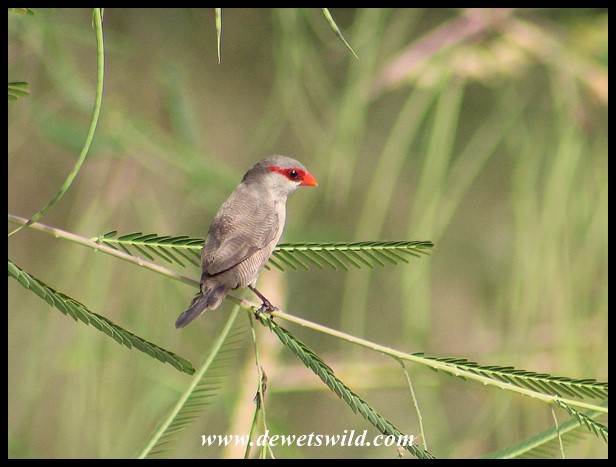
Estrilda astrild
The Common Waxbill is an adaptable little finch that occurs in a wide-range of habitats, but is especially fond of densely growing vegetation in wetlands and along watercourses, and also enters gardens and parks in towns and cities. They’re social birds, moving around in flocks that usually number up to 50 individuals (though sometimes into the hundreds or even thousands) and feed mainly on grass flowers and seeds and the occasional soft-bodied insect.
Common Waxbills may breed throughout the year but predominantly during the warmer months of spring and summer. The male builds the intricate nest – a horizontal, pear-shaped construction of grass stems and leaves with a nesting chamber and a “dummy” nest cavity to confuse predators – that is usually placed on or near the ground at the base of thick vegetation. Both parents take turns to incubate the clutch of 4-6 (sometimes up to 9) eggs over a two-week period. The chicks fledge about three weeks after hatching, but often returns to the nest for a few days more to roost at night. Fully grown they weigh around 8g and measure up to 12cm long. The Common Waxbill is the main breeding host for the Pin-tailed Whydah, which lays 1-4 of their eggs in the nest of the Waxbill, often removing some or all of the Waxbill’s eggs, for the Waxbill to incubate their eggs and raise their chicks.
Common Waxbills have a patchy distribution over Sub-Saharan Africa; from Guinea in the west and Ethiopia in the northeast to South Africa, where it can be found in every one of our provinces. According to the IUCN, the Common Waxbill is of least concern. It is commonly found in the cage-bird trade and feral populations have become established in other parts of the world.


 DeWetsWild