
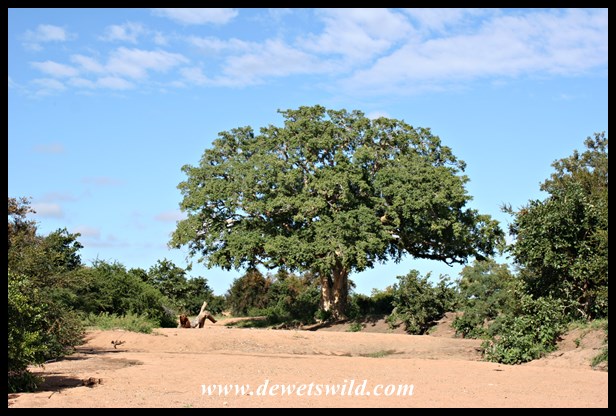
Ficus sycomorus
The Sycomore Fig, or Cluster Fig, is one of our most striking indigenous trees. They grow to an enormous size – up to 25m high with an equally impressive yellowish trunk supporting a widely spread canopy – in the alluvial soils along rivers and streams. Sycomore Figs flower and fruit throughout the year, bearing figs in huge quantities that sustain an incredible variety of insects, birds and mammals, humans included, and this is solely reliant on pollination by wasps of the genus Ceratosolon, which spend most of its life-cycle inside the fruit.
Apart from the obvious use of the figs, and less so the young leaves, as food, humans also use the bark and latex of the Sycomore Fig medicinally. And although the wood is soft, the Sycomore Fig was held in such regard that some Egyptian mummies were even interred in caskets made of the wood!
In South Africa, Sycomore Figs occur naturally in the north of Kwazulu-Natal, Mpumalanga and Limpopo, and beyond our borders throughout central, east and west Africa to Senegal. They’re also found on the Arabian Peninsula and from Egypt to Syria – presumably being the fig tree that is mentioned in several chapters of the Bible. The IUCN lists it as being of least concern.


 DeWetsWild