
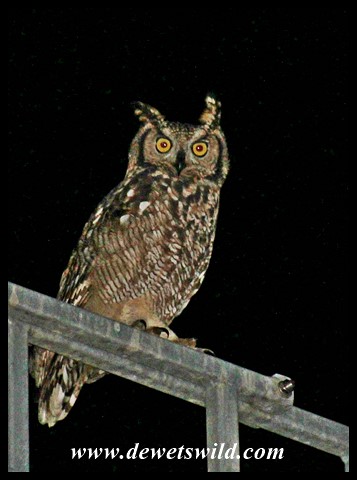
Bubo africanus
The Spotted Eagle-owl is one of our most frequently encountered nocturnal birds, even in towns and cities where they can become quite confiding with humans (beware though that they will defend their nests ferociously!). They’re not very picky about their habitat and feed on an enormous variety of rodents and other small mammals, insects, reptiles, birds, fish, bats, frogs and carrion. Standing about 45cm high, with a wingspan of just over a metre and a weight of 700g the Spotted Eagle Owl is one of the smaller members of its family.
Spotted Eagle Owls breed at anytime of year, though peaking in spring and summer, and nesting in any suitable location be it in a concealed spot on the ground, or in a gully, tree or building (such as our local library’s gutters!) or somewhere else they find to their liking. Broods usually number two or three chicks, hatched after an incubation period lasting almost 5 weeks, but as many as six chicks have been recorded. Pairs are monogamous and while the female is responsible for incubating the clutch of eggs the male supplies her with food at the nest. Juveniles become fully independent about four months after leaving the nest, which happens about 5 weeks after they’ve hatched. Spotted Eagle Owls may live for about ten years in the wild and much longer in captivity.
The Spotted Eagle Owl occurs over virtually all of Africa south of the equator, with a separate population on the Arabian peninsula. The IUCN lists it as being of least concern. It is also a common species in South Africa and can be found in every province. Sadly they are often killed by vehicles when scavenging at road kills at night.


 DeWetsWild