
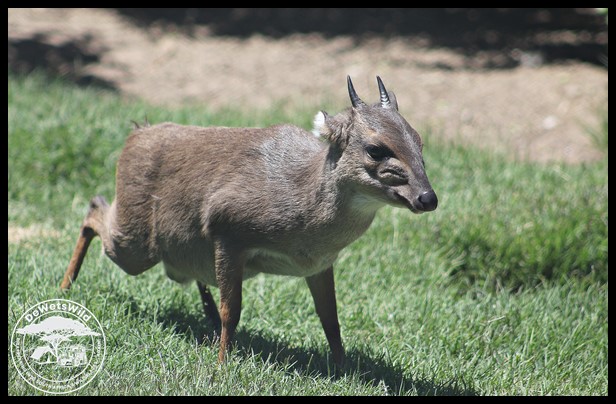
Philantomba (Cephalophus) monticola
The Blue Duiker is the smallest antelope found in South Africa, standing only about 30cm high and weighing about 5kg. It is found only in moist forest habitats with a permanent canopy and alternating pockets of open and closed underbrush. They feed on a wide variety of leaves, twigs, flowers, berries, fruit, pods and fungi, often following birds and primates to feed on the fruit they drop from high up in the trees, and drink water regularly.
Blue Duikers are usually seen in pairs that occupy a small shared territory, marked by both sexes using the prominent pre-orbital scent glands and dung heaps. Single individuals are usually newly independent youngsters in search of a mate and territory. They are usually most active from the afternoon, through the night (resting up during the night) and into the mid-morning, usually venturing into more open areas only under cover of darkness. They regularly use the same paths to move through their territory, making them vulnerable to predators (anything from leopards to pythons and crowned eagles) and poachers.
Blue Duiker ewes give birth to single lambs at any time of year, probably with a summer peak in South Africa, after a 6 month gestation. The lamb weighs only about half-a-kilogram at birth and is weaned at 3-4 months old, though it stays with its mother until her next lamb is born – ewes can lamb every 7-9 months under optimal conditions. In the wild they can live to between 6 and 10 years of age.
In South Africa the Blue Duiker is found in isolated pockets from Kwazulu-Natal to the Garden Route, and considered to be vulnerable. Overall though the IUCN lists it as being of least concern, given an extensive distribution throughout Africa’s equatorial forests, stretching from Nigeria to Kenya and from the DRC to Zambia, conservatively estimating a population of 7-million animals.


 DeWetsWild