
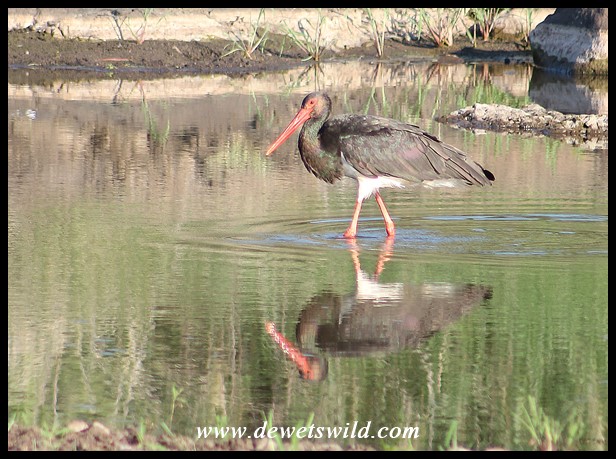
Ciconia nigra
The Black Stork is a very widely distributed species, occurring in Africa, Europe and Asia, and globally assessed as being of least concern by the IUCN despite their populations coming under pressure from loss of habitat and hunting. Although occurring all over the country they are not particularly common in South Africa either and it is estimated that the total population occurring south of the Zambezi and Kunene Rivers is in the region of about a thousand breeding pairs of which only 200 or so occur in our country, qualifying for a local conservation classification of “near threatened”. Although most populations of Black Stork are migratory that is not the case with Southern Africa’s birds which remain in the subregion throughout the year and only move around locally. In our experience the Kruger National Park is the most reliable area to find Black Storks in South Africa.
Black Storks are closely associated with wetlands, swamps, rivers, lagoons, estuaries and inundated grasslands and, as can probably be deduced from their preferred habitat, subsists mainly on an aquatic diet ranging from fish and amphibians to insects and other invertebrates sourced by wading in shallow water. They are usually found alone or in pairs, though congregations numbering into the hundreds have been seen on occasion.
Black Storks are monogamous, and pairs may even have a life-long bond. Their nests are rough platforms of sticks and reeds built on ledges and cliffs, often used for several years. The local breeding season spans the autumn and winter months, typically periods during which most of this country experiences drier weather making it easier to catch prey in dwindling pools of water. Clutches contain as many as five eggs, with incubation by both parents lasting over a month. The chicks fledge at between 2 and 3 months after hatching, becoming independent of their parents soon after. Black Storks may live to 20 years old in the wild, with up to 36 years recorded in captivity. Fully grown adults are magnificent birds, standing a metre high with a wingspan of around 1.5m.


 DeWetsWild