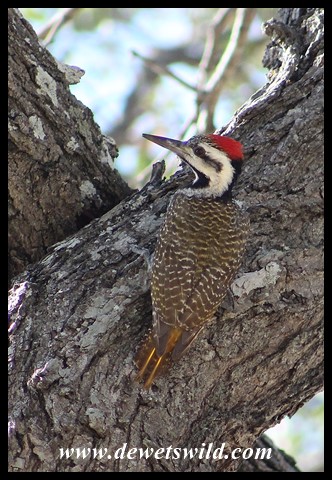
Dendropicos namaquus
The Bearded Woodpecker inhabits savannas and woodlands with tall trees, where it forages (it rarely descends to ground level) by tapping on branches and probing in crevices and behind bark for insects and spiders and the occasional lizard or gecko.
Adult Bearded Woodpeckers form permanent pairs that occupy the same home range year round. During the breeding season, which stretches from autumn to early summer, they both work at excavating their nest in the trunk of a tree. The nest may be between 30 and 50cm deep and it could take more than a month to complete. Here they incubate their clutch of 1-3 eggs over a period of roughly 2 weeks. Both parents feed the chicks at the nest until they fledge at about a month of age, though they may remain with their parents for a period of up to 2 months after leaving the nest. Fully grown they weigh around 80g and measure around 24cm in length, making them the largest arboreal woodpecker in the country.
The IUCN considers the Bearded Woodpecker to be of least concern. In South Africa it occurs mainly from Kwazulu-Natal, through Mpumalanga, Gauteng and Limpopo to the eastern parts of the North West Province, and beyond our borders is found as far northward as Sudan.


 DeWetsWild