
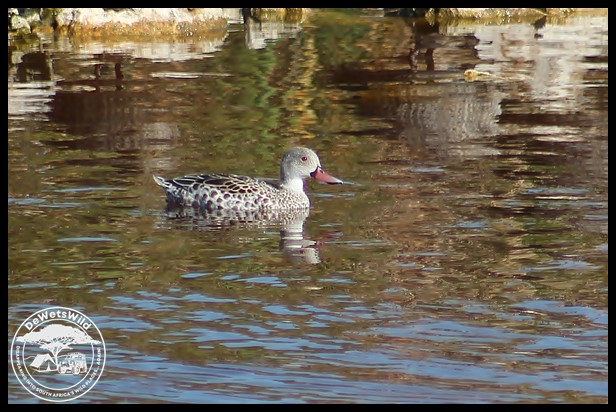
Anas capensis
An inhabitant of permanent and ephemeral wetlands of varying salinity, the Cape Teal feeds mainly on aquatic invertebrates and tadpoles with plant material making up a smaller part of its diet. They have also adapted to using farm dams and sewage ponds and greatly expanded their range as a result. They’re usually seen in pairs or small mixed flocks, though they may congregate in enormous numbers on deep water when moulting. They will move over short distances to find more suitable habitats when seasonal water bodies start drying up.
Pairs of Cape Teal are monogamous and breed on dry land, following good rains. The female builds a bowl-shaped nest of soft plant material lined with down. She lays a clutch of up to 13 eggs, though more usually around 8, and incubates them for about 4 weeks. She leads the ducklings to water very soon after hatching and they are adept at swimming and diving right from the start. The ducklings stay with their mother until they’re about 2 months old. Fully grown Cape Teals weigh around 400g and measure about 46cm long.
The Cape Teal has a rather patchy distribution in sub-Saharan Africa. Being especially numerous in our Western Cape Province, they’re found widely in South Africa and our neighbouring states as far as Angola, with more isolated populations in eastern and central-west Africa. According to the IUCN the Cape Teal is of least concern.


 DeWetsWild