
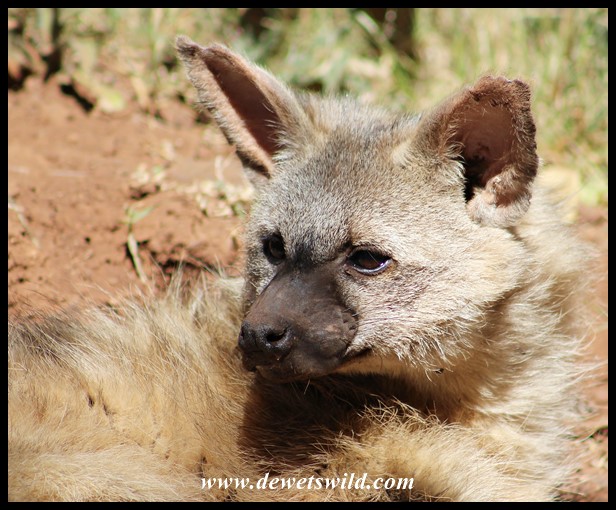
Proteles cristata
The Aardwolf (Afrikaans for “earthwolf”) is the smallest species of hyena. Adults stand about 45cm high at the shoulder and weight around 9kg. Unlike other hyenas that feed mainly on mammals carcasses, the Aardwolf’s diet consists almost exclusively of termites – they may eat between 200,000 and 300,000 termites a day! – with other insects and their larvae also featuring occasionally. Aardwolves can be found in any habitat where termites occur, from semi-deserts to densely vegetated savannas.
Although they’re normally observed singly while feeding, Aardwolves form monogamous pairs that inhabit a territory with their youngest offspring. The boundaries of the territory is marked by latrines and scent glands. They’re usually active between dusk and dawn, sleeping by day in burrows that they dig themselves or take over from other animals. All of Africa’s large predators will attack Aardwolves and so when threatened they raise the mane on their backs to make themselves look larger and more intimidating. Females give birth to 1-4 pups, usually during the wet season, and though the young are fully grown at about about 9 months of age they’d normally remain in their parents’ home range until the next litter is born. In the wild, Aardwolves have a life expectancy of about 12 years.
The Aardwolf occurs in two distinct parts of Africa. Their southern distribution area (subspecies P. c. cristata) includes all of South Africa and extends into all our neighbouring countries and as far as Angola and Zambia, while the East African range (subspecies P. c. septentrionalis) stretches from Tanzania to southern Egypt. According to the IUCN the Aardwolf is of least concern, despite not being common anywhere, and while they were previously widely persecuted as suspected predators of livestock, modern farmers understand that the Aardwolf is incapable of killing small stock and protect the species due to their important role in limiting termite populations.


 DeWetsWild