While I doubt it reached proportions that would convince the Pharaoh to allow the Israelites to leave Egypt, the “eruption” of little froglets we saw at uMkhuze Game Reserve during our recent visit was quite fascinating. Rain or shine, literally hundreds (if not more) of tiny frogs could be seen jumping around on the roads all over the reserve, making driving quite tricky if you didn’t want to squash them under the vehicle’s wheels.
Thanks to the help of the iSimangaliso Wetland Park the little ones were identified as juvenile African Bullfrogs (also known as Edible or Lesser Bullfrogs), a species that occurs over wide areas of Eastern, Central and Southern Africa, and indeed is eaten by humans in many countries where they occur. Though these newly metamorphosed juveniles were only about the size of a thumbnail, the African Bullfrog can grow to 12cm in length.
African Bullfrog
They can be found in seasonally flooded savannas and grassy woodlands, remaining dormant underground for most of the year (up to 10 months) and emerging only when sufficient rain has fallen for breeding to commence. During the breeding season males act very aggressively towards one another and will even kill each other. Eggs are laid in well vegetated, shallow, seasonal bodies of water where the males guard the eggs and tadpoles against other males and predators. Interestingly, when the tadpoles’ pools start drying up the males will dig channels to deeper pools. African Bullfrogs feed on a variety of invertebrates and small vertebrates, including other frogs, and feature in turn in the diets of various species of birds, reptiles and mammals (humans included).
During a visit to the Kruger National Park in December 2019 we witnessed the breeding habits of the African Bullfrog following a few days of continuous rain.
Everyone will quickly recognise the White Stork as the legendary bird responsible for the delivery of newborn babies. These large, strikingly pied birds stand over a metre tall, has a wing span of up to 2 metres and weighs as much as 4kg.
White Storks migrate in enormous flocks (numbering hundreds or even thousands) from Europe, North Africa and Western Asia to Sub-Saharan Africa to spend the summer in our warm weather, the first birds arriving around September and the last departing again by April or May. At those times they are a regular sight in savannas, grasslands and cultivated fields right across South Africa, often close to water, feeding in flocks usually numbering from 10 to 50, though larger groups of several hundred are not uncommon. White Storks are diurnal in habit, roosting communally at night. They feed mainly on insects (but also rodents, reptiles and frogs), and often take advantage of fires to catch prey escaping the flames. Only a handful of pairs breed here, and only in the Western Cape. Nests are constructed of sticks in high trees or on top of buildings or other man-made structures, and often used for several consecutive years, even decades. As the nests are continuously expanded they can become quite huge over time, and are often shared by other kinds of birds. Pairs will build their nests in isolation or in loosely associated small colonies of up to 30 pairs. Up to 7 (more usually 4) eggs are laid and incubated for 33 days or so by both parents. The chicks stay in the nest for about two months after hatching.
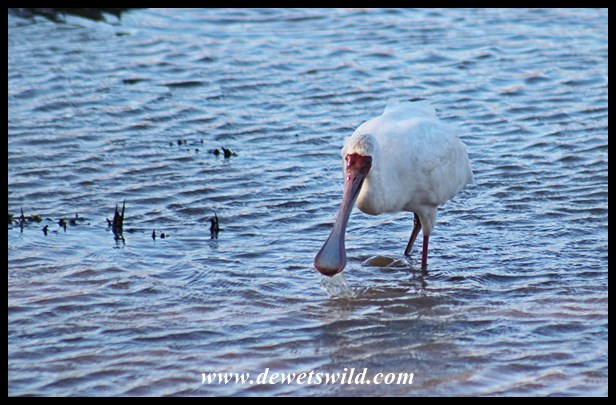
The African Spoonbill is a large wading bird (90cm long, weighing up to 1.8kg) with a characteristic spoon-shaped beak.
They can be found at shallow bodies of freshwater – natural and man-made lakes, pans, rivers, marshes, floodplains, estuaries and even sewerage works – where they feed on small fish and aquatic invertebrates caught by moving their bills sideways through the water. Spoonbills can often be seen close to hippos and crocodiles, hoping that these large animals will flush something edible. Breeding is timed to start just before or during the rains. They nest colonially in trees, reedbeds or on rocky islands and ledges, usually in groups numbering from 5 to 250 or more monogamous pairs and often together with other species of waterbirds as well. The nests are platforms built of sticks and reeds in which 3 to 5 eggs are incubated for around 4 weeks by both parents.
The African Spoonbill has a wide distribution and stable population, and is considered of least concern by the IUCN. They occur over almost all of South Africa with the exception of the arid northwestern corner of the country, and further range over most of Sub-Saharan Africa (except the equatorial forests) and Madagascar.
African Spoonbill
African Spoonbill
African Spoonbill
African Spoonbill
African Spoonbill
African Spoonbill
African Spoonbill
Loskop Hide: sacred ibis, spoonbill and yellow-billed ducks
African Spoonbill
African Spoonbill
African Spoonbill (with a Sacred Ibis just behind)
One of South Africa’s best known, most common, and most widely occurring bird species, the Hadeda is a large ibis weighing up to 1.5kg. Few South Africans would not be familiar with their distinctive “ha-ha-ha-de-dah” call.
Hadedas are mostly sedentary, and some have been known to use the same roosts for many years. By day they forage in pairs or small groups along wooded streams and in suitable man-made habitats (like irrigated fields, garden lawns and golf courses) for their invertebrate staple diet (chiefly worms, snails and slugs, endearing them to gardeners), which they locate by probing in the soft earth and leafy detritus with their long, curved bills. Unlike many other ibis species, Hadedas nest in solitary pairs during or just after the rainy season. Three or four eggs are laid in nests usually used for many consecutive breeding seasons and constructed of sticks and twigs on a level tree branch (or similarly suitable man-made structure), often over water. Both adults take turns to incubate the eggs. Traditional healers use the ground-up bones of Hadedas to prepare a potion said to prevent love partners from leaving with someone else, a belief based in the Hadeda’s enduring monogamous associations.
The Hadeda has an expanding population distributed over most of Sub-Saharan Africa, and is considered of “Least Concern” by the IUCN. They are a common sight all over urban South Africa, which has aided their rapid range expansion, and in most nature reserves.
Hadeda Ibis flock in flight
Hadeda Ibis
Hadeda Ibis
Hadeda Ibis
Hadeda Ibis
Hadeda Ibis
Hadeda Ibis
Hadeda Ibis
Hadeda Ibis
Hadeda Ibis chicks in nest
Hadeda
Hadeda Ibis
Hadeda Ibis
Hadeda Ibis
Hadeda
Hadeda
Hadeda
Hadeda
Hadedas
Hadeda Ibisses
Hadeda Ibis nest at Mphafa hide (photo by Joubert)
Hadeda in flight over Pretoria
Hadeda Ibis
Hadeda Ibis
Hadeda
Hadeda Ibis
Hadeda
Hadeda Ibisses
Hadeda Ibis
Hadeda Ibis
Hadeda Ibis
Hadeda nesting in a dead tree in the middle of Tilodi Dam
The Glossy Ibis is a rather small ibis (weighing between 500 and 750g with a wingspan of a metre or less), occurring in shallow wetlands, lagoons, estuaries, swamps and flooded meadows, rice paddies and sewerage works. Here they feed mostly on aquatic invertebrates (insects, worms, molluscs, crustaceans, etc) and only occasionally on vertebrates like fish and frogs.
Most breeding takes place just before or during the rainy season. Glossy Ibis nest in colonies, usually consisting of between 5 and 100, but often thousands, of monogamous pairs, and often together with other waterbirds. The nests are platforms constructed from twigs, usually just slightly above the waterline in trees or other emergent vegetation standing in wetlands. Females normally lie three to five eggs that are incubated by both parents for around three weeks. Nestlings fledge a month after hatching but are fed by the parents for up to 2 months. Once the breeding season comes to an end, individuals become nomadic and range widely.
The Glossy Ibis has an enormously wide distribution, and can be found in North and South America, the Caribbean, Europe, Asia, Australia and most of Africa and the Indian Ocean islands, except the driest deserts and equatorial forests. In South Africa they are absent only from the driest portions of the Northern Cape Province. The IUCN estimates that there may be as many as 2.3-million of these birds on earth, and though some populations are declining (due mostly to loss of their wetland habitat) considers them to be of Least Concern in conservation terms.
The beautiful Leopard is at the top of the wishlists of many visitors to South Africa’s wild places, and certainly deserves its position among Africa’s “Big Five“. One of the most adaptable of the large carnivores, their build and colouration is supremely attuned to the environment in which they live. Depending on the harshness of the environment and the size of prey available, the weight of adult males can vary between 20 and 90 kilograms (females weigh slightly less), with a shoulder height ranging between 55 and 80cm.
Serene leopard near Punda Maria
Catnapping leopard near Punda Maria
Leopard seen near Olifants
Beautiful leopard encountered near Red Rocks
Leopard male and kill
Leopard and kill (photo by Joubert)
She quickly repositions (photo by Joubert)
Leopardess eyeing an injured wildebeest calf
Her interest peaked by a growl from the male, the leopardess moves to a lower branch
Leopardess in a tree
There’s a leopard hidden in the Sausage Tree
Leopard along the Timbavati
Hidden leopard
Leopard in a tree
Lazy leopard
Leopards have adapted to every habitat on the African continent, from the driest deserts to the tropical rainforest and high mountain ranges. They are just as catholic in their diet, which ranges from insects, fish, amphibians, reptiles, birds and rodents to large mammals and even other predators (including jackals, spotted hyenas and cheetahs) or carrion, though they normally prefer commonly occurring medium-sized antelope and wild pigs. Though they are not dependent on the availability of surface water they will drink regularly if it is available. Their penchant for storing the carcasses of their prey up high in the branches of trees, where it is inaccessible to competing predators, allows them to feed from the same carcass for up to 6 days.
Leopard hunting jackals
Leopard lying in wait at a waterhole
Leopard lying in the bed of the Nwatimhiri near Skukuza in the Kruger Park
Remains of a leopard kill
Leopard on the prowl
Leopard hiding in long grass
Leopard camouflage in a thicket
Lazy Leopard
Leopard up a tree near Phalaborwa Gate
Leopard in a tree on the bank of the Tsendze River south of Mopani
Leopard seen early morning in the Sedudu Valley
Leopard stalking a steenbok in the Kruger National Park
Solitary by nature, Leopards only associate with others of their kind when mating or when cubs accompany their mother. Adults of both sexes hold territories that may cover enormous areas, depending on the availability of prey, are advertised by their rasping call and marked with urine, scat and scrape marks against prominent trees, and defended viciously, sometimes to the death, against interlopers of the same sex. Male territories are larger and can overlap with the areas of up to six females. Leopards are nocturnal, with most activity occurring from dusk to dawn, resting up in the deep shade of tree canopies, thickets and caves. They love basking in the early morning or late afternoon sun. Leopards can reach a speed of up to 60km/h, but can only maintain it for short bursts and rely on their camouflage and expert stalking skills to get within range of their prey.
Leopard at Nwanetsi Bridge, on a night drive from Satara in the Kruger Park
Leopard hunting jackals
Leopard in a tree, S36 (Kruger Park)
Leopard in a tree on the S3 near Skukuza, Kruger Park
Leopard on the Maroela Loop, near Skukuza in the Kruger Park
Leopard in tree, at Ximangwaneni Dam (Kruger Park)
Leopard on Ngubhu Loop in Ithala Game Reserve
Leopard trying to hide among the thorns
Leopard sighting on the Grassland Loop on the Eastern Shores of Lake St Lucia – 15th June 2015
Leopard in golden early morning sunshine
Leopard in a tree south of Skukuza
Leopard near Lower Sabie
Leopard
Leopard lounging in a tree
Female Leopards usually give birth to 2 or 3 cubs (range from 1 to 6) after a short 3 month gestation at any time of the year. Newborn cubs are kept hidden in caves, among boulders, in thickets and even burrows while the mother is out hunting, until they start accompanying her at the age of about two to four months. Cubs become independent anywhere between 12 and 24 months of age, though only about half of the cubs born reach that age. Lions and spotted hyenas will attack and kill adult Leopards, while even jackals pose a threat to unguarded cubs.
Leopard female calling for her cubs
Sub-adult leopard cubs
Leopard cub in a rocky outcrop between Tshokwane and Skukuza
Leopards have a wide distribution in Africa and Asia, but their populations have been reduced and become confined to increasingly isolated pockets over most of that range, leading the IUCN to classify it as “vulnerable” due to the persistent threats of illegal hunting and loss of habitat and prey. In South Africa, Leopards can be found in the mountains of the Western and Eastern Cape, along the Namibian and Botswana borders with the Northern Cape, in the Drakensberg range and northern Kwazulu-Natal, and widely in the North-West, Limpopo and Mpumalanga provinces, but their secretive nature makes it virtually impossible to determine their population size, with the EWT estimating the number of leopards occurring in South Africa between 2,800 and 11,600. In our experience, the Kruger National Park, Kgalagadi Transfrontier Park, Mapungubwe National Park, Pilanesberg National Park, Hluhluwe-Imfolozi Park, iSimangaliso Wetland Park (especially the Eastern Shores section) and Ithala Game Reserve presents the best chance of finding these elusive cats on a self-drive safari in South Africa.
Spotted Hyenas roaming outside Mpila Cottage 16 in December 2018
Often depicted as cowardly villains and skulking scavengers, the truth is that the Spotted Hyena is a very efficient predator that mostly catches its own prey and dominates all other African predators with the exception of lions. Standing up to 90cm high and weighing up to 85kg, the females are considerably stronger built than the males and have very male-like genitalia, leading to a common misconception that spotted hyenas are hermaphrodites.
Lazy hyena cub
Hyena Queen (H6, Kruger National Park)
Spotted hyena
Spotted hyena
Spotted hyena close-up
Spotted hyena close up
Spotted Hyena
Spotted Hyena on the run
Spotted Hyena
Spotted Hyena
Spotted Hyena (photo by Joubert)
Spotted Hyena cub (photo by Joubert)
Hyena and cheetah interaction at Orpen
Hyena looking menacing as it emerges from the dark
Spotted Hyena
Spotted Hyena
Spotted Hyena
Spotted Hyena
Hyena seen before sunrise
Hyena with a chunk of leg
Spotted Hyena
Spotted Hyena
The way Hyenas get attention!
Spotted Hyena
Spotted Hyena
Spotted Hyena
Hyena youngster
Spotted Hyena
Young hyena
Spotted Hyena
Spotted Hyena on the run
Spotted Hyena outside the fence at Tamboti
Spotted Hyenas have adapted to every habitat on the African continent except the tropical forests, though they prefer savannas, grasslands, woodlands and semi-deserts. They’re not dependant on drinking water but will drink when it is available and love cooling off in natural pools on hot days. Spotted Hyenas easily prey on anything from insects to giraffes and buffaloes, their diet normally reflecting which animals are most common in their area, but will also opportunistically scavenge from the kills of other carnivores (less than a third of their diet) and around rubbish dumps and human settlements. Excess food is often stored under water for later consumption. In many protected areas Spotted Hyenas have learnt that tourist camps are a reliable source of discarded food; a dangerous situation that often leads to injuries to people with lethal consequences for the hyenas.
Spotted hyena staking out the Black Umfolozi
Spotted hyenas with porcupine kill
The story of the (over) ambitious hyena
Spotted hyena sniffing the breeze
Spot the spotted hyena!
Spotted hyena
Cooling down on a hot day
Spotted Hyenas chasing after prey
Spotted Hyena
Spotted Hyena seen at night right from Shingwedzi’s fence
Spotted Hyena scavenging from a buffalo carcass in the Mphongolo River
Time to fight about who gets the lion’s share
Spotted Hyena and Buffalo prey
Spotted Hyena
Spotted Hyena sneaking up on a bushbuck (photo by Niel de Wet)
Spotted Hyena (photo by Joubert)
Spotted Hyenas live in clans numbering from 3 to 80 (the size and stability of which depends on prey availability) in which a strict, female dominated, hierarchy exists. The most dominant female passes her status to her female young, and all females are dominant over all males in the clan. Males mostly join clans from other groups from which they were evicted, and it can take weeks and even months for them to be accepted into a new family. Each clan has a territory covering between 40 and 1800km² (dependent again on prey availability), that is demarcated with scent glands and communal dung middens and will be fiercely defended against interlopers. Within the territory a number of dens are established in dense vegetation, caves, between boulders or in holes in the ground (they’ll also often use human-made culverts under roads for this purpose) and used on a rotational basis. Spotted Hyenas are most active from dusk to dawn, usually hunting alone or in small parties except when going after big game, when the whole pack will join forces. When hunting they can reach speeds of up to 65km/h, but they can sustain a pace of 50km/h over a distance of up to 5km as they tire out their intended prey. They’re among the most vocal of mammals, and their well known laughing, howling and cackling is synonymous with the African night.
Spotted hyena waiting for the lions to have their fill
Spotted Hyena on Satara Night Drive
Spotted hyena along the road
Spotted Hyena on Satara Night Drive
Hyena on the S29 to Mlondozii
Spotted hyena track
Hyenas come into camp every night. This one we saw at Masinda Lodge, a short distance from Mpila, one morning
Hyenas are commonly encountered at Skukuza
Hyenas, Ngotso (Kruger Park)
Hyenas on the S65 (Kruger Park)
Hyenas’ early morning bath
Spotted hyena on the way to Malelane Gate
Spotted hyena
Spotted hyena
Spotted hyena
Spotted hyena near Afsaal
Spotted Hyena Matriarch
Spotted Hyena in the spotlight
Spotted Hyena on the run
Spotted Hyena attending a barbeque in Mpila Camp
Leader of the clan
Lazing about
Spotted Hyena on the run
Spotted Hyena
Spotted Hyena
Spotted Hyena outside our cabin in the dark of night
Spotted Hyena (photo by Joubert)
Spotted Hyena
Spotted Hyena
Scruffy-looking Spotted Hyena
Spotted Hyena
Spotted Hyena
Spotted Hyena
Spotted Hyena (photo by Joubert)
Spotted Hyena
Spotted Hyena
Spotted Hyena (photo by Joubert)
Spotted Hyena
Spotted Hyena
Spotted Hyena
Spotted Hyena cub near Cape Vidal
Spotted Hyena
Spotted Hyena
Spotted Hyena
Spotted Hyena
Spotted Hyena
Spotted Hyena
Spotted Hyena
Spotted Hyena
Females usually give birth to two cubs (though up to 4 have been recorded) at anytime of year. Cubs are kept hidden from the rest of the clan for the first two weeks of their life. More than one female in the clan may be raising cubs at the same time, but they will not take care of one another’s young. Cubs are often extremely aggressive to one another, especially of the same sex, and it is not unusual for some of the litter to die as a result of the constant fighting. The cubs are dark brown to black at birth, attaining adult colouration from the age of 2 to 3 months. Lions consider Spotted Hyenas their mortal enemies and will kill them at any opportunity, and outbreaks of rabies can decimate entire clans. Spotted Hyenas can live to the age of about 25 in the wild, and up to 40 years in captivity.
This Spotted Hyena mother couldn’t tolerate her naughty child playing in the road one second longer!
Spotted hyena cub
Spotted hyena cub
Hyenas at their den just outside Letaba, Kruger Park
Hyenas, Ngotso (Kruger Park)
Hyenas patrol the fence at night, hoping for (illegal) handouts from campers
Two very coy young hyenas
Spotted hyena mother
Spotted Hyena youngster
Spotted Hyena cubs are black at birth
Spotted Hyena youngster
Spotted Hyenas at their den
Spotted Hyena cousins
Spotted hyena cub and mother
Spotted hyena suckling cub
Spotted hyena cubs
Spotted hyena cub
Spotted Hyena cubs with a bone
Spotted Hyena cub and mother
Spotted Hyena cub
Spotted hyena cub
Spotted hyena cub
Spotted hyena cub
Spotted Hyena cub
Spotted hyena female and two young cubs
Spotted Hyena family (photo by Joubert)
Spotted Hyena family
Spotted Hyena on the move (photo by Joubert)
Spotted Hyena profile
Spotted Hyena
Young Spotted Hyena
Fluffy Spotted Hyena youngster (photo by Joubert)
Heavily pregnant Spotted Hyena
Spotted Hyena family (photo by Joubert)
Spotted Hyena female showing off her tools (photo by Joubert)
Cute Spotted Hyena youngster (photo by Joubert)
Baby Spotted Hyena
Spotted Hyena
Hyena frantically trying to get a bite of the action
Hyena frantically trying to get a bite of the action – zebras fleeing!
Hyena frantically trying to get a bite of the action
Hyenas occupying a stretch of mud at Hapoor Dam
Spotted Hyena
Spotted Hyena
Spotted Hyena portrait
Spotted Hyena
Spotted Hyena
With a total population estimated between 27,000 and 47,000, the spotted hyena is one of the most numerous large carnivores on the African continent, and considered of least conservation concern by the IUCN. However, their populations are decreasing, especially outside large conservation areas, due to human pressures such as illegal hunting, poisoning and loss of habitat and prey. South Africa’s biggest population can be found in the Kruger National Park, estimated at up to 3,900 animals, and they are also a regular sighting in Addo Elephant National Park, Mapungubwe National Park, Hluhluwe-Imfolozi Park and the iSimangaliso Wetland Park.
African Wild Dogs are large canids, standing between 60 and 80cm high at the shoulder and weighing up to 36kg. Their blotched coats have patterns as unique to each individual as our fingerprints are. Perhaps “Painted Wolves” would be a more accurate name for these enigmatic carnivores, one of Africa’s rarest species.
Ragged African Wild Dog
African Wild Dog
Wild dog profile
African Wild Dog
Painted Wolves, or African Wild Dogs
African Wild Dog
Wild dogs near Orpen
Playful Painted Wolf (photo by Joubert)
African Wild Dog
African Wild Dogs in playful mood before starting their hunt
African Wild Dogs inhabit grasslands, marshes, savannas, woodlands and semi-deserts, where they hunt mammals ranging in size from rodents to buffaloes, though their main prey is medium-sized antelope like the impala, springbok, bushbuck, nyala and reedbuck. These dogs have great stamina, and tire out their prey by chasing it at speeds of up to 60km/h for distances of up to 6km. They are among the most successful of predators, with between 70 and 90% of their hunting attempts resulting in a kill. They kill their prey by disembowelment, and although it appears cruel is actually a much quicker death than the suffocation employed by lions and other big cats. They feed extremely quickly; a pack of nine dogs can completely devour a 100kg antelope within 15 minutes. African Wild Dogs are not dependent on the availability of drinking water, but will drink regularly if it is available.
On the hunt
On the hunt
On the hunt
On the hunt
Sizing up a pair of zebras
Leg of lamb, wild dog style…
African Wild Dog – Hluhluwe-Imfolozi Park
African Wild Dogs live in closely-knit packs numbering from 2 to 50 and occupying vast home ranges. Within the pack a strict hierarchy is maintained, with only the dominant pair allowed to breed. Often all the animals of the same sex within a pack are related as new packs are formed by groups of the same sex leaving their maternal packs when they become adult at about two years of age and joining up with unrelated animals of the opposite sex. Wild Dogs hunt mostly in the early morning and late afternoon, and also on moonlit nights, and rest up in the shade during the heat of the day.
Wild Dog pack on the move
African Wild Dog
Wild Dog pack on the move
Wild Dog on the hunt
Wild Dog stretching for the hunt
Wild Dogs taking a break
Wild Dog pack on the move
Wild Dogs are very social
African Wild Dog
African Wild Dog on the alert
The alpha female gives birth to between 2 and 21 tiny pups annually, mostly during the dry season when prey is easier to come by. The pups are born in holes in the ground, usually abandoned aardvark or warthog burrows. All the pack members take excellent care of the pups in the pack, bringing food back to the den for small puppies and allowing older puppies to feed first at a kill. Wild Dogs are susceptible to a wide variety of infectious diseases, often causing entire packs to be wiped out, but it is bigger and stronger predators – lions, hyenas and leopards – that are the biggest natural threat to both adult and juvenile Wild Dogs. Their life expectancy in the wild is only about 10 years.
Wild Dog pups waiting for the adults to return
Wild Dog alpha pair
Wild Dog alpha pair
African Wild Dogs at the Rhino & Lion Nature Reserve
Wild Dog (Photo by Joubert)
Wild Dogs
The African Wild Dog is considered endangered with their population estimated at most around 6,600 and still declining due to disease and human pressures. Centuries of persecution by hunters and farmers have decimated their numbers, eradicating them from most of their former range. Today African Wild Dogs occur in only a few scattered pockets across the continent. In total South Africa is home to only about 400 – 500 African Wild Dogs, of which roughly half occurs in and around the Kruger National Park, with smaller populations in a handful of other public and private conservation areas, including Hluhluwe-Imfolozi Park, iSimangaliso Wetland Park, Tembe Elephant Park and Pilanesberg National Park.
White rhino bulls use dung middens to communicate their presence and demarcate their territories. They’ll also kick around in the middens to transfer the scent onto their feet and then spread it throughout their stomping grounds, communicating their ownership to interlopers.
When we found a small colony of Mauritian Tomb Bats on the outside walls of the reception office at the Hluhluwe-Imfolozi Park’s Nyalazi Gate, it presented a good opportunity to learn a bit more about this seldomly seen creature.
Mauritian Tomb Bats are quite large for insectivorous bats, weighing as much as 36g and up to 11cm long. They occur in the moist savanna areas of north-eastern South Africa, further north into Central and East Africa, as well as on a few of the islands of the Indian Ocean. By day they roost in small, loosely associated groups on the shaded walls of buildings or on tree trunks, and not in caves or tombs as their name might suggest. At night they forage for moths and other nocturnal invertebrates, which they catch and eat in flight.
Most females raise a single baby at a time, though some do give birth twice annually. Dependent young cling to the mother as she flies around and at their roost, but as soon as they can fly themselves they become autonomous.
Mauritian Tomb Bat, Nyalazi Gate, Hluhluwe-Imfolozi Park
Mauritian Tomb Bats, Nyalazi Gate, Hluhluwe-Imfolozi Park