Considered a cunning creature of tricks and magic in local folklore and reviled by small stock farmers, Black-backed Jackals are the most common canid occurring in South Africa. Easily recognisable by their black-and-silver “saddles”, these jackals stand between 30 and 48cm high at the shoulder and weigh between 5 and 13kg.
Black-backed jackal
Black-backed jackal
Black-backed Jackal trying to hide from the camera
Hiding jackal pup
Black backed jackal
Black-backed jackal
Black-backed Jackal
Black-backed Jackal
Black-backed Jackal
Black-backed Jackal (photo by Joubert)
Black-backed Jackal
Black-backed Jackal with a bullfrog
Black-backed Jackals have a very wide habitat tolerance, and can be found from desert coasts to high mountain ranges, though they prefer drier, more open country and avoid forested areas. They are even known to live in the suburbs of many towns and cities. They are equally catholic in their diet and there’s very little that a Black-backed Jackal will not eat. Where they share their range with large predators, like lions, leopards and cheetahs, carrion makes up a large proportion of their intake, though they are quite capable hunters and will prey on anything from invertebrates to fish, reptiles, birds and small mammals up to medium-sized antelope like the springbok and seal pups. They will also eat berries, fruit and rizomes. Black-backed Jackals are independent of drinking water, but will drink when it is available.
Black-backed Jackal nervously approaching the carcass
Black-backed jackal
Black-backed jackal scaling a rocky outcrop
Daring jackals at a lion kill, seen on a night drive from Satara
Playful jackal pups
Black-backed jackal setting out to forage at dusk
Black-backed jackal
Black-backed jackal
Black-backed jackal are quite common near Orpen
Wet black-backed jackal
Black-backed jackal silhouette
Jackal jumping to catch a mole
Two jackals squabbling over a carcass
Black-backed Jackal in typical open habitat
Black-backed Jackal
Black-backed Jackal jumping after a rodent in long grass
Black-backed Jackals at Mavuso’s carcass
King of the castle: Black-backed Jackal at Mavuso’s carcass
Black-backed Jackals fighting over scraps
Black-backed Jackal
Black-backed Jackal (photo by Joubert)
Black-backed Jackals are nocturnal animals, usually emerging at dusk and returning to their dens at dawn, though they may at times be active throughout the day, and especially so in overcast weather. By day they sleep in thickets, caves or holes dug in the ground by other animals, The normal social grouping consists of a mated pair with their offspring, often of consecutive litters, defending fairly large territories. Apart from being very clever animals, Black-backed Jackals are quite brave and tenacious, and will even mob lions and hyenas on a carcass.
Black-backed Jackal
Black-backed Jackal
Black-backed Jackal
Black-backed jackal saying his morning prayer?
Black-backed jackal at Satara
Black-backed jackal
Black-backed jackal
Black-backed jackal
Black-backed Jackal
Black-backed Jackal
Black-backed Jackal
Black-backed Jackal
Black-backed Jackals
Black-backed Jackal
Black-backed Jackal (photo by Joubert)
Black-backed Jackals pairs usually have litters of 3-4 pups born on late winter or spring after a short 2 month gestation. Previous litters help the dominant pair to raise the youngest offspring by bringing food to the den (usually a cave or hole in the ground). Black-backed Jackals often fall prey to larger carnivores (leopards are especially fond of jackal meat), are also very susceptible to mange, distemper and rabies, and have a life expectancy of only 6 to 14 years in the wild.
Black-backed jackal at Tinhongonyeni, near Mopani
Leopard hunting jackals
Black-backed jackal
Black backed jackal
Black-backed jackal at the turnoff to Tamboti
Jackals suffering from mange
Black-backed Jackal
Black-backed Jackal seen from the hide at Nossob
Black-backed Jackal
Black-backed Jackal at Shipirivhiri Waterhole
Black-backed Jackal
Black-backed Jackal
Black-backed Jackal
Black-backed Jackal
Shy Black-backed Jackal
Black-backed Jackal
Black-backed Jackal
Black-backed Jackal
Black-backed Jackals
Black-backed Jackal
Black-backed Jackal
Black-backed Jackal
Black-backed Jackal
Black-backed Jackal
Black-backed Jackal
Black-backed Jackal
Black-backed Jackal and Blesbok
Black-backed Jackal
Black-backed Jackal
Black-backed Jackal
Black-backed Jackal
Black-backed Jackal pup
Black-backed Jackal
Black-backed Jackal
Black-backed Jackal
Black-backed Jackal
The IUCN considers the Black-backed Jackal as being of least concern, being common with a stable population over most of its distribution in East and Southern Africa, despite being persecuted as vermin by farmers. They occur all over South Africa, though they are understandably much easier to see in conservation areas than in farming communities. In our experience good places to go looking for Black-backed Jackals are the Kruger National Park (especially around Satara), Addo Elephant, Golden Gate, Marakele and Pilanesberg National Parks, Giant’s Castle in the uKhahlamba Drakensberg Park, and Rietvlei Nature Reserve.
Black-backed Jackal
Black-backed Jackal
Black-backed Jackal eating from the carcass of a Spotted Hyena
Black-backed Jackal
Black-backed Jackal
Black-backed Jackal
Black-backed Jackal
Black-backed Jackal
Black-backed Jackal
Black-backed Jackal
Baboon chasing a Black-backed Jackal
Black-backed Jackal
Black-backed Jackal
Jackal testing a lion’s patience
Black-backed Jackal
Black-backed Jackal
Black-backed Jackal couple.
Black-backed Jackal
Black-backed Jackal
Black-backed Jackal
Black-backed Jackal
Black-backed Jackal
Black-backed Jackal
Black-backed Jackal
Black-backed Jackal
Black-backed Jackal
Black-backed Jackal
Black-backed Jackal
Black-backed Jackal
Blesbok eyeing a Black-backed Jackal with some suspicion
Black-backed Jackal
Black-backed Jackal
Black-backed Jackal
Black-backed Jackal looking for a little shade at Tihongonyeni
Black-backed Jackal and Blue Wildebeest at Mooiplaas
Black-backed Jackal
Black-backed Jackal (photo by Joubert)
Black-backed Jackal
Black-backed Jackal
Black-backed Jackal
Black-backed Jackal
Black-backed Jackal
Black-backed Jackal
Black-backed Jackal
Black-backed Jackals
This warthog family almost ran straight into the jackal!
Swainson’s Spurfowl is a fairly large (up to 800g) type of francolin. They are normally encountered in pairs or small groups numbering up to 6 in woodland, savanna, grassland and planted fields, where they subsist on seeds, berries, other plant material and insects.
In South Africa, these birds breed mostly in summer and autumn, although nesting has been recorded throughout the year. Nests are well-hidden scrapes in the ground in which up to 7 eggs are laid.
Swainson’s Spurfowl is a common resident of South Africa’s northern provinces (Kwazulu-Natal, Free State, Gauteng, North West, Limpopo and Mpumalanga). Outside of our borders they occur in Lesotho, Swaziland, Angola, Namibia, Botswana, Zimbabwe, Mozambique and Zambia, and marginally into Malawi. Despite being hunted as food, the IUCN considers Swainson’s Spurfowl as being of “Least Concern” owing to an abundant and aparently stable population.
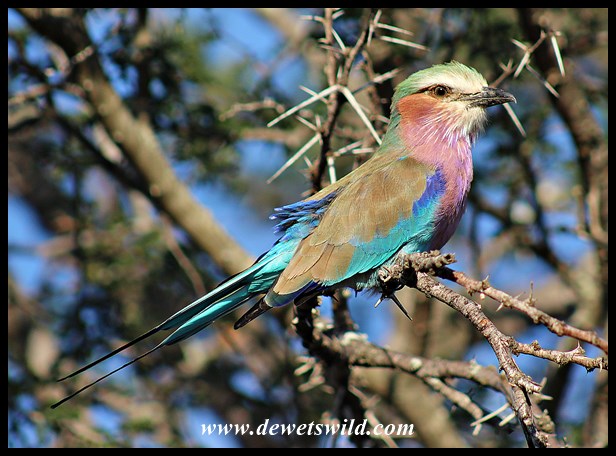
Few people would fail to be impressed by the beautiful plumage of the Lilac-breasted Roller, especially when seeing those electric colours swooping past in flight!
Lilac-breasted Rollers are inhabitants of the more open woodlands and savannas, often perching quite conspicuously on trees or poles, either singly or in pairs. They are mostly insectivorous in diet, though they will also take small reptiles, frogs, small birds and rodents when the opportunity arises. They’re often seen at veldfires, hawking the small prey items trying to escape the flames. They are acrobatic fliers, hence the name.
Pairs are monogamous and strictly territorial. In South Africa, this species breeds mostly in spring, nesting in abandoned holes made by other birds and animals in trees. Clutches contain 2-4 eggs and are incubated by both parents for just over three weeks.
These colourful birds are common residents of Eastern and Southern Africa, and considered of “least concern” by the IUCN. In South Africa they can be found from Northern Kwazulu-Natal through Mpumalanga, Limpopo Province, the North of Gauteng and North-West Province to the Kalahari regions of the Northern Cape.
The Northern Black Korhaan is a species of open grassland, dry savanna and semi-arid scrub. They feed primarily on insects and other invertebrates as well as seeds. Adults can weigh up to a kilogram.
Male Northern Black Korhaans are fiercely protective of their territory and attempt to mate with as many females as possible, whom they attract by an elaborate courtship dance. Females incubate the clutch (1-3 eggs) for about three weeks and then raise the chicks on their own. They don’t construct a nest, instead laying their eggs directly on the ground among tufts of grass, often under small thorn bushes. Most chicks are raised in the spring and summer.
Northern Black Korhaan occur on South Africa’s central Highveld, principally the provinces of the Eastern and Northern Cape, Northwest, Free State, Limpopo, Mpumalanga and Gauteng. Its range also extends into Botswana and Namibia. The IUCN considers the species of “least concern” as it has a stable population and appears to be common throughout its range.
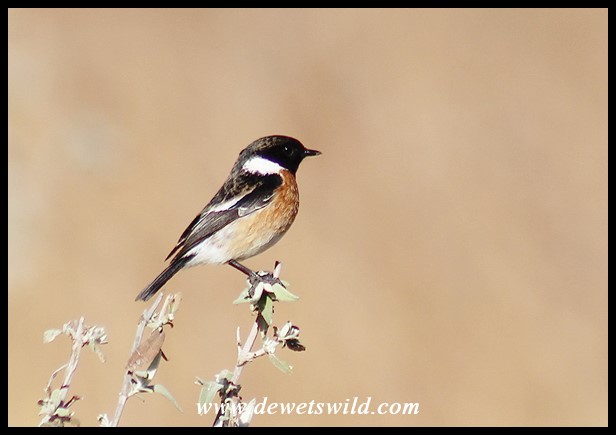
African Stonechats generally inhabit higher altitude grasslands with long, rank growth, though in South Africa they also occur down to sea level in suitable habitat, and especially so during the colder winter months. The African Stonechat has also adapted very well to large scale agriculture, though they avoid overgrazed areas. They feed mainly on small insects and other invertebrates. These are active little birds, only 13cm long and weighing only 12 – 17g.
African Stonechats are usually seen in pairs, and breeding occurs in spring and summer. Females build their nests of grass and softer material in the shape of a deep cup, usually positioned on the ground at the base of a bush or other plant providing good cover. Clutches, containing up to 6 eggs, are incubated only be the female for a period of two weeks, but both parents feed the chicks once they’ve hatched. Chicks leave the nest at about two weeks of age, and then stay with their parents for a further three weeks or so.
The African Stonechat is a common sight in South Africa, occurring all over the country with the exception of the arid interior of the Northern Cape Province. They are also patchily distributed over East and Central Africa, and is considered common throughout its range.
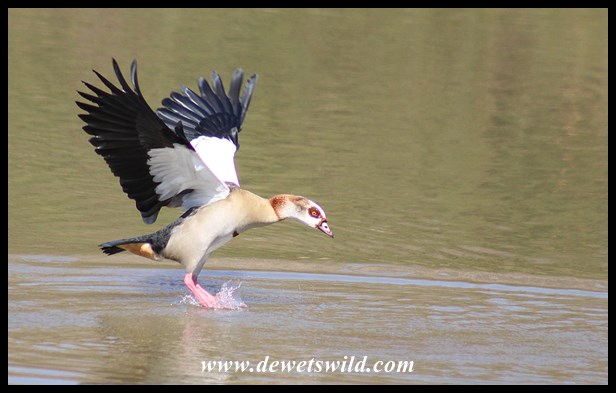
The well-known Egyptian Goose is a large (up to 3.5kg) duck that is probably South Africa’s most numerous waterfowl species.
Egyptian Geese inhabit almost every freshwater habitat, preferring rivers and waterbodies with open shorelines within easy reach of open fields for grazing. Their diet is mostly vegetarian, particularly including grasses and cultivated crops (which is why they are regarded as pests in some parts of their range).
Outside of the breeding season, which in South Africa mainly stretches from late winter to early summer, Egyptian Geese can be found in large flocks of hundreds, even thousands, especially so while moulting (which leaves them flightless for about a month). In the breeding season however pairs are more solitary in habit, viciously defending small territories around their nests and goslings from others of their kind. Nests, lined with plant material, are bult in a variety of places ranging from shallow depressions hidden on the ground in thick vegetation to burrows, the abandoned nests of other large birds, holes in trees, cliffs, caves and buildings. Pair bonds often last for life, and the females incubate the clutch of 5 to 11 eggs for about 4 weeks. Chicks hatched in elevated nests have to jump out after hatching, responding to the call of their mother below, and then follow the parents to water. Both parents take care of the young, which start flying at around 10 weeks of age.
The IUCN considers the Egyptian Goose as being of “Least Concern“, having a large (though likely decreasing) population distributed over most of Sub-Saharan Africa, with introduced or feral populations in many other parts of the world. Ironically they no longer occur on the lower Nile, where they were once considered sacred by the ancient Egyptians. They are however a very familiar sight all over South Africa.
Although the Hippopotamus seldom needs any introduction, most people are entirely unaware of just how big these portly animals are. Bulls can reach 1.7m high at the shoulder and weigh as much as 3,200kg (though usually around 2 tons), while cows are smaller, reaching weights of 1,700kg.
Hippo close-up
Hippo on land showing their short legs and portly body
Hippo showing enormous gape
Hippo posturing at the Balule causeway
Hippo posturing
Hippo posturing
Hippo eyeing us from the Sabie River
Hippo pod (Photo by Joubert)
Hippo on land
Hippopotamus require deep, permanent pools in slow-flowing rivers, dams and lakes, usually with exposed banks and islands and easy access to grazing grounds. They consume 100kg or more of fodder daily, consisting mostly of grass but will also feed on fruits, reeds and other waterplants. Areas subject to heavy grazing by Hippo take on a park-like appearance, with short “mown” lawns. They have been recorded taking carrion from carcasses. In times of drought hippos will travel up to 30km in a night to reach grazing, and will try to make do with any water or mudhole as protection from the sun.
Hippos lazing in the water
Hippo hiding in the shade of a bush
Young hippo looking for something to eat
Hippos from N’wamanzi Viewpoint
Pod of hippos in the bed of the Olifants
Mazithi Dam was little more than a drying mud puddle crammed with tired hippos and flayling barbel
Hippopotamus yawn
Hippo pod in the Pioneer Dam
Hippos at Nkakane
Hippo pod (Photo by Joubert)
Hippos
Just look at that tiny hippo baby!
Hippo in the dark, grazing past our camp
Hippo making the most of the overcast conditions
Hippo tusk
Hippo in the Sabie River (photo by Joubert)
Hippos returning to the hippo pool in the early morning
Hippos in a quiet pool of the Sabie
The hippo has the pool all to himself
Hippo eyeing us from the waterhole
Hippo
Hippos live in herds consisting of a territorial bull, cows and calves, numbering from 2 to 200 (usually around 15). The territorial bull will tolerate other mature bulls in his area provided they act suitably submissively – if not, terrible fights will break out in which one or both combatants are often killed. Inside the group the cows also maintain a strict hierarchy. Territories are demarcated by dungpiles and scattering droppings on prominent bushes and rocks by flicking the tail. Hippos follow specific trails between their waterhole and feeding grounds, and is especially dangerous when encountered along these. In fact, Hippos are among the most dangerous of African animals and cause several human deaths annually. Instances have also been noted of Hippos killing (by drowning or biting) other herbivores or crocodiles which venture too close. They are surprisingly fast on land, capable of speeds in excess of 35km/h, and are just as fast in the water. Hippos are most active at night, preferring to spend the hot daylight hours lolling in the water or baking in the sun on a sandbank and then heading out to feed at dusk.
It is unusual to find hippos moving around on land during daylight
What seems a lazy yawn may be a threat display
Hippos in a deep pool
Hippos
Hippos baking on a sandbank
Young hippo resting on an adult
Hippos lazing on a sandbank in the Nwaswitsontso River
The normal view of hippos, lazing in a pool of water on the Sweni River
Hippo encountered on a night drive from Olifants
Another pod of hippos at the Ngotso weir
Hippo antics at Nsemani Dam
Hippos at Lake Panic
Hippo highway leading from the water
Hippopotamus
Hippopotamus
Hippos at kuMfazana Pan
Hippopotamus
Hippopotamus
Most Hippo calves are born in the rainy season, when cows give birth to a single offspring after a gestation of about 8 months. The calves are usually born in reedbeds, where they remain hidden for a few weeks before being introduced to the herd as bulls are known to kill calves, even their own. Cows are incredibly protective of their young and nursing usually takes place in the water. Thanks to their large size and aggressive nature, few Hippos succumb to predator attacks, though lions, hyenas and crocodiles will attempt to catch calves given an opportunity. Drought and starvation are the biggest cause of natural deaths in Hippo populations. They have a life expectancy of up to 50 years in the wild.
Playful baby hippos
Playful hippos
Chubby hippo calf and mom
Baby hippo
Hippopotamus
Baby Hippo at Mestel Dam
Hippo gang at Sunset Dam
Hippo becoming a temporary island for Marsh and Serrated Hinged Terrapins
Hippo walking back to Lake Bhangazi
Hippos lazing at Amazibu Pan
Hippos
Baby Hippo resting on mom’s back at Rathlogo
Hippo baby (photo by Joubert)
Hippo babies (photo by Joubert)
Lazy family of hippos at Mestel Dam
Pair of Hippos walking along the Letaba River
Hippo family at rest
Hippopotamus
Hippopotamus
Hippopotamus
Resting hippos
Hippos
Hippopotamus cow and calf
Hippopotamus calf
Owing to a declining population due to poaching and loss of habitat, the IUCN considers the Hippopotamus to be “Vulnerable” and estimate that the total African population numbers between 125,000 and 148,000. It is estimated that there are at least 5,000 (and probably considerably more) Hippos in South Africa, where they now occur naturally only in the Lowveld of the Mpumalanga and Limpopo Provinces and the north of Kwazulu-Natal, although reintroductions have occurred outside these areas. Reliable places to see Hippos in South Africa are the Kruger National Park, iSimangaliso Wetland Park and Pilanesberg National Park.
Hippos
Pod of Hippos in Sunset Dam
Pod of hippos seen in the river from Crocodile Bridge
Hippopotamus in the rapids below the causeway
Hippos yawn as a threat
Hippo going walkabout in broad daylight
Hippos in the Mfazana Swamps (photo by Joubert)
Hippo
Hippo Babies
Hippopotamus (photo by Joubert)
Hippos in a dam in the Manyeleti Nature Reserve
Lazy Hippos
Hippo in a dam in the Manyeleti Nature Reserve
Hippo in a dam in the Manyeleti Nature Reserve
Hippopotamus
A pod of Hippos on the shores of Lake St. Lucia at Catalina Bay
Hippopotamus
Pair of Hippopotamus
Pod of Hippopotamus in Nsumo Pan
Hippopotamus eyeing us with some suspicion from among the reeds
Hippopotamus
Hippos in Transport Dam
Baby Hippo
Hippopotamus
Hippos and a crocodile sharing a corner of Manyeleti’s biggest dam
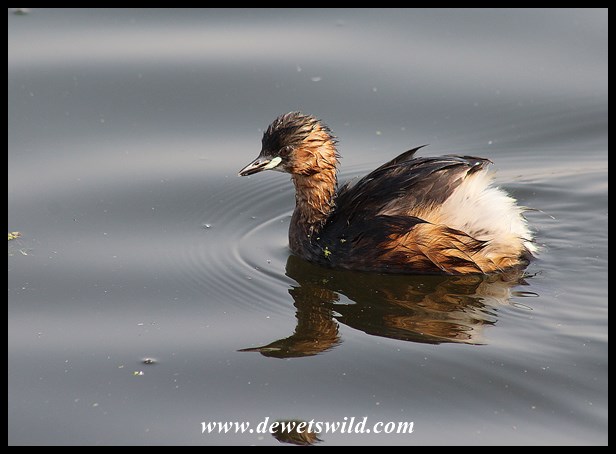
The Little Grebe, or Dabchick, is a small (120-190g, 20-29cm long) resident waterbird, commonly seen in pairs or small groups on shallow wetlands, ponds, lakes, pans, dams and other quiet freshwater habitats (rarely in fast flowing rivers). They feed on aquatic prey, including fish, amphibians, crustaceans and insects, mostly caught under water, and in turn are preyed upon by large predatory fish.
In South Africa, Little Grebes breed mostly in the spring and summer months. Solitary pairs build a floating platform of plantmaterial, anchored to some underwater structure, for a nest. Before leaving the nest the parent bird always covers the eggs, of which there may be up to seven in a clutch, with some nest material. After hatching the chicks are often carried on their parents’ backs when swimming. At the end of the breeding season the Little Grebes moult and are then flightless for a short time.
Despite a declining population, estimated at as many as 3.5-million, the IUCN consders the Little Grebe of Least Concern, owing to a wide distribution across Africa, Asia and Europe. Little Grebes occur all over South Africa wherever suitable habitat is to be found.
Little Grebe
Little Grebe
Little Grebe
Little Grebe
Little Grebe
Little Grebe
Little Grebe
Little Grebe with chicks
Little Grebe chick
Immature Dabchick
Little Grebe
Little Grebe
White-faced Whistling Duck surrounded by Little Grebes
The Great Crested Grebe is a relatively big (up to 1.5kg, 45-56cm long, with a wingspan of up to 73cm) waterbird inhabiting large bodies of open water (mostly dams, lakes and pans, and rarely rivermouths and protected bays) where they feed on fish, crustaceans, amphibians and aquatic insects pursued underwater.
Locally, breeding seems to occur at any time of the year, on platforms of floating plant material anchored to emergent plants such as reeds or in flooded thickets. These birds are well known for their elaborate mating display. Clutches usually contain only two eggs, and the chicks are often carried on the parents’ backs.
Great Crested Grebes have a wide distribution across Europe, Asia and Australasia, with a limited occurrence in Southern and East Africa. The IUCN estimates their population at as many as 1.4-million and considers the species of Least Concern. In years past this grebe suffered greatly due to hunting for the plume trade, but today gill-netting is a more serious threat to their survival, especially so in East Africa where they are now rare. Great Crested Grebes are locally common residents in South Africa and occur mostly on the central Highveld (Gauteng, Northwest, Mpumalanga and Free State Provinces) and the Eastern and Western Cape.
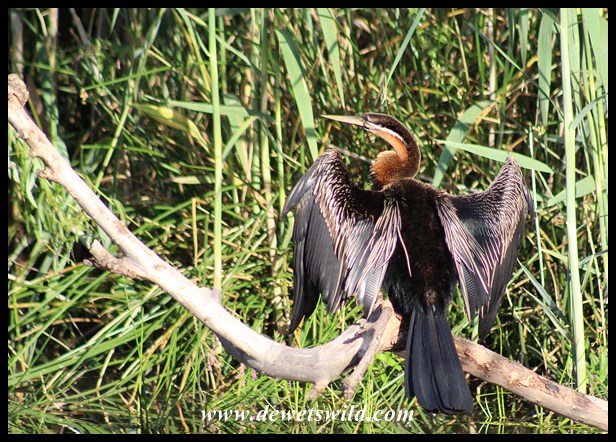
African Darters have a wingspan of up to 1.3m and weigh in at as much as 1.7kg.
Darters are common residents at most wetlands, lakes, dams and slow flowing rivers, and occasionally lagoons and estuaries. They swim low in the water, usually with only their neck and head above the water, and can stay underwater for up to a minute when pursuing prey. African Darters feed mostly on fish, and occasionally frogs, water snakes and crustaceans, which are swallowed whole and head first.
Breeding occurs in colonies (often mixed with other species) in trees and reedbeds, mostly during the summer months. Nests are platforms built of sticks, on which both parents incubate the 3-6 eggs with their feet. Darter feathers are not waterproof, explaining why they are often seen sunning themselves on rocks and dead tree branches with wings outstretched. Some birds loose all their feathers when they moult after the breeding season, and then are flightless for a short period.
African Darters occur over most of Africa south of the Sahara, and can be seen almost all over South Africa, even occurring in the arid west of the country along the course of the Orange River. Despite a declining population (estimated at between 25,000 and 127,000) in many range states, the IUCN considers the African Darter of “least concern”.












 DeWetsWild