Category Archives: South African Wildlife

The inhabitants of South Africa’s wild places

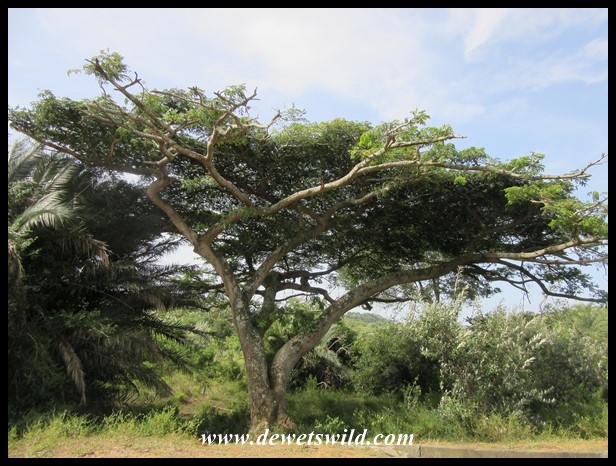
Knob Thorn

Senegalia (Acacia) nigrescens

The Knob Thorn is a well-known tree, thanks to its characteristic spines, occurring in the low-lying areas of northern Kwazulu-Natal, the Lowveld of Mpumalanga and Limpopo, and along the Limpopo River Valley. Beyond our borders it is found as far north as Tanzania. It may grow up to 18m tall and is very drought resistant.  Many animals, particularly giraffes and elephants, love browsing on the leaves and pods of the Knob Thorn.

Spotted-necked Otter

Hydrictis (Lutra) maculicollis

The Spotted-neck Otter inhabits freshwater habitats with good water quality and well vegetated margins. They feed mainly on fish, crabs, frogs and occasionally waterbird chicks. These otters hunt by sight and are consequently mainly diurnal and most active at sunrise and sunset. By night they sleep in tunnels in river banks, in dense vegetation or among logs and rocks.

Spotted-necked Otters live in family groups of 2-6 individuals consisting of an adult pair and their latest offspring. They’re very intelligent, curious and playful. Cubs are born after a two month gestation, with births in South Africa peaking in the summer months. The babies stay in their den for up to 3 months and have to be taught to swim, a task undertaken mostly by their mother. The little ones remain with their parents until the next litter is born. Fully grown Spotted-necked Otters weigh between 3 and 6kg, with males being considerably bigger than the females. They’re about a metre long.

The IUCN considers the Spotted-necked Otter to be near-threatened, concerned by the degradation of the otter’s habitat throughout its wide distribution over most of sub-Saharan Africa. In South Africa, Spotted-necked Otters occur mainly on the highveld of the Free State, Gauteng and Mpumalanga and in adjacent parts of the Eastern Cape and Kwazulu-Natal. In our country their population is estimated at a maximum of 10,000 animals and they’re considered to be vulnerable to extinction, with habitat destruction being the major threat. Our local Rietvlei Nature Reserve on the outskirts of Pretoria is one of the best places to see these endearing creatures, and all the following photographs were taken there.

Black-striped Hairtail Butterfly

Anthene amarah

The Black-striped Hairtail is a tiny (wingspan less than 3cm) butterfly with a wide distribution across southern, eastern and northern South Africa and a special fondness for thorn trees – adults relish the flowers while caterpillars subsist on the leaves. Adults can be seen year-round though they’re much more numerous in summer when they can sometimes be seen together in groups numbering several dozen.

Red-capped Lark

Calandrella cinerea

The Red-capped Lark is a common bird species that occurs throughout South Africa, with greatest population densities on the Highveld, in the Karoo and in the Fynbos-biome, indicating their preference for open grasslands and shrublands. They’ll also utilise recently burned or ploughed fields to search for food, which consists mainly of seeds and insects. Beyond our borders they occur over most of the continent south of the equator.

Red-capped Larks breed on the ground, usually just before the first spring or summer rains, using natural hollows – often hoofprints – lined with soft plant material gathered mostly by the female as a nest. The female incubates a clutch of 2-4 eggs for around 2 weeks, with the male providing her with food. Once hatched the chicks are reared by both parents and leave the nest before they’re 3 weeks old. Outside of the breeding season they may form flocks of up to 30 individuals.

Citing a widespread and increasing population, the IUCN considers the Red-capped Lark as being of least concern.


Finally seeing a Pangolin in the wild!

Last month, while travelling between Elephant Sands Lodge and the Sua Pan in Botswana during Gospel on Safari, a life-long dream of mine was realised when I finally had the chance to see a Pangolin in the wild!

Smutsia temminckii – The Ground Pangolin

Sadly, the Ground Pangolin is being threatened with extinction and is currently listed as vulnerable by the IUCN. Like other kinds of pangolin their populations are being driven downward by illegal trade for mainly superstitious medicinal uses and as a high-end delicacy. Farming practices, electric fences and road deaths are further threats to these enigmatic animals. In South Africa today they’re found mainly in the Northern Cape, North West, Limpopo, Mpumalanga and northern KZN, with populations in the Eastern Cape and Free State now feared extinct, while their natural distribution stretches beyond our borders as far north as Chad and Sudan.

Fully grown Ground Pangolins measure between 70 and 110cm in length, stand about 30cm high on all fours and weigh between 5 and 18kg, with males being considerably bigger than females. They feed on ants and termites, breaking open their nests with the powerful claws on their front feet and lapping the insects up with a tongue that is longer than the Pangolin’s body! They inhabit any habitat that has an ample supply of their favoured food items, being found from semi-deserts to the edge of forests. They do not need to drink.

As their name suggests, Ground Pangolins are strictly earthbound. They rest in tunnels that they dig themselves or take over from other animals. They plug the entrance to the tunnel from inside when using it. If caught outside they will roll up into a tight ball, their hard, sharp scales serving as excellent protection. Pangolins have wonderful senses of hearing and smell, but poor eyesight, and are solitary animals except when mating or when a mother is with her offspring. Females give birth to a single baby at a time, which she carries around with her on her tail for much of the first months of its life. They live to about 12 years of age in the wild.

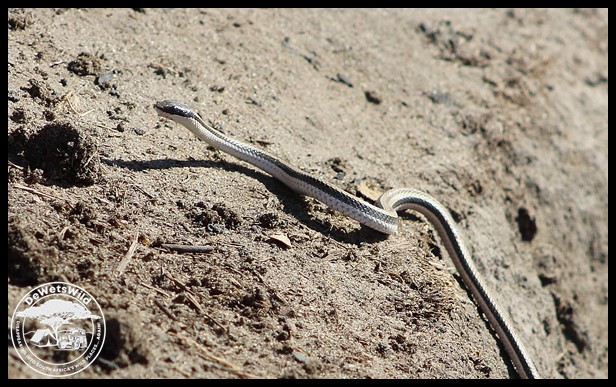
Watching Black Mambas at Domtshetshu Pan in Botswana

While camping near Domtshetshu Pan in Botswana recently, as part of Gospel on Safari, I took a stroll towards a muddy part of the waterhole, where I found two Black Mambas – one of the deadliest species of snake on the planet – wallowing in the mud, drinking from little pools and being very coy with each other. The snakes paid me no notice at all, making me think that they probably have never seen a human before – what an amazing thought! Later, one of my fellow campers joined me at the sighting and still the snakes acted as if we weren’t even there.

Red-sided Skink

Trachylepis (Mabuya) homalocephala

In South Africa, Red-sided Skinks commonly occur mainly along the southern coast, stretching from Saldanha Bay to Durban, and adjacent hinterland, with a few isolated populations deeper inland in Mpumalanga and the Free State. It lives in areas with sandy soils in a variety of vegetation types, ranging from karroid and fynbos to forest, often near water. In the summer months females may lay up to 10 eggs in nests dug in soft soil below logs and rocks. The eggs hatch after approximately 3 months. Leaving the tail out of the measurement adults are about 7cm long.

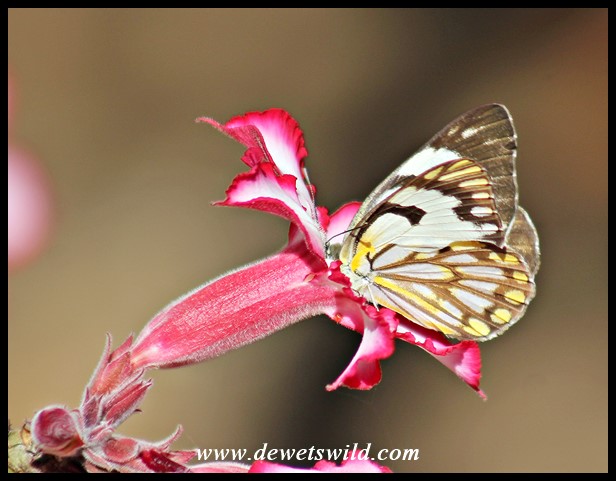
Veined Tip Butterfly

Colotis vesta

The Veined Tip is a commonly seen butterfly occurring in savanna habitats and as such is found year-round in Kwazulu-Natal, Mpumalanga, Limpopo, North West, Gauteng and isolated parts of the Northern Cape. Adults have a wingspan of around 4cm and fly relatively low and slow, often landing on flowers.

Marico Flycatcher

Bradornis (Melaenornis) mariquensis

The Marico Flycatcher is an insectivorous bird that lives in dry, thorny savannas (they are entirely independent of drinking water), and in South Africa occurs from the Lowveld through Mpumalanga, Limpopo, Gauteng and North West through to the Northern Cape and western Free State. Their distribution further extends to Namibia, Botswana, Zimbabwe and southern reaches of Zambia and Angola.

Marico Flycatchers live alone, in pairs or small groups of up to 5. They may breed at any time of year. Monogamous pairs raise clutches of 2-4 chicks that hatch in a flimsy cup-shaped nest built by the female. Chicks remain with their parents for up to 2 months after leaving the nest. Adults weigh about 24g and measure approximately 18cm in length.

The IUCN considers the Marico Flycatcher to be of least concern.

Barn Swallow

Hirundo rustica

Barn Swallows are amongst the best known birds in the world, occurring on all the continents (except Antarctica) for at least part of the year. They breed in the northern hemisphere and migrate to the southern continents during the northern winter, covering distances of up to 11,500km between their breeding grounds and non-breeding abodes. Locally they arrive from late September and depart again by April and can be seen in basically every corner of the country during that time. The IUCN estimates that there’s at least 290-million Barn Swallows in the world and lists the species as being of least concern.

in South Africa Barn Swallows can be found in any habitat though they reach their highest densities in areas of higher rainfall. They feed mainly on insects caught on the wing. Barn Swallows are highly gregarious and usually roost in reed beds – some of these have been in use for decades and may host up to 3 million birds! Barn Swallows measure about 14cm in length and weigh around 20g.