Category Archives: South African Wildlife

The inhabitants of South Africa’s wild places

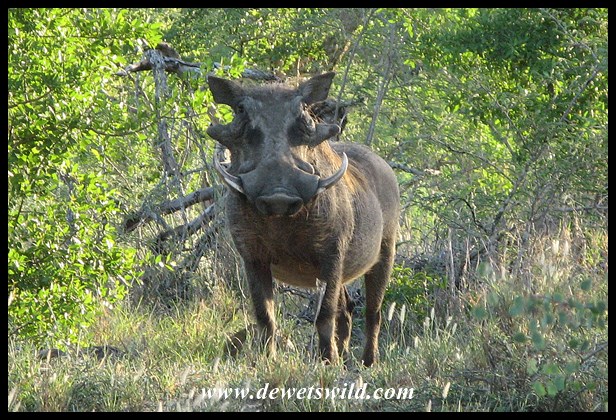
Warthog

Phacochoerus africanus

The comically-looking Warthog is a firm favourite for many visitors to South Africa’s wild places, who probably find it easy to relate to the lovable Pumbaa from Disney’s The Lion King movies. These large pigs – males weigh as much as 115kg – are tough in the extreme and can put those impressive tusks to good use defending themselves and their piglets.

Warthogs inhabit open savannas, short grasslands, floodplains and semi-desert scrub, avoiding more densely vegetated areas (particularly forests and areas with long grass cover). They primarily feed on grass, roots, fruits, seeds and bark, but have been known to scavenge from carcasses and have even been recorded robbing cheetahs of their prey! They can go for long periods without water but will drink daily where it is available. They prefer feeding on very short growth and digging for morsels with their snouts, often going down on their knees for better access.

Groups of Warthogs, called sounders, usually consist of related sows and young, sometimes accompanied by an adult boar and number up to 16 individuals, though the males are mainly solitary especially outside the breeding season. Warthogs are sedentary and will often remain in the same general area for most of their lives. They are diurnal in habit, taking shelter in the disused holes of other animals or in man-made culverts at night. They always enter these burrows backside first, so as to protect themselves with those formidable tusks. Warthogs love a mudbath and through their rolling in the stuff help to enlarge waterholes over many years. These pigs have excellent sense of smell and hearing but terrible eyesight, often relying on oxpeckers to give them advance warning of danger. They can run at speeds in excess of 40km/h, always with their thin tails held aloft like the aerial on a radio-controlled car!

Sows give birth to between 1 and 8 (usually around 4) tiny piglets in their burrows during the spring and summer. Lactating sows will accept any piglets as their own. Warthogs feature on the menu of all Africa’s large predators, although adults will defend themselves and their young viciously with their tusks. Piglets are prone to dying of exposure to cold, wet conditions. Warthogs have a life expectancy of up to 20 years in the wild.

Listed as “Least Concern” by the IUCN, it is estimated that there are at least 22,000 Warthogs in South Africa (and probably considerably more) where they seem to be expanding their range. There are free ranging populations of warthog in all South African provinces with the exception of the Western Cape. Good places to find Warthogs are the Addo Elephant, Kruger, Mapungubwe, Marakele, Mokala and Pilanesberg National Parks, Hluhluwe-Imfolozi Park, iSimangaliso Wetland Park, and Dinokeng and Ithala Game Reserves. Elsewhere in Sub-Saharan Africa Warthog populations are declining due to habitat loss, competition with livestock and severe hunting pressure, and are evermore being restricted to conservation areas.

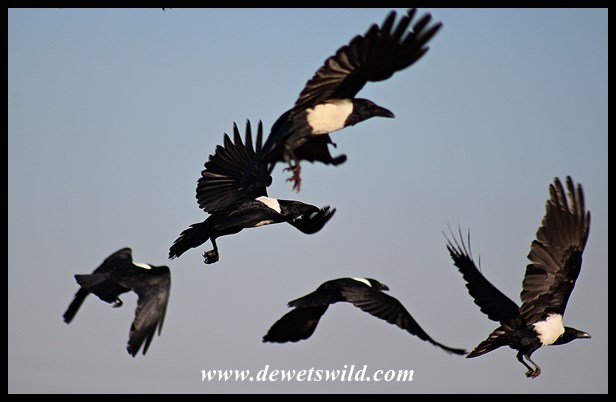
Pied Crow

Corvus albus

The Pied Crow is a distinctly cosmopolitan creature, adapting to almost any habitat and closely associating with humans and our wasteful activities wherever possible. They’re a common sight along roads, where they feed on road kills, and at slaughterhouses and dumpsites where they scavenge for discarded scraps. Apart from cleaning up after humans, Pied Crows include a wide selection of food items in their naturally omnivorous diet: insects and other invertebrates, small mammals, birds and reptiles, eggs, carrion, seeds, fruits, roots and mushrooms are all consumed, and they will mob large birds of prey to steal their food. They’ve even been known to kill lambs and sick sheep. Pied Crows have a wingspan of almost a metre and weigh around half a kilogram.

The Pied Crow is a sociable species, usually seen in pairs or small groups but at times coming together in enormous flocks numbering in the thousands at communal roosts or in response to an abundant food source. Both sexes work together in constructing nests of sticks and twigs in isolated tall trees or on telephone and electricity pylons and windpumps. Breeding takes place in spring and summer, when clutches of 3-6 eggs are incubated by the female for about three weeks. Both parents raise the brood, which fledges at about 45 days.

Thanks to an enormous distribution range covering almost all of Sub-Saharan Africa and Madagascar, its close association with humans and a large and stable population, the Pied Crow is considered of least concern in conservation terms. In South Africa too they are spread over the entire country, being described as increasingly abundant.

Pearl-spotted Owlet

Glaucidium perlatum

These tiny owls (75g weight, 30cm wingspan) are mainly nocturnal in habit (like most other owls), but are often also active during the day, especially in winter, and then its position is frequently given away by other birds mobbing it. It feeds primarily on a wide variety of invertebrates, but will also take small reptiles, eggs, birds, bats and rodents. Pearl-spotted Owlets nest in holes in trees in the springtime, lying 2 – 4 eggs. Pairs defend their territories year-round.

The Pearl-spotted Owlet is a common resident of the savannas and woodlands of Sub-Saharan Africa, and listed as “Least Concern” by the IUCN. In South Africa it is found from the north of Kwazulu-Natal through Mpumalanga, Limpopo, Gauteng and North West Province to the Kalahari regions of the Northern Cape.

Grey-headed Gull

Chroicocephalus cirrocephalus poiocephalus

The locally common Grey-headed Gull is the only species of their kind regularly encountered at open, shallow inland freshwater habitats in South Africa, though they are also found along the open coast and at lagoons and estuaries, and often in close association with human activities, scavenging on our waste. They do not wander far out to sea like many other gulls do. Their natural diet includes fish, molluscs, eggs and carrion. This is a medium-sized gull, weighing in at about 300g.

Grey-headed Gulls are gregarious and rarely seen alone. They also breed in tightly packed colonies, with nests positioned on the bare ground on islands or among clumps of vegetation. Though breeding activity has been recorded through most of the year, it reaches a peak in early winter. Clutches usually consist of 2 or 3 eggs.

It is estimated that there are more than 2000 breeding pairs of Grey-headed Gull in South Africa. Though they can be seen almost over the entire country, their biggest concentrations are to be found around Cape Town, Port Elizabeth, on the North Coast of Kwazulu-Natal and on the Highveld of the Free State, North West, Gauteng and Mpumalanga Provinces. Apart from our neighbouring countries, the Grey-headed Gull also has a patchy distribution throughout East and West Africa, Madagascar and parts of South America. The IUCN listst it as “Least Concern“.

Black Crake

Amaurornis flavirostra

The Black Crake is a small (90g), diurnal species and not as shy as many of their close relatives, often emerging quite confidently into the open. They are mostly seen in pairs or small family groups, inhabiting densely vegetated wetlands and streams. These crakes subsist on aquatic invertebrates, small fish, frogs and tadpoles as well as seeds and waterplants.

Black Crakes breed throughout the year, with a peak in summer. The nest is a cup of plant material floating on or suspended just above the water, or built on the ground in a safe, densely vegetated area, in which between 2 and 6 (usually 3) eggs are laid and incubated for almost three weeks by both parents. While breeding they become extremely aggressive, even taking on birds much larger than themselves. Juveniles from previous broods often assist in raising the current clutch, which can fly from about 6 weeks old and become independent shortly thereafter.

The Black Crake occurs over all of Sub-Saharan Africa with the exception of the most arid areas. The IUCN estimates their population at 1-million and lists the species as least concern. In South Africa they are considered a common resident, absent only from the dry Karoo and Kalahari regions the Eastern, Northern and Western Cape Provinces.

Laughing Dove

Streptopelia senegalensis

Occurring over the entire country, most South Africans would be familiar with the Laughing Dove as a common garden bird (to the point of being considered a pest by many). They inhabit a wide range of habitats, avoiding only forests and deserts, and being very much associated with human habitation. They feed primarily on the ground, pecking up small seeds and to a lesser extent include fruit and insects in their diet.

Laughing Doves usually forage in pairs or small groups, though larger aggregations may form at abundant food or water sources. Nests, built by both parents, are flimsy constructions of twigs in trees, against buildings or under roofs, in which clutches of two eggs are incubated by both sexes. The eggs hatch after two weeks, and the chicks fledge after about the same time. They nest throughout the year, with a peak in spring and summer.

The Laughing Dove has a wide distribution across Africa, through the Middle East to the Indian subcontinent, with an apparently stable population estimated at as many as 8-million, which is why the IUCN considers the species to be of least concern.


Chacma Baboon

Papio ursinus ursinus

The Chacma Baboon is the biggest wild primate occurring in South Africa. Males can weigh up to 50kg, while females are more lightly built and weigh up to 28kg.

Baboons can be found in virtually any habitat, provided there is a reliable supply of drinking water and safe places to sleep at night (usually in the form of tall trees, cliffs or caves). They are equally easy to please when it comes to their diet, taking fruit, berries, grass, leaves, flowers, mushrooms, roots and tubers, insects, scorpions, snails, eggs, small birds, reptiles and mammals (including the lambs of antelope) and, along the coast, molluscs, crayfish, crabs, etc. Unfortunately they quickly learn that humans and their waste is an easy source of food, and in many reserves, towns and cities have become quite adept at raiding human habitations.

Chacma Baboons keep to large troops, some over 300 animals in size, in which a strict hierarchy is maintained, sometimes through violent fights. This dominance hierarchy determines where an individual will feature when it comes to access to food, water, sleeping spots and mating partners. They also forge alliances and friendships strengthened by mutual grooming. Lower ranking adult males take turns to act as sentinels on the look-out for danger. Chacma Baboons are diurnal and mainly terrestrial and troops can cover as much as 15km in a day while foraging. Because they have such keen senses Baboons are often accompanied by other herbivores.

Female Baboons give birth to single young (rarely twins) at any time of the year. Newborn babies hang from their mother’s tummy when she’s walking, while older babies ride on her back like a jockey. Youngsters remain dependant on their mother until they are at least a year old. Females remain in their maternal troop when they reach adulthood, while young males join other troops. All animals in the troop are extremely protective of babies, and when attacked by a predator the large males will usually launch a counter attack. Leopards are the main threat to adult baboons, but they are not easy prey by any means. Chacma Baboons have a life expectancy of up to 45 years in the wild.

The IUCN regards the Chacma Baboon as being of least concern in conservation terms. Despite being persecuted as vermin in farming areas and suburbs, the Chacma Baboon remains common and widespread, and is one of the few large mammals still regularly encountered outside the formal conservation areas in South Africa. They can be found in virtually every nature reserve and national park in the country, but in our experience they are most easily viewed at the Blyde River Canyon Nature Reserve, Garden Route National Park, Golden Gate Highlands National Park, Hluhluwe-Imfolozi Park, Kruger National Park, Pilanesberg National Park and uKhahlamba Drakensberg Park. Chacma Baboons also occur in Angola, Zambia, Namibia, Botswana, Zimbabwe, Mozambique, Swaziland and Lesotho.

Baboons occurring in neighbouring countries north of the Limpopo belong to a different subspecies, P. u. griseipes, and have a slight yellowish tinge to their fur.


Red-knobbed Coot

Fulica cristata

A denizen of rivers, wetlands, lakes, lagoons, estuaries, dams, ponds and pans with still water and surrounded by dense vegetation, the Red-knobbed Coot follows an omnivorous diet of aquatic plants, algae, molluscs, crustaceans, insects and the eggs of other waterbirds. Adults can weigh up to 1kg.

Red-knobbed Coots are solitary breeders, pairs establishing a territory in which to raise their young. They are very aggressive, both towards their own kind and other species of waterfowl. in South Africa they breed at any time of the year. Nests are platforms built of aquatic plant material on open water or among emergent vegetation. When not breeding they are more gregarious, occasionally congregating in flocks that number more than a thousand birds.

The Red-knobbed Coot has a wide distribution in East and Southern Africa and a population estimated at over a million, though declining mostly through habitat loss, and considered of Least Concern by the IUCN. There is an isolated, threatened population in Morocco and Southern Spain. They can be found commonly all over South Africa where suitable habitat exists, including on farm dams and rivers in the arid west of the country, expanding their range in response to the building of suitable artificial waterbodies.

African Fish Eagle

Haliaeetus vocifer

If there is one sound that is symbolic of Africa’s waterways, it must be the call of the African Fish Eagle. It is the national bird of several African countries, and the South African presidential jet carries its Zulu name Inkwazi. They occur over almost all of Sub-Saharan Africa in close association with rivers, lakes, dams, swamps, estuaries and lagoons. As can be deduced from their name, African Fish Eagles subsist mainly on a diet of fish (weighing up to 2kg) snatched from the water in flight, though they will also catch baby crocodiles, terrapins, small mammals and other birds (up to the size of flamingos), scavenge the catches of other waterbirds like storks and herons and feed on carrion. Adults can weigh over 3kg and have a wingspan of almost 2.5m.

African Fish Eagle pairs are monogamous, pair for life and maintain their territories year-round, nesting in tall trees or on cliffs near water. Their nests are large, built of twigs and reeds. In South Africa the breeding season coincides with the drier months of the year, when fish are easier to catch in dwindling pools. Clutches contain up to three eggs, and are incubated mostly by the female for about 6 weeks. The parent birds are usually successful in raising all their chicks to fledging at about two-and-a-half months of age, whereafter the young stay with their parents for another three months or so. Newly independent juveniles often congregate in flocks that can number as many as 75 birds. African Fish Eagles have a life expectancy of up to 24 years in the wild.

The IUCN lists the African Fish Eagle as being of Least Concern, siting its large, stable population estimated at about 300,000, wide distribution and no real threat from humans. They can be found in all South Africa’s provinces – even penetrating the arid west along the course of the Orange River and its tributaries.

Red-winged Starling

Onychognathus morio

The Red-winged Starling is an omnivorous species feeding on a wide range of seeds, fruits and berries, nectar, invertebrates (even pecking parasites from large mammals), small vertebrates (such as the hatchlings of other birds) as well as carrion and human waste.

These large starlings (30cm long, weighing up to 150g) are closely associated with cliffs and rocky hills and mountains, occurring in a wide range of mesic vegetation types wherever these favoured breeding sites are to be found. They have also adapted to built-up environments, where they use buildings as artificial nesting sites. Monogamous pairs of Red-winged Starlings stay together for years, are territorial when breeding and aggressively protect their nests, even against humans. The nest is built of mud, twigs and grass on a ledge, and the female is responsible for incubating the 2 to 4 eggs over a period of about two weeks. Hatchlings fledge at about a month old. Outside of the summer breeding season they are highly gregarious and congregate in large flocks.

The Red-winged Starling commonly occurs in a band stretching from Ethiopia to South Africa and is considered of least concern by the IUCN, with a growing population as it continues to exploit man-made habitats. In South Africa this species can be found in the south, east and north of the country, being entirely absent from the arid parts of the Northern Cape. It is regarded a pest in orchards.