Category Archives: South African Wildlife

The inhabitants of South Africa’s wild places

African Black Duck

Anas sparsa

African Black Ducks are mostly found on shallow, fast-flowing, rocky streams and rivers, often in mountainous or wooded areas, though they do also utilise other natural and man-made water bodies nearby. They follow an omnivorous diet, feeding on aquatic plants, grain, fruits and berries, insects, fish eggs, crustaceans and tadpoles. African Black Ducks are diurnal, doing most of their foraging at dawn and dusk, and weigh around 1kg.

African Black Ducks are territorial throughout the year, each pair occupying a considerable stretch of river. They are usually seen singly or in pairs, rarely congregating in large numbers (when they do, it is usually unmated or immature birds without a territory gathering at a popular roost). The breeding season spans most of the year with a peak in autumn and winter in South Africa. The nest is a cup of plant material lined with down, usually built on the ground on islands and river banks near the water, and surrounded by dense grass, reeds or driftwood. The female is responsible for building the nest, incubating the eggs (of which there are between 4 and 11 in a clutch) and caring for the chicks. Incubation takes about 4 weeks, the ducklings fledge at between 2 and 3 months old, and then stay with their parents for another month or two.

Despite a decreasing population, caused by degradation of their preferred riverine habitats and hybridization with feral populations of the exotic Mallard, the IUCN lists the African Black Duck as being of least concern. They are widespread over much of southern, central and east Africa, and in South Africa occurs in all our provinces, though only patchily in the arid Northern Cape.

Bold, begging crocodile and terrapins near Olifants

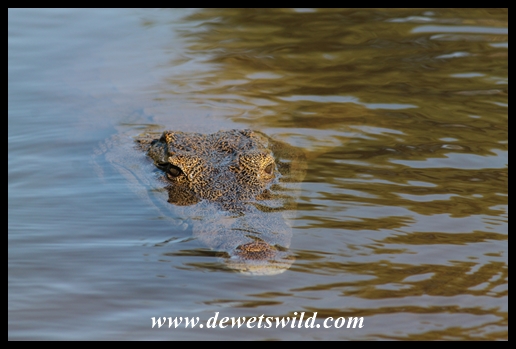
Nile Crocodile

Crocodylus niloticus

One of Africa’s most dangerous animals, the Nile Crocodile is also by far the largest and one of the most widespread reptiles found on the continent. Adults measure on average around 3.5m long , but the largest accurately recorded specimen (from Tanzania) had a length of 6.45m and weighed 1090kg!

Nile Crocodiles inhabit rivers, marshes, lakes, lagoons and estuaries, and even venture out to sea at times. From hatching crocodiles are entirely carnivorous, feeding at first on small fish, insects, crustaceans and frogs. Fish also make up about ¾ of the diet of adult Nile Crocodiles, though they are capable of drowning animals up to the size of an adult buffalo when the opportunity presents itself! Such a large meal can sustain the crocodile for many weeks. When a meal is too large to swallow in one gulp, Nile Crocodiles will take a large bite and then spin their bodies in the water to tear a mouthful of flesh from the carcass. We’ve also seen Nile Crocodiles using their bodies and tails to trap schools of fish against the bank and pick off their hapless prey one at a time.

Often living in close proximity to sizable human populations, it is no surprise that Nile Crocodiles are responsible for hundreds of human deaths annually, especially when people are directly reliant on waters inhabited by crocodiles for their daily needs (fetching drinking water, fishing, washing clothes, bathing, etc).

At times, Nile Crocodiles can congregate in huge numbers, especially when water resources dwindle during the dry season or at a favourite nesting area. They are surprisingly fast on land, and capable of running at up to 17km/h! By day they like to bask in the sun on a rock or sandbank with their mouths wide open when they start to overheat, preferring to stay in the water at night. They hunt mostly at dawn and dusk, approaching prey on land with only their nose and eyes breaking the surface of the water.

Adult male Nile Crocodiles are territorial, and often get involved in deadly battles with other males. In South Africa the mating season stretches through winter, with the females then moving to a favourite, suitably sunny spot high enough above the floodline, to dig their nest –  a hole in the sand between 20 and 45cm deep. Here she lays up to a 100 eggs, which she then covers again with sand. She diligently guards the nest for the next three months until the eggs hatch. The hatchlings call out to their mother, who digs them out and moves them, very carefully, to the water in her mouth. She looks after them for another 2 to 6 months in a nursery area, which is usually a densely vegetated stretch of water (they feed themselves from hatching). The eggs and hatchlings are a delicacy for a wide range of predators both on land and in the water, and despite the mother’s best efforts only about 2% of eggs laid reach maturity. The temperature at which the eggs are incubated determines the sex of the babies – lower temperatures produce females. Young crocodiles spend much of their time out of the water catching insect prey. It is estimated that Nile Crocodiles can live to an age of 100 years in the wild.

The IUCN lists the Nile Crocodile as “lower risk / least concern“, and while the species is threatened by habitat loss, environmental poisoning and poaching their numbers across their distribution range are estimated at between 250,000 and 500,000. It is found from the upper reaches of the Nile in Egypt, and most of West Africa south of the Sahara, southwards through Equatorial and East Africa to Angola in the West and to South Africa’s east-flowing rivers from the Tugela nortwards. They are also found on Madagascar and farmed for their meat and leather in several countries. In South Africa wild Nile Crocodile populations are considered to be vulnerable. The country’s largest wild populations are to be seen in the iSimangaliso Wetland Park and Kruger National Park, while the Crocodile Centre on the outskirts of the town of Saint Lucia in Kwazulu-Natal is a must visit for anyone interested in this species as well as the two other African species of crocodiles (few authorities have as yet recognised the West African Crocodile (C. suchus) as a seperate species).


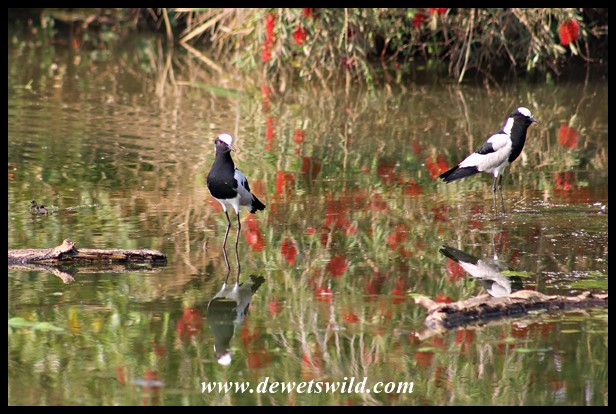
Blacksmith Lapwing

Vanellus armatus

Blacksmith Lapwings inhabit grasslands (dry or wet), mud flats or agricultural fields, golf courses and sports fields, almost always within a kilometre or two from a reliable water source, and feed on insects, worms and aquatic invertebrates. They are usually seen alone or in pairs, though they do at times congregate in flocks that number a hundred or more in response to a locally abundant food supply, especially outside the breeding season. Blacksmith Lapwings get their name from their call, which sounds almost like a blacksmith’s hammer hitting an anvil, and weigh around 160g with a wingspan just short of 80cm.

While they may breed throughout the year, nesting in this species reaches a peak at the end of the dry season in South Africa. Pairs nest well away from others of their kind and are highly territorial during the breeding season. The nest is a shallow scrape out in the open on the bare ground or among short grass, and near water, lined with vegetation, stones or mud. Both parents incubate the clutch of 1-4 eggs for around 4 weeks. Breeding birds will aggressively defend their eggs and chicks against anyone or anything that venture too close. The hatchlings fledge at about 40 days old, and then become independent about a month later.

The Blacksmith Lapwing has an increasing population distributed over much of Africa south of the equator and is considered of least concern by the IUCN. It can be found almost anywhere in South Africa.

Cape Robin-Chat

Cossypha caffra

Most South Africans would be very familiar with the confiding little (28g) Cape Robin-chat – it was after all voted South Africa’s favourite bird!

Cape Robin-chats have adapted very well to human habitation, being extremely common in suburbs and around farmsteads. They occupy a wide range of natural habitats; from arid Karoo thicket vegetation along water courses to the edges of forests and suitably dense montane vegetation, from whence some birds move to lower altitudes during harsh winters. Cape Robin-chats search for food on the ground, amongst dense vegetation or out in the open, feeding on invertebrates, tiny frogs and reptiles, fruits and seeds. They are very fond of their daily splash bath, and are excellent at mimicking the songs of dozens of other birdspecies. They are usually seen singly or in pairs.

Pairs are monogamous and most hold their territories for years on end. The cup-shaped nest is usually built low in a dense bush. Breeding reaches a peak in spring. Clutches contain 2 or 3 eggs and are incubated by the female for between 14 and 19 days. Both parents feed the chicks until they fledge at about two weeks old and then for another few weeks more. The maximum recorded life span of a Cape Robin-chat is over 17 years!

The Cape Robin-Chat is a common resident in every South African province, though they are very patchily distributed north of our borders into East Africa, and with an apparently large and stable population is considered of least concern by the IUCN.

Water Thick-knee

Burhinus vermiculatus

The Water Thick-knee, or Water Dikkop, is a nocturnal bird species inhabiting riverbanks, lake shores, swamps, estuaries and occasionally beaches with sufficient cover in the form of shrubs and bushes. By day they hide in deep shade near the water. Their diet includes invertebrates like insects, crustaceans and molluscs, tadpoles and frogs, and seeds. They weigh about 300g, with a wingspan of about 75cm.

Outside of the breeding season the Water Dikkop congregates in groups of up to 30 birds. The breeding season usually coincides with the end of the dry season, preferring to nest on sand bars in low-flowing rivers or on the shores of other water bodies. The nest is just a scrape in the ground, usually adjacent to a rock, piece of driftwood or other similar structure, but the eggs and chicks are superbly camouflaged. 1-3 eggs are incubated by both parents for just over 3 weeks, with the chicks fledging at about 2 months old.

The Water Thick-knee has a wide, albeit patchy, distribution over Sub-Saharan Africa and is listed as Least Concern by the IUCN. In South Africa the species occurs along the coast of the Cape Provinces, through large parts of Kwazulu Natal, into the Lowveld of Mpumalanga and Limpopo Provinces, along the Limpopo Valley and south along the course of the Crocodile River into Gauteng.

Pied Kingfisher

Ceryle rudis

The Pied Kingfisher can be expected at almost any body of fresh or brackish water, and at times even at tidal pools, with suitable perches as vantage points from which it can hunt fish, tadpoles, frogs, crustaceans and aquatic insects, often hovering above the water before launching a diving attack. Large prey is pounded repeatedly against a favourite perch to kill it and soften it up before swallowing. They are usually seen in pairs or small family groups and have been recorded up to 5km from the nearest land over the open water of large lakes. With a weight of up to 110g, and a length of up to 25cm, it is the second biggest kingfisher found in South Africa.

Though nesting has been observed throughout the year, the breeding season of the Pied Kingfisher peaks in spring, when pairs nest in burrows of up to 2.5m long that they dig themselves in earth banks, with up to 7 eggs laid in a wide chamber at the end. Incubation takes about 18 days and is mainly the female’s responsibility. The chicks stay in the nest for another 3 to 4 weeks and then start to learn to hunt, becoming independent by about 3 months of age. Usually a pair has helpers from previous broods assisting in the feeding of the present clutch.

The IUCN considers the Pied Kingfisher to be of least concern, thanks to its wide distribution over Sub-Saharan Africa, the Middle East, Indian Subcontinent and South-East Asia. It may be one of the three most numerous kinds of kingfishers, but some populations however are in decline due to poisoning and habitat loss, while others are thriving. In South Africa they are commonly found from the Western Cape and along the coast and adjacent interior of the Eastern Cape, through Kwazulu-Natal into Mpumalanga, Limpopo, Gauteng, North West and the Free State. They also occur along the length of the Orange River in the otherwise arid Northern Cape.

Reed Cormorant

Microcarbo africanus

Reed Cormorants inhabit most freshwater habitats, with the exception of fast flowing rivers, preferring quiet, sheltered, shallow and well vegetated water bodies where they hunt underwater, primarily for fish as well as frogs, crustaceans and molluscs, either singly or in small groups.

Reed Cormorants are diurnal, being most active in the early morning and late afternoon. At night they roost in large communities, often mixed with other species. The Reed Cormorant is subject to some nomadic movements in response to fluctuating water levels. It is a relatively small cormorant, with a wingspan of 85cm and a weight of about half a kilogram. They often rest with wings outstretched to dry.

Reed Cormorants often breed in groups of 1 – 50 pairs in mixed-species colonies with herons, ibises and other cormorants. They nest at any time of year, though there is a peak in spring and summer. Their nests are built of twigs and other vegetation over water, either in trees or reedbeds or on cliffs, and clutches contain 1 – 6 (usually 3 or 4) eggs that are incubated by both parents for just over 3 weeks. The chicks become independent at about two months of age.

The Reed Cormorant occurs widely across Sub-Saharan Africa and Madagascar, and is considered as being of least concern by the IUCN, despite a declining population as a result of persecution by fish farmers and disturbance by human activities. In South Africa they can be found in all provinces, even occurring in the arid Northern Cape along the courses of the Orange and Vaal Rivers and their large tributaries.

White-bellied Sunbird

Cinnyris talatala

An inhabitant of open woodlands, riparian thickets, bushveld and suburban gardens, the tiny (6-9g) White-bellied Sunbird feeds mainly on nectar from a variety of flowers, although insects and other invertebrates also makes up a sizable portion of its diet.

White-bellied Sunbirds breed throughout the year, with a peak in spring and summer. The nest is built by the female, of dry plant material bound together by spider web, often in a very thorny plant or near a wasp nest. The female is also singly responsible for incubating the clutch of 1-3 eggs for about two weeks, but both parents feed the chicks until they fledge after another two weeks.

In South Africa, White-bellied Sunbirds occur in Kwazulu-Natal, the Free State, North West, Gauteng, Mpumalanga and Limpopo Provinces. It is also found in Angola, Botswana, Malawi, Mozambique, Namibia, Swaziland, Tanzania, Zambia and Zimbabwe, and with an abundant, stable population is regarded as being of least concern by the IUCN.

As you can see from this gallery, Joubert and I have great fun photographing the White-bellied Sunbirds visiting the Cape Honeysuckle and other flowering shrubs in our small garden.

Cape Glossy Starling

Lamprotornis nitens

Cape Glossy Starlings are a common feature of bushveld-savanna (especially thornveld) and woodland habitats in Southern Africa, and have of late become increasingly abundant in towns and suburbs where it takes advantage of discarded scraps and garden bird feeders. Its natural diet consists of fruit and insects.

They are gregarious birds, forming large flocks outside of the summer breeding season and often also associating with other kinds of starlings. Nests are built in holes in trees (or similar artificial structures, even post boxes!) and often used for many consecutive years by the same pair. Clutches are made up of between 2 and 6 eggs, incubated by the female. Mating pairs often have as many as 6 helpers assisting in the feeding of the latest brood.

The Cape Glossy Starling has a common and stable population throughout its range, which includes Angola, Botswana, Lesotho, Mozambique, Namibia, South Africa (all provinces except the Western Cape), Swaziland, Zambia and Zimbabwe, and is considered of least concern by the IUCN.

Natal Spurfowl

Pternistis natalensis

An inhabitant of woodland, savanna, riverine thickets, wooded hills and coastal forests, the Natal Spurfowl subsists on an omnivorous diet of seeds, bulbs, roots, fruit and insects, often pecking undigested items from the dung of large herbivores. They’ll also exploit agricultural fields adjacent to their preferred habitats. Natal Spurfowl weigh in at around 400g.

Natal Spurfowl move around in pairs or family groups. Nests are scraped in the ground among dense vegetation, and lined with soft plant material and feathers. Clutches contain up to 7 eggs, incubated by the female for 3 weeks. Breeding has been recorded throughout the year, with a peak in summer and autumn.

The Natal Spurfowl occurs in Botswana, Zambia, Zimbabwe, Mozambique, Swaziland and South Africa, where they can be found in the provinces of Kwazulu-Natal, Free State, North West, Gauteng, Limpopo and Mpumalanga. They are common throughout their range and listed as “least concern” by the IUCN.