Category Archives: South African Wildlife

The inhabitants of South Africa’s wild places

Southern Grey-headed Sparrow

Passer diffusus

The Southern Grey-headed Sparrow inhabits savanna, woodlands, plantations, agricultural areas and suburbs where it feeds mainly on seeds, fruit, nectar and insects and is often seen in association with other kinds of seed-eating birds, including the very similar Cape Sparrow. Grey-headed Sparrows weigh about 24g and grow to around 15cm in length.

Pairs are monogamous and usually breed well away from others of their kind, although they do form flocks outside the breeding season. Both parents work together to construct the nest, a simple aggregation of matted grass, leaves, stems, hair and feathers in holes in trees, under roofs or in the abandoned nests of other birds. The breeding season stretches from spring to autumn, reaching a peak in summer. The parents take turns to incubate the clutch of 2-6 eggs over a period of 2 weeks. The chicks leave the nest at between 2 and 3 weeks old and remain dependent on their parents for another 3 weeks or so thereafter.

In South Africa, Grey-headed Sparrows can be found in all provinces, representing a rapid range expansion aided by their ability to exploit human habitations for food and nesting. Today, Southern Grey-headed Sparrows are only absent from portions of the arid Northern Cape. Apart from South Africa they are also found in Lesotho, Swaziland, Namibia, Botswana, Zimbabwe, Mozambique, Angola, Zambia, Malawi and Tanzania. The IUCN considers this species to be of least concern.

Joubert got these Grey-headed Sparrows fighting in Satara


Striped Skink

Trachylepis striata striata

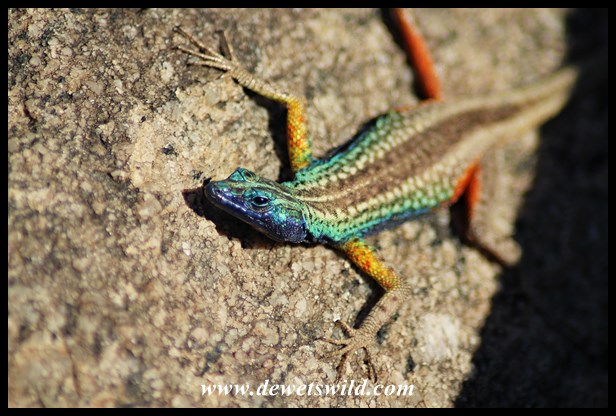
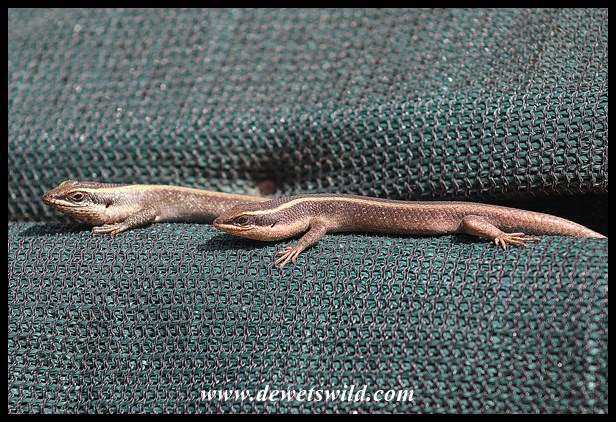
Striped Skinks are medium-sized lizards growing to 11cm long (excluding the tail, including the tail up to 25cm) and inhabiting a wide variety of habitats, from mangrove swamps to arid bushveld. They are diurnal and feed primarily on small insects and other small invertebrates which they catch among rocks or in trees. They can “drop” their tails when caught to escape predators and adults without tails, or with regrowing tails, are often seen.

Female Striped Skinks give birth to litters of 3-9 live young during the summer months.

in South Africa, the Striped Skink occurs in north-east Kwazulu Natal and the Lowveld of Mpumalanga and Limpopo. They are commonly seen in towns and game reserve camps and can become quite habituated to humans. Outside of our borders they can be found in Swaziland, Mozambique, Zimbabwe, Botswana, Namibia and northwards to Ethiopia.

Caracal

Caracal caracal

The Caracal is the biggest and arguably fiercest of the small wildcats occurring in South Africa. Males may weigh up to 22kg and stand 45cm high at the shoulder, females are slightly smaller. They inhabit every imaginable habitat in the country, from the driest desert to temperate forests. Caracals prey mainly on small and medium-sized mammals, from rodents to antelope the size of impala. They’re extremely agile and can catch birds out of the air! They’ll also take reptiles (including venomous snakes) and other carnivores, like foxes and jackals. Caracals do not require regular access to drinking water.

Caracals are mainly active from dusk to dawn, although they may hunt throughout the day in inclement weather. By day they shelter in thickets or long grass. They’re solitary animals and any groups consist of either a female with her cubs or a female in oestrus being accompanied by a male. Males are territorial and their areas overlap the home ranges of several females.

Females give birth to litters of 1-6 cubs (usually 2 or 3) at any time of year. Popular den sites include thickets, hollow trees, animal burrows and rocky crevices. The female raises the cubs alone until they become independent when they’re about 10 months old. Caracals only rarely fall prey to bigger carnivores, and have a life expectancy in the wild of between 11 and 18 years.

Overall, the IUCN considers the Caracal to be of least concern, although several specific populations in various countries are declining and range from rare to threatened with local extinction. Caracals are widely distributed through Africa (except the equatorial forests), the Middle East and into the Indian subcontinent. In South Africa they can be found in every corner of the country – even in some of our biggest cities – despite being persecuted as killers of small livestock.


Painted Reed Frog

Hyperolius marmoratus

Painted Reed Frogs, also known as Marbled Reed Frogs, are tiny little amphibians, growing to a maximum length of 33mm (females are slightly larger than males). As their name suggest, they inhabit reeds and other emergent vegetation around ponds, pans and riverbanks in forests, savanna, grassland and to a lesser extent fynbos. They feed entirely on insects and other invertebrates.

By day Painted Reed Frogs hide in dense plant material (when exposed to sunlight during the day they turn pale grey to white) to emerge at dusk, the males giving voice to their short, high-pitched chirps in large choruses in the breeding season that spans spring and summer. Females can lay several clutches of between 150 and 650 eggs in a season, roughly a month apart.  Once fertilised, their eggs are attached to submerged plants. The eggs hatch after about 5 days, and by 8 weeks old the metamorphosis from tadpole to frog is complete.

In South Africa, three races of the Painted Reed Frog is distributed from the lowveld of Limpopo and Mpumalanga, through Kwazulu-Natal and the Eastern Cape to the Cape Peninsula. They seem to be expanding their range is recent times, and at least some of this may be due to assisted translocations by humans moving plants from nurseries in their native range to other localities. Painted Reed Frogs are also found in Malawi, Mozambique, Swaziland and Zimbabwe. The IUCN considers the species to be of least concern.

Fiscal Flycatcher

Melaenornis silens

Fiscal Flycatchers inhabit open woodland, grasslands with scattered trees, scrubland, thickets, plantations, parks and gardens where they feed on insects, berries and nectar. Adults are about 18cm long and weigh around 26g.

Fiscal Flycathers are monogamous. The females are responsible for building the sturdy cup-shaped grass-nests lined with softer material, most often in thorn trees. The breeding season in this species stretches from late winter to the end of summer, reaching a peak from October to December. The female alone incubates the clutch of 2-4 eggs for a period of two weeks and is fed by the male during this time. The male however doesn’t take much of an interest in the chicks, and the female alone feeds them until they leave the nest about two weeks after hatching.

Thanks to a large and stable population, and no obvious threats, the IUCN lists the Fiscal Flycatcher as being of Least Concern. They are found only in South Africa, Lesotho and marginally into Botswana. Mozambique and Swaziland. There does appear to be a seasonal dimension to their occurrence, being more common in the warmer, lower-lying areas during the cold of winter.

Pin-tailed Whydah

Vidua macroura

The little Pin-tailed Whydah (12cm long, without the tail, and weighing only about 15g) is most known for the aggressive nature of the breeding males, which carries tails almost double their own body length and have no qualms tackling birds many times their own weight, like doves and pigeons, over a food source or territory!

Pin-tailed Whydahs are brood parasites, meaning that the female lays her eggs (usually 1 or 2 but up to 4 at a time) in the nests of other birds, mostly small seed-eaters like waxbills, for them to raise the chicks, often after removing some or all of the host birds’ eggs. A single Pin-tailed Whydah female may lay up to 25 eggs in a season. Their breeding season stretches from spring to autumn. Males are polygamous and highly territorial. The chicks hatch after about 11 days of incubation and leave the nest at about 3 weeks old, staying with their host family for about another week before joining a Whydah group.

Their habitat ranges from savanna, grassland, reedbeds and scrublands to suburban parks, orchards and gardens. They feed mostly on seeds and termites. In South Africa they occur in all our provinces, though they’re rather sparsely distributed in the arid Northern Cape, while outside of our borders Pin-tailed Whydahs occur over most of the continent south of the Sahara. The IUCN considers the Pin-tailed Whydah to be of least concern.

Temminck’s Courser

Cursorius temminckii

Temminck’s Courser inhabits open savannas with a covering of short grass, favouring recently burned or overgrazed areas as well as recently ploughed fields, where it is easy to capture their insect prey. These are the smallest species of courser in Africa, with a wingspan of 42cm, length of around 20cm, and a weight of about 70g.

Temminck’s Coursers are diurnal and usually seen in small, loosely associated flocks of around 12, though up to 40 in a group have been recorded. They breed almost throughout the year with a distinct peak in spring. Pairs are monogamous and both parents incubate the clutch of two eggs which is simply laid on the bare ground. Chicks are precocious and start moving around with their parents hours after hatching, and able to fly by the time they’re 3 weeks old.

The IUCN considers Temminck’s Courser to be of Least Concern, and it is found in two large parts of Africa – one in West Africa south of the Sahara and the other from Ethiopia southwards to Angola and South Africa. In our country they can be encountered mainly in the central and northern provinces – Free State, North West, Gauteng, northern Kwazulu-Natal, Mpumalanga and Limpopo.

South African Shelduck

Tadorna cana

South African Shelducks inhabit bodies of fresh water, ranging from small seasonal pans and farm dams to large impoundments, mostly in fairly arid areas or areas of open grassland. They grow to a length of 60-65cm and weigh between 0.7 and 2.2kg, and are often found alongside the slightly larger Egyptian Goose with which they could be confused. They’re active both during the day and night, searching mainly for vegetable food (including agricultural produce) although they will also consume crustaceans and the like when the opportunity arises.

In early summer South African Shelducks congregate in enormous flocks of up to 5,000 on large dams and lakes for their flightless moulting phase. After this they disperse into solitary, territorial, monogamous pairs (which often hold for many years) for the breeding season which mainly stretches from April to September. They usually nest in abandoned animal burrows, mostly those dug by aardvarks, porcupines or springhares, or other natural cavities, but very rarely on the open ground. Clutches of 6-15 eggs are incubated by the female only for around a month, after which both parents look after the ducklings until they become independent at between 3 and 4 months old.

South African Shelducks are only to be found in Namibia, a small part of Botswana, Lesotho and South Africa, where they can be seen at suitable habitat in all the provinces except Limpopo, eastern Mpumalanga and the northeast of Kwazulu-Natal. The IUCN lists the species as being of least concern and, although they’ve greatly expanded their range and numbers thanks to artificial water bodies laid on in arid areas, the population may be facing pressure from human disturbance as well as a decline in aardvark populations and the resultant diminishing of available nesting sites.

Lesser Bushbaby

Galago moholi

The Lesser Bushbaby, or South African Bushbaby, is by far the tiniest primate occurring in South Africa. These cute little furballs weigh only about 150g and grow to a length of around 35cm, including their tail.

Lesser Bushbabies inhabit savanna habitats, especially those dominated by thorn trees and mopane. They feed on tree gum, fruit, berries, blossoms, insects and even small vertebrates from time to time.

Being exclusively nocturnal, Lesser Bushbabies spend the day in nests constructed of leaves, in hollow tree trunks, in abandoned bird nests or the roofs of buildings. These nests are shared by groups numbering 2-8, though they mostly forage alone. These groups are territorial and mark their home ranges by urinating on their hands and feet. They are almost exclusively arboreal and amazingly agile, being capable of jumps over 2m high and over 5m long!

Litters of two tiny 9g babies (1 or 3 in a litter is most unusual) are born in summer. The babies grow very quickly and become independent when they’re only 2 months old. Lesser Bushbabies have a life expectancy of around 10 years in the wild, and are a favoured prey of owls, genets, pythons and other carnivores.

The IUCN lists the Lesser Bushbaby as being of least concern. They occur widely in the savanna areas of Africa south of the equator, and in South Africa specifically can be found in the provinces of North West, Gauteng, Limpopo and Mpumalanga.

Water Monitor

Varanus niloticus

The Water, or Nile, Monitor is one of the three largest lizards occurring in Africa, growing to a total length of up to almost 2.5m and a weight of up to 15kg or more!

As its name suggests, this enormous lizard is very much at home in aquatic habitats (streams, rivers, pans, lakes, dams, marshes, etc.) and is an excellent swimmer, often diving beneath the water surface to hunt for prey or escape enemies. They feed predominantly on crustaceans and molluscs, but will also prey on insects, frogs, fish and the eggs of birds, tortoises and crocodiles. They’re often seen basking in the sun on rocks or logs close to the water and are very good climbers, often hibernating in the tops of trees in temperate regions like South Africa. When cornered they lash out with their long, muscular tails in self-defense, often inflicting serious damage to any bold attacker.

After the first spring rains, females dig holes in occupied termite mounds in which they lay between 20 and 60 eggs. The termites then fix the nest and the monitor eggs then develop inside it at a constant temperature and humidity. The eggs can take anything between 6 months and a year to hatch, with the young then digging themselves out of the termite mound.

In South Africa, the Water Monitor occurs along all the river systems running to the Indian Ocean north of Port Elizabeth, as well as along the rivers making up the Orange-Vaal system running to the Atlantic. North of our borders they occur widely in sub-Saharan Africa and along the Nile River into Egypt. Sadly they are a target species of the exotic pet trade.