Category Archives: South African Wildlife

The inhabitants of South Africa’s wild places

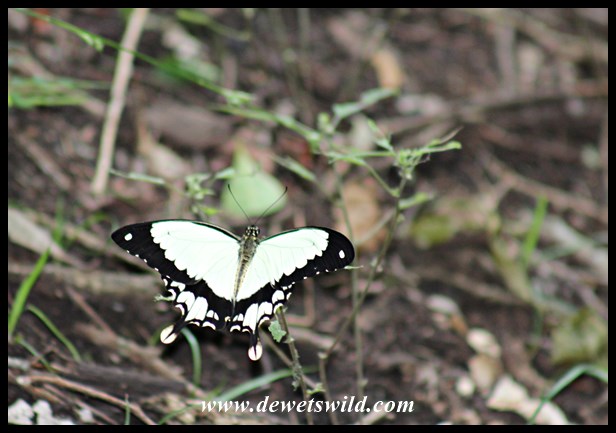
The Flying Handkerchief / Mocker Swallowtail Butterfly

Papilio dardanus

Not only is the Mocker Swallowtail one of the biggest and most beautiful butterflies to be found in South Africa, but it can also be one of the most confusing! The males, also known as Flying Handkerchiefs, boast extravagantly shaped wings with striking black and cream-white markings, while the females are excellent at mimicking at least 14 other species of foul-tasting or poisonous butterfly across their sub-Saharan African distribution, with their comparably larger size usually the best clue to their true identity. Adults have a wingspan measuring up to 11cm and fly throughout the year, though much less numerous in the cooler months.

The Mocker Swallowtail inhabits riverine, montane and coastal forests. In South Africa it is commonly found from the Garden Route, through Kwazulu-Natal and along the escarpment of Mpumalanga and Limpopo to the Soutpansberg range.

Larvae feed on a wide range of food plants from the Rutaceae family which includes citrus plants. The feminine progeny of a single female can metamorphose into a variety of mimic forms and don’t necessarily all look like their mother. Larvae grow quickly and complete their transformation within a few weeks.

Cinnamon-breasted Bunting

Emberiza tahapisi

Cinnamon-breasted Buntings, or to call them by a previous colloquial name Rock Buntings, inhabit stony and rocky slopes and hillsides, rocky outcrops, dry rocky streambeds, bare stony patches and even abandoned quarries and borrow-pits in woodland, savanna and grassland, and are regularly seen foraging on road verges. They are mainly seed-eaters but include a fair number of insects in their diet, and require regular access to drinking water.

Usually encountered singly, in pairs or small groups of three or four, it is highly unusual to find larger congregations of Cinnamon-breasted Buntings. They breed during spring and summer, forming monogamous pairs that build cup-shaped nests at the base of grass tufts or next to a rock. Clutches of 2-4 eggs are incubated by both parents over a 2 week period. Both parents feed the chicks at the nest until they fledge about two weeks after hatching, and the chicks remain with their parents for another month or so thereafter before moving off. Fully grown, Cinnamon-breasted Buntings weigh about 15g and measure 15cm in length.

The Cinnamon-breasted Bunting has a wide distribution throughout sub-Saharan Africa, with the exception of deserts and the equatorial forest. In South Africa they’re found over most of the eastern half of the country. The IUCN considers the species to be of least concern.

World Wildlife Day 2021

What better excuse to take another look at the 83 species of South African wildlife that we featured here at de Wets Wild in the past year than World Wildlife Day?

Crowned Eagles

We were about half-way through our visit to Cape Vidal in January 2021 when we found that a pair of Crowned Eagles were rearing a chick in a tall Casuarina tree right inside the camp and very near our cabin. The eagles were very careful not to attract attention to their nest and being known for attacking humans that venture too close to their nests we didn’t hang around there too often. We therefore got very few glimpses of the chick in its treetop fortress.

Considered Africa’s most powerful eagle, capable of preying even on mammals the size of bushbuck, the Crowned Eagle is a very large bird of prey – females, the larger of the sexes, weighs up to 5kg and has a wingspan of around 1.6m.  Crowned Eagles are forest birds, but have adapted to life in exotic plantations where there’s suitable prey available. Mammals – hyraxes, monkeys and antelope – make up the majority of their dietary intake and small pets regularly feature on the menu of Crowned Eagles living in or near urban areas that fall within their distribution range.

Crowned Eagles are monogamous and form lasting pair bonds, each pair defending a large tract of forest as their exclusive territory. Their large stick-platform nests are built by both partners on cliffs or at the top of tall forest trees. These nests are usually reused for consecutive years and are continuously added to, eventually becoming massive structures up to 3m tall. Clutches of two eggs are laid in the spring months and incubated over a seven week period, mostly be the female. Unless the first laid egg doesn’t hatch the older sibling will kill the younger soon after it hatches. While the male regularly brings food to the nest it never feeds the chick, this task is always performed by the female until the chick is about a month-and-a-half old, at which point it starts feeding itself on meals brought to it by the parent birds. The chick takes its first flight around four months after hatching and is finally chased from its parental territory when it is at least ten months old.

Though occurring widely over Africa’s forested areas, the IUCN lists the Crowned Eagle as being near-threatened, siting a decreasing population of no more than 50,000 mature individuals caused by habitat destruction and persecution by humans. In South Africa they’re found from the Garden Route, through the Eastern Cape and Kwazulu-Natal, to the escarpment of Mpumalanga and Limpopo, the Soutpansberg  range and the Pafuri region of the Kruger National Park.

Summertide Diary: Exploring Wilderness and surrounds

21 December 2020

It pays to be out early in South Africa’s wild places, and the Wilderness section of the Garden Route National Park is no exception. Even when the sky is still heavy with rain and the sun nowhere to be seen.

After breakfast we felt like exploring a little further afield, and so headed to the Woodville indigenous forest a few kilometers away from Ebb-and-Flow. We explored the wet forest, marveled at the enormous Outeniqua Yellowwood that rules over it and kept a lookout for birds and other creatures trying to hide from us, until we could stand the pestering mosquitoes no more!

From Woodville we extended our joy ride to Rondevlei and the Swartvlei beach, and then had a quick look around the holiday town of Sedgefield, of which I have many happy childhood memories, before heading back to camp.

Just being outside at Wilderness was such balm for the soul. You don’t always have to be out chasing the “hairy and scary” animals for which Africa is famous to enjoy yourself in our wild places…

More frog hunting before bed-time resulted in these photographs of Raucous Toads:

If you’d like to read more about the Wilderness section of the Garden Route National Park, please have a look at this special feature about it that we published a while ago.

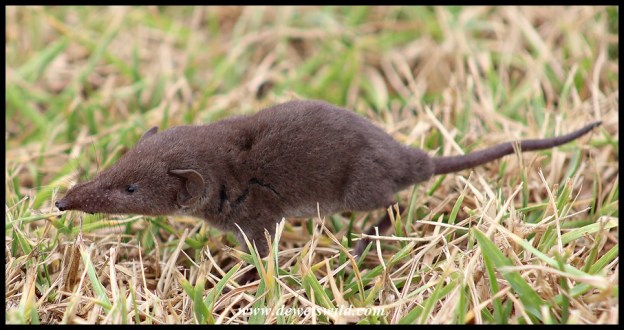
Greater Red Musk Shrew

Crocidura flavescens

One of the real highlights of our visit to the Wilderness section of the Garden Route National Park was an encounter with a rarely seen small mammal: a Greater Red Musk Shrew.

Although it is tiny, weighing only about 30g, the Greater Red Musk Shrew is one of the biggest members of the shrew-family occurring in South Africa. We found the shrew next to a reed bed along the Touw River – typical habitat for the species, although they do occasionally venture into gardens and houses. Greater Red Musk Shrews are insectivores, feeding on a wide range of insects, worms and other invertebrates, and like other shrews have a relatively enormous appetite needing to consume at least half its own weight on a daily basis.

These cute creatures are mostly nocturnal, so we count ourselves very lucky seeing one in daylight (although heavily overcast) and out in the open. By day they hide in grass-nests built slightly above ground level in dense grass cover.

Females give birth to up to 7 young after a gestation of only a month, mainly in the summer months. The babies follow their mother around from 6 days old by forming a “train” nose-to-tail with their siblings. Like other shrews they live extremely fast-paced lives – the young are weaned at only 3 weeks old, reaching sexual maturity when they’re 2-3 months old and then have a life expectancy of maximum 18 months!

The IUCN considers the Greater Red Musk Shrew to be of least concern in conservation terms. It is almost endemic to South Africa, occurring all along our coast from Namaqualand to Maputaland and into extreme southern Mozambique and also along the Drakensberg through Lesotho and eSwatini to the escarpment in Mpumalanga.

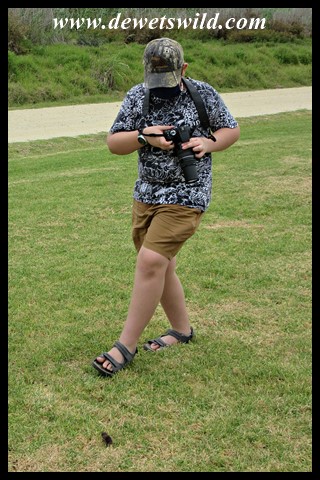
Joubert photographing the Greater Red Musk Shrew at Wilderness

Summertide Rambles 28 December 2020

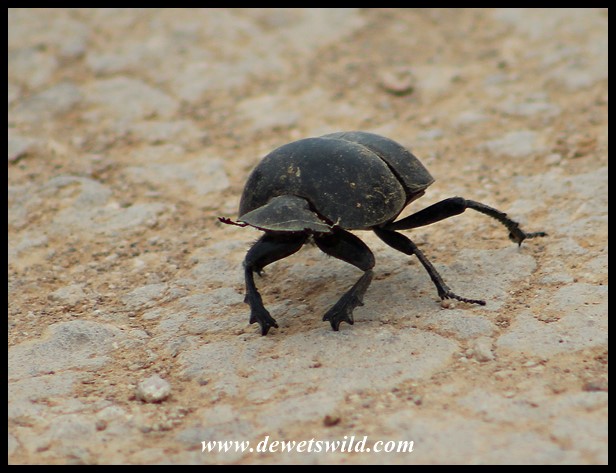
With it being a rather hot day in the Addo Elephant National Park today another of the Park’s star attractions – the Addo Flightless Dung Beetle – were out in their numbers gathering food for their progeny.

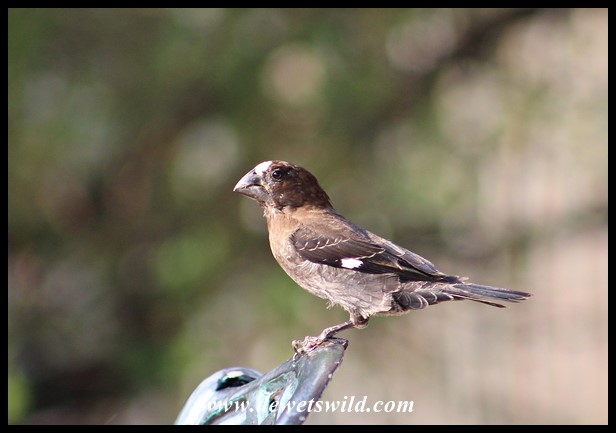
Thick-billed Weaver

Amblyospiza albifrons

During the breeding season, which extends through spring and summer, Thick-billed Weavers can be found near and in marshes and other wetlands with rank grass and reedbeds, but they roam more widely at other times and are then found from forest edges to suburban parks and gardens. They use their strong bills (ask anyone who’s ever handled a Thick-billed Weaver) to good effect feeding on fruit, pips and seeds. They’re one of the largest species of weaver in South Africa, measuring 18cm in length and weighing up to 50g.

The males alone construct the colony of characteristic dome-shaped nests anchored to two or more reeds or thick-stemmed, tall grasses, while the female, if she accepts the nest, will line the inside with soft materials. Males attempt to attract and mate with as many females as possible. The female lays a clutch of 2-4 eggs which she incubates by herself over a two week period. She’s also the sole caretaker to the chicks, which leave the nest about 3 weeks after hatching.

The Thick-billed Weaver has a very patchy distribution over sub-Saharan Africa and the IUCN considers it to be of least concern, siting a common and apparently stable population. In South Africa they’re found in the wetter eastern and northern provinces, and absent from most of the Free State and the Northern and Western Cape. They’ve actually expanded their distribution considerably in recent years due to the availability of suitably vegetated artificial wetlands, like sewerage treatment installations, being constructed.

Brown Hyena

Parahyaena brunnea

Brown Hyenas are found in a wide selection of habitats, occurring from moist mountain grasslands to desert coastlines (earning them their old Afrikaans name “Strandwolf”, translating as “Beach Wolf”). They’re often found near rocky hills, these providing shelter in the form of dense vegetation and caves, but where this isn’t available they will use burrows dug by themselves or other animals as dens. Brown Hyenas feed mainly on carrion, ostrich eggs and wild fruits, with prey they catch themselves making up only a very small percentage of their total dietary intake. They are not dependent on surface water but will drink where and when it is available.

Territorial family groups, known as clans, are the principal social grouping in Brown Hyena society. These number up to 18 individuals, though around 7 is more usual. Adult males are nomadic and move from one clan to the next, mating with receptive females. Territories are marked with dung and scent glands and neighbouring clans will get involved in serious fights over territory. Brown Hyenas are mostly nocturnal and most active just after sunset and just before sunrise. They may cover enormous distances on their nightly excursions in search of food.

Female Brown Hyenas give birth to 1-5 tiny cubs at any time, approximately 3 months after mating. Females look after the cubs by themselves for the first 2 to 3 months after birth, before introducing them to the rest of the clan. While they start eating solid food from 3 months old, the cubs are only weaned at about a year of age. At about 15 months old the cubs are big enough to fend for themselves. Fully grown Brown Hyenas weigh around 45kg and stand about 80cm high at the shoulder, males being only slightly larger than females. Brown Hyenas have a life expectancy of up to 25 years in the wild, though larger predators are a considerable threat.

Much rarer and less well known than the larger Spotted Hyena, the Brown Hyena is also the hyena species with the most limited distribution. The IUCN estimates that there’s a total of between 4,300 and 10,100 adult Brown Hyenas left in the wild (half of which in Botswana), and evaluates its conservation status as being near threatened. The biggest threats to their continued survival is persecution by livestock farmers and habitat loss. While they occur at low densities almost all over South Africa, with a population estimated at probably no higher than 2,200 within our borders, the best places to go looking for Brown Hyenas in South Africa in our experience is the Kgalagadi Transfrontier Park and Pilanesberg National Park. Apart from South Africa and Botswana, Brown Hyenas are also found in Angola, Namibia and Zimbabwe, while it is doubtful any remain in Lesotho, eSwatini (Swaziland) and Mozambique.

Little Sparrowhawk

Accipiter minullus

It might be the smallest member of the genus Accipiter (comprising 51 species of sparrow- and goshawks)  but the Little Sparrowhawk isn’t a raptor that ought to be underestimated, especially if you are a small bird (up to the size of doves), rodent, bat, lizard or frog – small vertebrates making up the bulk of their diet. They hunt by ambushing prey from dense foliage, striking swiftly and acrobatically. Due to their small size and adeptness at hiding, the Little Sparrowhawk is easily overlooked. They prefer dense habitats, inhabiting a range of forest, thicket, woodland and riverine plant communities.

Little Sparrowhawks are monogamous and pairs defend a territory. The female builds the nest, which is little more than a platform of sticks and leaves, high in the fork of a large tree. They breed mainly in the spring season, laying 1-3 eggs that are incubated by both parents in turns for approximately a month. The chicks grow quickly and leave the nest by the time they’re a month old, but they remain in their parents’ territory until the next breeding season before they disperse. Fully grown, female Little Sparrowhawk weighs just 100g (males are about a quarter smaller still) and measure 25cm in length.

The Little Sparrowhawk occurs from Ethiopia and Eritrea southwards through most of central and eastern Africa all the way to South Africa, and its conservation status is listed as “least concern” by the IUCN. In our country they can be found from the coastal Eastern Cape, through most of Kwazulu-Natal and into Mpumalanga, Limpopo, Gauteng and North West Province.