Category Archives: South African Wildlife

The inhabitants of South Africa’s wild places

Puku

Today, on Endangered Species Day, we feature another African mammal that isn’t indigenous to South Africa.

Kobus vardonii

The Puku is a medium-sized antelope, with rams standing about 90cm tall at the shoulder and weighing around 75kg. The ewes are considerably smaller. They’re particularly picky about their habitat, always having to be within easy reach of water and preferring the limited areas of grassland wedged between rivers or marshes and the surrounding woodland on higher ground. Pukus are almost exclusively grazing animals and they’re most active at dawn and dusk.

Puku ewes and their lambs live in rather unstable herds numbering up to 50, though usually much smaller, passing through the territories of mature rams which try to keep the herd in his area so he may mate with any receptive females. Rams that aren’t able to compete for territory come together in bachelor herds. Ewes give birth to a single lamb at any time of year, with a peak during the drier months, after an 8 month gestation.

Given a clearly declining and fragmented population the IUCN considers the Puku to be near threatened. The population on the Chobe river floodplain, confined to Botswana’s Chobe National Park, likely numbers less than 200. It was therefore a real thrill for me to see wild Puku on a visit there in 2024, during which these pictures were taken. They’re also found in pockets of Angola, Zambia, the DRC, Malawi and Tanzania.


Gabar Goshawk

Micronisus (Melierax) gabar

The Gabar Goshawk is a raptorial bird that live in open woodlands, especially where Vachellia thorn trees dominate the vegetation. Small birds make up the bulk of their diet, though they will also occasionally catch rodents, reptiles and large insects.

Like many other birds of prey adult Gabar Goshawks are usually bonded in monogamous, territorial pairs. They normally nest from mid-winter to early summer. During this time the female takes about a month to build the stick-platform nest in a large tree before laying her clutch of 2-4 eggs. She also does most of the incubation duty, which takes about 5 weeks, and then stays with the hatchlings for around 3 weeks while the male brings food to the family. The chicks eventually leave the nest at about 5 to 6 weeks of age but remain dependent on their parents for at least another month thereafter.

According to the IUCN, the Gabar Goshawk is of least concern. They occur widely over sub-Saharan Africa and in our country occurs in parts of every province.

Giant Mantis

Sphodromantis gastrica

The Giant Mantis, also known as the African Mantis or the Common Green Mantis, is an imposing insect, growing to up to 7cm in length. It is a very common mantid species and occurs in practically every corner of South Africa, being as at home in our gardens as it is in more natural surroundings. They are excellent ambush hunters and feed on invertebrates – they are especially fond of caterpillars – but occasionally even bigger prey, like small frogs and geckos, gets their attention.

As in many other kinds of praying mantis the males of the Giant Mantis may be unlucky enough to be eaten by the female, starting at his head, during or after copulation! The female deposits as many as 100 eggs in a soft cocoon-like egg case, with the babies then hatching at the onset of the spring season. There is no parental care whatsoever and the hatchlings disperse quickly to avoid being cannibalised by their parent or siblings. If they make it to adulthood they may live to about a year old. Females are much more plump than males.

Southern Pied Babbler

Turdoides bicolor

Southern Pied Babblers inhabit drier savanna woodland and thornveld habitats, subsisting on a diet of insects and other arthropods supplemented by small invertebrates like geckos, lizards and frogs, and apparently do not have any requirement for surface water to drink. They usually forage in groups of 3 to 15, often alongside other kinds of birds, taking turns to keep watch for danger. They also breed cooperatively, usually during spring and summer, with all group members helping to build the nest and feed the clutch of up to 5 hatchlings that hatch after two weeks of incubation. While the chicks fledge before they’re 3 weeks old they will be provided food by other group members until they’re about two-and-a-half months old.

The Southern Pied Babbler occurs only in Namibia, Botswana, south-western Zimbabwe and South Africa (Limpopo, Gauteng, North West and the Northern Cape). According to the IUCN it is considered to be of least concern, despite a declining population.

Serval

Serval

Leptailurus serval

The long-legged Serval is a wild cat that inhabits areas with long grass, usually near water, marshes and reedbeds. They feed mainly on rodents but will prey on anything from insects to birds, reptiles, amphibians and mammals up to the size of small antelope. Servals mostly hunt on the ground, leaping spectacularly – up to 3m high and 4m long – to stun their prey from above, being successful in about 50% of their attempted hunts and killing on average 16 animals per day.

Servals weigh about 10kg and stand around 55cm high at the shoulder. Males are slightly larger than females.

Like most felids Servals are active from dusk to dawn, taking refuge in dense vegetation, holes, among boulders and even occasionally up in trees during the day. They’re usually seen alone unless when a pair is mating or when a female moves around with her kittens. The extent to which both males and females are territorial is not clearly understood. Servals are quite fast over short distances and given their preferred habitat it is probably no surprise that they’re good swimmers as well. Females give birth to up to 3 kittens after a 2.5 month gestation, their births coinciding with periods during which rodent numbers are likely to peak. The kittens may stay with their mother for up to a year though they can hunt for themselves from about 6 months of age. They may live to 19 years of age though about 12 years is more usual in the wild.

In South Africa the Serval occurs widely in all provinces except the Eastern, Northern and Western Cape, where they are spotted only occasionally following reintroduction programmes and natural range expansion. While it is considered near-threatened in South Africa, mainly due to habitat loss, the IUCN lists the Serval overall as of least concern, being found over most of sub-Saharan Africa with the exception of the tropical rain forests and the arid Kalahari and Namib deserts. An isolated population in Morocco however is considered to be endangered.

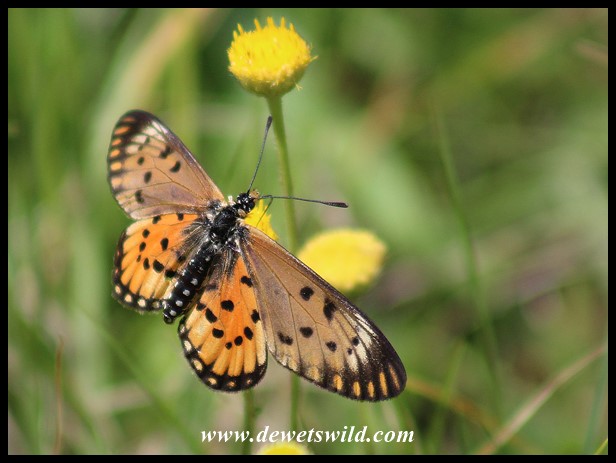
Dotted Blue Butterfly

Tarucus sybaris

The tiny Dotted Blue butterfly – it has a wingspan of only about 2.5cm – may be seen throughout the year but they’re much more numerous during spring, summer and early autumn. They fly slow and low to the ground, settling often on small flowers and muddy patches of ground. Larvae feed on the leaves of the buffalo thorn tree and its close relatives. In South Africa they are found from the Eastern Cape, through the Free State, Kwazulu-Natal, North West and Gauteng to Limpopo and Mpumalanga, indicative of their preference for grassland and savanna habitats.

Lesser Swamp Warbler

Acrocephalus gracilirostris

Lesser Swamp Warblers, as their name suggests, confine themselves to reedbeds and stands of bullrushes in a wide variety of wet habitats – marshes, estuaries, riversides and even man-made wetlands like sewage ponds. Here they feed on a wide range of invertebrates picked off the surface of the water or emergent plants.

Lesser Swamp Warblers are usually seen in pairs – they are monogamous and territorial. The female builds their conical nest using strands of reeds and other plant material, usually placing it in a well-vegetated thicket over the water. They breed through spring and summer. Both parents incubate the clutch of 2 or 3 eggs over a two week period and then feed the nestlings until they fledge about 2 weeks after hatching.

In South Africa, Lesser Swamp Warblers are found in suitable habitat throughout the country, having expanded their distribution even into arid areas thanks to artificial water bodies constructed on farms and for municipal water supply and waste water treatment. Aside from isolated populations in Nigeria and Tchad it occurs widely through the eastern, central and southern parts of the continent. The IUCN considers the Lesser Swamp Warbler to be of least concern.

Banded Martin

Neophedina cincta

Banded Martins prefer open habitats, such as grassveld, marshlands and the fynbos shrublands. They visit South Africa during our spring and summer, arriving from about September to breed and then departing again by May to their overwintering areas in central Africa. They feed on flying insects caught in flight and are usually seen in pairs or small flocks. Banded Martins nest in tunnels that they dig in aardvark burrows, stream banks or eroded gullies. Both parents care for the 2-4 chicks, which leave the nest when they’re about 3 weeks old.

In South Africa Banded Martins are commonly found on our central highlands, with a smaller concentration occurring in the Western Cape and scattered records from elsewhere. Depending on the season they roam over most of sub-Saharan Africa. The IUCN lists the Banded Martin as being of least concern and note that their population is probably increasing due to agricultural practices opening up more areas for them to utilise.

Black-chested Prinia

Prinia flavicans

A denizen of shrublands, thornveld and riverine thickets in more open areas, the Black-chested Prinia is a very active little insectivorous bird, hopping about the branches gleaning its food from among the leaves and bark of shrubs and trees. Black-chested Prinias are usually encountered in pairs and may nest at any time of year, though more usually in the spring and summer months, incubating a clutch of 2-6 eggs over a 2 week period in a pear-shaped nest woven of green grass and placed in a dense shrub. The chicks leave the nest about 2 weeks after hatching. The cuckoo finchwhich we featured a short while ago here on DeWetsWild – often parasitizes the nests of Black-chested Prinias.

The Black-chested Prinia occurs widely in north-western and central South Africa and in Namibia and Botswana, as well as in western Zimbabwe and Zambia and southern Angola. According to the IUCN it is in no danger of extinction.

African Quail-Finch

Ortygospiza atricollis

The African Quail-Finch occurs throughout South Africa, being absent only from the arid west of the country, and patchily through most of sub-Saharan Africa. Though difficult to observe up close due to their skittish nature, these highly nomadic flock-living birds are common in grasslands and woodlands with bare ground, where they feed on seeds and small insects, and usually found close to water. Their nesting season coincides with periods of high rainfall when grasses are in seed. It takes a little over 2 weeks for the clutch of up to 6 eggs to hatch. The chicks leave the nest when they’re about 3 weeks old and become self-sufficient about a month later.

The IUCN lists the African Quail-Finch as being of least concern.