Category Archives: South African Wildlife

The inhabitants of South Africa’s wild places

Satara Summer 2021 – Eastern Olive Toad

Another amphibian that we regularly encountered during our nocturnal walks though Satara in December 2021 is the Eastern Olive Toad, whose loud calls made it quite easy to find them.

Sclerophrys (Bufo) garmani

The Eastern Olive Toad occurs patchily from Ethiopia to South Africa and is considered to be of least concern according to the IUCN. It is a savanna species preferring areas with relatively high rainfall, and thus in South Africa is found in northern Kwazulu-Natal, eastern Mpumalanga and most of the Limpopo Province. By day these toads shelter under rocks and logs, in dense vegetation or termite mounds and around houses. They feed on almost any kind of invertebrate.

Females are considerably larger and measure almost 12cm long when fully grown. Breeding usually takes place in temporary pans and marshes, though they’ll also use garden ponds and farm dams, during spring and summer. Females may lay several thousand eggs, which hatch within 24 hours. The tadpoles complete their metamorphosis in 2 to 3 months.

These photographs of Eastern Olive Toads were not taken during our recent visit to the Kruger National Park in December 2021:

Satara Summer 2021 – Banded Rubber Frog

Whenever we experienced a rain shower during our December 2021 visit to the Satara area of the Kruger National Parkand this was a regular occurrence – the high-pitched calls of Banded Rubber Frogs quickly filled the air. Once the rain subsided we’d go looking for them around the camp and usually found at least a few individuals.

Phrynomantis bifasciatus

Banded Rubber Frogs occur from southern Somalia to Angola and South Africa. In our country specifically they’re found from northern Kwazulu-Natal, through Mpumalanga, Limpopo and Gauteng to the North West Province. The IUCN considers the species to be of least concern.

Banded Rubber Frogs inhabit savanna habitats, where they hide under rocks and logs, inside tree trunks or termite mounds, tunnels dug by other animals and even in and around houses and drains. They feed mainly on ants and termites, but will also include other invertebrates in their diet.  They breed in temporary pools and pans and other similarly shallow watery habitats after the first rains have fallen. Females lay between 300 and 1,500 eggs, which hatch after 4 days, in a mass of “jelly” that surrounds each egg, usually attached to emergent vegetation in the water. The tadpoles are gregarious and if they have sufficient food may complete their metamorphosis in 1½ to 3 months. Adults grow to about 6cm long.

Banded Rubber Frogs rarely jump, preferring to walk or run. When threatened they stiffen their legs and inflate their bodies, showing off their bright warning colouration to great effect. These warning colours should be heeded, for the Banded Rubber Frog can secrete cardiotoxic poisons through their skin which, if it gets into the skin or bloodstream in sufficient quantities can cause humans to experience painful swelling, nausea, headaches, and difficulty breathing. The poison can be deadly to smaller creatures.

These photographs of Banded Rubber Frogs were taken during a previous visit to Satara in 2019:

Mozambique Tilapia

To the east of Satara, the S41 gravel road crosses several streams as it winds its way over the plains. Three of these – the Mavumbye, Gudzani and Nwanetsi – usually have water, but owing to good summer rains were flowing especially strongly when we visited during December 2021. While flowing water is always a pleasing sight (and sound), crossing these streams during this latest visit was particularly enjoyable for us as it allowed a glimpse into a facet of the Lowveld ecosystem that is pretty difficult to experience while driving around in a vehicle. With the water flowing over the causeways we were able to watch large schools of juvenile Mozambique Tilapia, as well as the occasional adult, swimming around in the pools on either side of the drifts.

Oreochromis mossambicus

Naturally the Mozambique Tilapia occurs in rivers flowing into the Indian Ocean from the Zambezi River southwards to the Boesmans River and its tributaries in the Eastern Cape of South Africa. They have however been introduced to waters outside this range, both in South Africa and elsewhere in the world, as they are a highly regarded aquaculture species. Regrettably their adaptive nature means that they often outcompete indigenous fish species for food and prime breeding locations in places where they were introduced. Ironically the IUCN considers the Mozambique Tilapia to be vulnerable in its native range due to the introduced Nile Tilapia, with which it hybridizes.

Male Mozambique Tilapia are considerably larger than the females. They grow to about 40cm in length and can weigh over 3kg, though around 1kg is more usual.

Mozambique Tilapia are very adapatable and hardy, being able to live in fresh, brackish and sea water, allowing them to exploit estuaries under the influence of the ocean tides, with water temperatures in the range from below 15ºC to 42ºC. They prefer standing or slow-flowing water. These fish have a varied diet ranging from algae and other water plants to invertebrates and even small fish.

Mozambique Tilapia breed in summer, when adult males sport a deep black body colour with a white throat. The male prepares a saucer-shaped nest on a sandy bottom in which he courts the female. After spawning, the female broods the eggs and fry in her mouth until they are more capable of looking after themselves. In this way she can produce a brood every 3-4 weeks. Young Mozambique Tilapia mature rapidly and can breed within a year of hatching. They may live for up to 11 years.

The following photographs of Mozambique Tilapia were not take during the above-mentioned trip to the Kruger National Park:


Satara Summer 2021 – Ratel on the Rampage

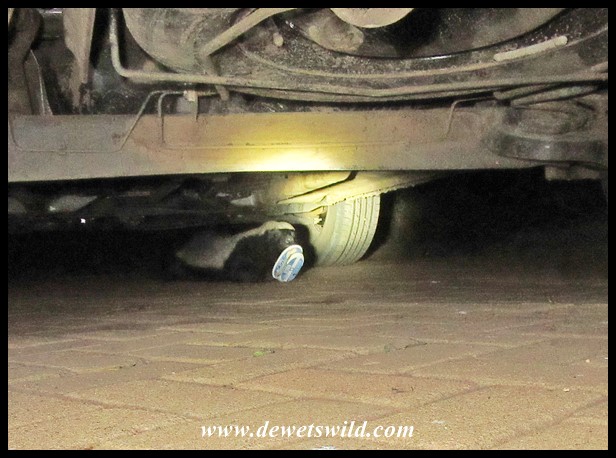
We had just retired into our bungalow at Satara Rest Camp on the night of 19 December 2021 when there was an almighty noise of rubbish crashing to the floor outside our unit. Now, it is well known that there are Honey Badgers, aka Ratels, in Satara and so I immediately knew who the culprit was. However, because we know they are there I thought that putting the rubbish bin, with a few kitchen scraps and glass and plastic bottles inside, up high on the narrow kitchenette counter would be an effective measure to prevent any nocturnal raids. This Badger was much more clever than I thought!!! He easily pulled out the three kitchen drawers containing the cooking and eating utensils and used these as a stepladder to get on top of the counter. As I opened the Bungalow door Mr. Ratel scampered away with his chosen prize clenched in his jaws, to enjoy at leisure underneath our vehicle. Now, only those with a death wish would dare tangle with a Honey Badger, so I’d gladly retrieve the empty tub of cream cheese after he’s licked it clean…

While the Badger was enjoying his morsel, we quickly deposited the remaining scraps and bottles in one of the receptacles dotted through the camp, and then set up the camera traps to capture the inevitable return of the marauder. We pushed a chair against his “ladder” as we feared the drawers wouldn’t hold for long under the Ratel’s weight. We then returned the, now empty, rubbish bin atop the counter and went back to bed. The muddy paw prints all over the counter could wait till morning… He probably smelled that the rubbish bin was empty and didn’t try to get to the top again. Our lesson learned, we didn’t leave the rubbish bin outside overnight again.

Satara Summer 2021 – Wild Parasol Flowers

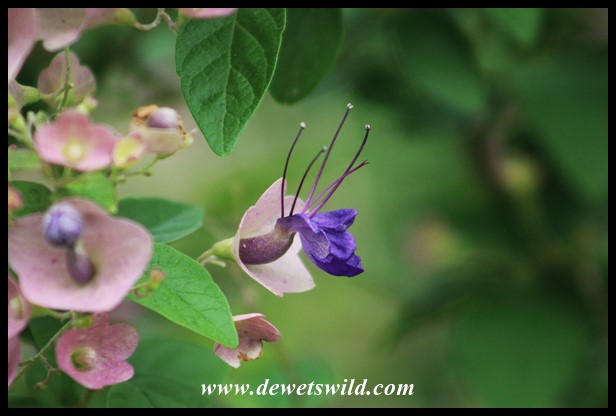
This summer the gardens in Satara were alive with the beautiful blooms of the Wild Parasol Flower bushes and the insects they attract.

Karomia speciosa

The Wild Parasol Flower is a shrub or small tree growing up to 6m tall, and usually found on rocky mountain slopes and along rivers in the bushveld regions of extreme northern Kwazulu-Natal, eastern Mpumalanga, and Eswatini. They are deciduous and carry the characteristic bi-coloured flowers from November to April. This plant is a great addition to the summer garden, but no other or traditional uses are known.

Dwarf Bittern

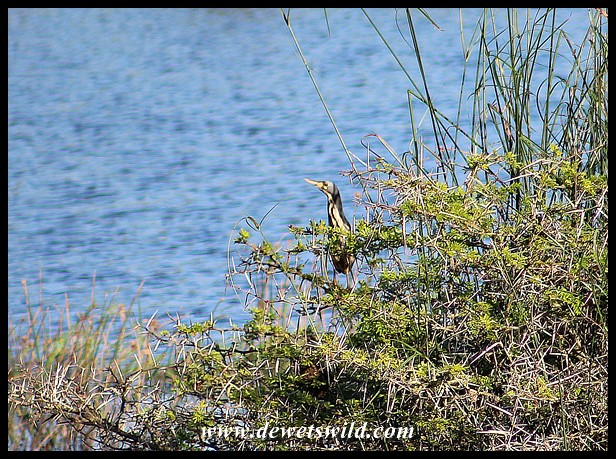
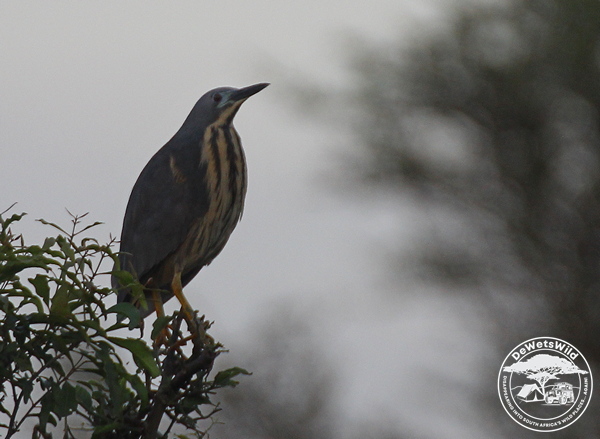
We’ve been bird-watching for quite a while now, and finding a new species for our list does not happen all that often anymore. The 15th of December therefore was a red letter day for us when we encountered this Dwarf Bittern between Lower Sabie and Skukuza in the Kruger National Park, taking our number of South African bird species seen to 588 (of roughly 973 ever recorded in this country).

Ixobrychus sturmii

The Dwarf Bittern is a small species of heron that is mostly nocturnal and found singly or in pairs. It generally occurs around seasonal and permanent water bodies surrounded by dense and emergent vegetation. They feed mainly on insects, crabs, frogs and small fish.

Dwarf Bitterns breed in periods of highest rainfall, often nesting in association with other kinds of heron. Their nests are flimsy platforms of twigs, built in a hurry by both partners. Clutches of 2-5 eggs are incubated for around 3 weeks by both parents. The chicks leave the nest before they’re 2 weeks old, although they can’t fly yet.

The Dwarf Bittern is an uncommon summer visitor to South Africa, with most records from Mpumalanga and Limpopo. It occurs in low densities over much of sub-Saharan Africa and the IUCN considers the Dwarf Bittern to be of least concern.

As luck would have it, just a few months later we found another Dwarf Bittern, this time on the Eastern Shores of Lake St. Lucia.

Dwarf Bittern

Dwarf Bittern

Koppie Foam Grasshopper

Dictyophorus spumans

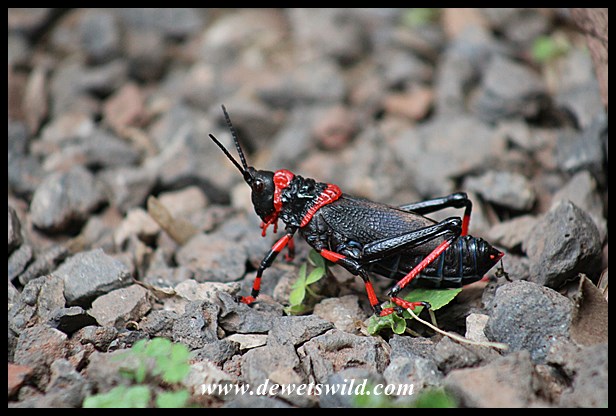
The Koppie Foam Grasshopper is a large (up to 8cm long) insect whose brilliant red-and-black colouration advertises to any would-be predator that it is poisonous enough to kill a dog. This poison is accumulated in the body tissues of the Koppie Foam Grasshopper when it feeds on poisonous plants from the milkweed family and is exuded in the form of a bloody foam when the insect is attacked. Their wings are far too short to permit flying. Koppie Foam Grasshoppers occur over most of South Africa, being absent only from Kwazulu-Natal and the eastern Free State. They live in open, sparsely vegetated and often rocky areas and are regularly encountered on hills (koppies in Afrikaans) and mountain tops.

Aiming at Diederikkies

The housing complex where we live here in Pretoria has seen a proliferation of Garden Acraea butterflies and their caterpillars over the past few weeks.

These in turn have been a boon for the Diederik Cuckoos that visit our part of the world in summer. Caterpillars are a staple for them.

An added bonus for the Diederikkies are the number of nests of Southern Masked Weavers to be found in our complex gardens. The Diederik Cuckoo is a brood parasite that is especially fond of using weavers as foster parents for their chicks. Of course this isn’t going down too well with the weavers, who frequently dive bomb any Diederikkie found exposed.

These photographs were all taken by Joubert in the past couple of days. His examinations are over and for all intents and purposes his Grade 6 year is concluded – all that he still needs to do is collect his report card and certificates. The dramas of the Diederikkies and their neighbours has been great entertainment and Joubert quickly got very adept at using both stories of our townhouse as photographic hides from which to capture their antics. Of course I am very grateful that he loves photography so much rather than vegetating on the couch with tv games.

European Bee-eater

Merops apiaster

The European Bee-eater is mainly a summer visitor to southern Africa from its breeding grounds in Asia, Europe and Africa’s Mediterranean coast. While visiting in our summer, the European Bee-eater can be found over most of South Africa, being strangely absent from most of Kwazulu Natal and the Eastern Cape though. Their melodious calls are certainly part of the summer soundtrack here in Pretoria. Interestingly there is a breeding population of a few thousand of these birds in our Western Cape Province that appears to migrate only as far as equatorial Africa during our winter months. The IUCN considers it to be of least concern, estimating a population of at least 14-million for the species, of which the vast majority is found in Africa south of the Zambezi during the austral summer.

European Bee-eaters inhabit a variety of habitats, ranging from shrubland to woodland, though it appears they avoid both the driests and wettest extremes. As both its common and Latin names suggest, it feeds primarily on bees and wasps and other flying insects. They’re social birds and almost always encountered in sizable flocks.

Most European Bee-eaters arrive here from about October and depart again by April. These slender, colourful birds nest in tunnels they excavate into sandbanks, usually as small colonies. Pairs are monogamous and incubate clutches of 2-8 eggs. The eggs hatch after 3-4 weeks and the chicks fledge when they’re about a month old.

Twin Dotted Border

Mylothris rueppellii

The Twin Dotted Border is a butterfly occurring over much of Sub-Saharan Africa. In South Africa they’re found in the savanna and forest regions stretching from the Eastern Cape through Kwazulu-Natal and into Mpumalanga, Limpopo, Gauteng and North West. Adults are seen throughout the year and have a wingspan of 5-6cm. They usually fly slow and high and are fond of settling on flowers. Females lay eggs in clusters numbering up to 100, usually on the leaves of different kinds of mistletoe which are their major foodplants. The larvae are gregarious and remain together until it is time to pupate.