Category Archives: South African Wildlife

The inhabitants of South Africa’s wild places

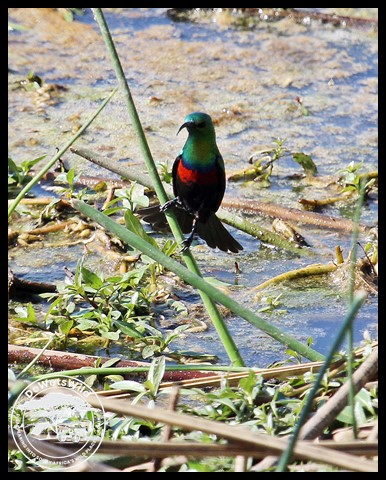
Orange-breasted Sunbird

Anthobaphes violacea

The striking Orange-breasted Sunbird is a nectar and insect-feeding bird that is endemic to South Africa’s fynbos biome, and as such occurs only in the Western Cape and western-most portions of the Eastern Cape coast. They’re mostly associated with natural stands of Protea and Erica plants, and will only occasionally visit gardens with flowering Aloe plants.

Orange-breasted Sunbirds are usually seen singly or in pairs, but they may on occasion congregate in enormous numbers at a rich food source. They may breed throughout the year, though there is a peak in nesting activity between autumn and spring. It takes the female about 3 weeks to construct the oval-shaped nest, with a side-entrance in a densely-leafed shrub, using soft materials and spider web. While the male defends the pair’s territory, the female is also solely responsible for incubating the clutch of 1 or 2 eggs for about two weeks, though both parents feed the chicks on invertebrates brought back to the nest until they fledge at approximately 3 weeks of age. The youngsters become independent about two to four weeks later. Fully grown they measure about 16cm in length but weigh only 9g.

The IUCN classifies the Orange-breasted Sunbird as being of least concern, while noting that their population is probably declining due to loss of habitat to invading alien plants.

Aardwolf

Proteles cristata

The Aardwolf (Afrikaans for “earthwolf”) is the smallest species of hyena. Adults stand about 45cm high at the shoulder and weight around 9kg. Unlike other hyenas that feed mainly on mammals carcasses, the Aardwolf’s diet consists almost exclusively of termites – they may eat between 200,000 and 300,000 termites a day! – with other insects and their larvae also featuring occasionally. Aardwolves can be found in any habitat where termites occur, from semi-deserts to densely vegetated savannas.

Although they’re normally observed singly while feeding, Aardwolves form monogamous pairs that inhabit a territory with their youngest offspring. The boundaries of the territory is marked by latrines and scent glands. They’re usually active between dusk and dawn, sleeping by day in burrows that they dig themselves or take over from other animals. All of Africa’s large predators will attack Aardwolves and so when threatened they raise the mane on their backs to make themselves look larger and more intimidating. Females give birth to 1-4 pups, usually during the wet season, and though the young are fully grown at about about 9 months of age they’d normally remain in their parents’ home range until the next litter is born. In the wild, Aardwolves have a life expectancy of about 12 years.

The Aardwolf occurs in two distinct parts of Africa. Their southern distribution area (subspecies P. c. cristata) includes all of South Africa and extends into all our neighbouring countries and as far as Angola and Zambia, while the East African range (subspecies P. c. septentrionalis) stretches from Tanzania to southern Egypt. According to the IUCN the Aardwolf is of least concern, despite not being common anywhere, and while they were previously widely persecuted as suspected predators of livestock, modern farmers understand that the Aardwolf is incapable of killing small stock and protect the species due to their important role in limiting termite populations.

Puff Adder

Bitis arietans

The Puff Adder is without a doubt one of the best known, and most feared, snakes in South Africa. Their bad-tempered reputation is well deserved as they’re responsible for about 60% of the serious bites and most of the fatalities stemming from snake bites in the country. Their long fangs inflict deep bites and yields a large volume of cytotoxic venom, causing extreme pain, swelling, necrosis, organ failure and death if not treated quickly with antivenom. Unlike most other snakes they’re unlikely to move off foot paths when a person approaches. Before striking they emit a spine-chilling hissing warning sound by inflating and deflating their body, hence the name.

Puff Adders occur throughout South Africa and most of the rest of the continent south of the Sahara, with isolated populations in Morocco and Arabia. They are able to live in almost any habitat. They’re lazy snakes, relying on their excellent camouflage to ambush passing rodents, birds and reptiles. Their strike is so fast and powerful and the fangs penetrate so deeply that smaller prey may be killed by the impact alone! They move in a straight line and enjoy basking in the sun on a warm rock or road. They’re also surprisingly comfortable in water.

At a length of up to 1.9m and weight of up to 6kg, female Puff Adders are considerably bigger than the males. In the breeding season, peaking in autumn, several males may trail a female and fight for the right to mate with her. Litters of 20 to 40 babies (record of 156 noted in East Africa, most of any snake!) are born in the summer months.

The IUCN considers the Puff Adder to be of least concern.

Streaked Sailer Butterfly

Neptis goochii

Confined to warm and humid lowland and riverine forests, in South Africa the Streaked Sailer is found only in northern coastal Kwazulu-Natal and along the escarpment of Limpopo and Mpumalanga. Adults may be seen throughout the year and have a wingspan of less than 4cm. It is a very nervous butterfly and difficult to approach, and notable for their fondness for using a conspicuous twig or leaf as a lookout point from which to launch attacks on interlopers into their territory.

Bearded Woodpecker

Dendropicos namaquus

The Bearded Woodpecker inhabits savannas and woodlands with tall trees, where it forages (it rarely descends to ground level) by tapping on branches and probing in crevices and behind bark for insects and spiders and the occasional lizard or gecko.

Adult Bearded Woodpeckers form permanent pairs that occupy the same home range year round. During the breeding season, which stretches from autumn to early summer, they both work at excavating their nest in the trunk of a tree. The nest may be between 30 and 50cm deep and it could take more than a month to complete. Here they incubate their clutch of 1-3 eggs over a period of roughly 2 weeks. Both parents feed the chicks at the nest until they fledge at about a month of age, though they may remain with their parents for a period of up to 2 months after leaving the nest. Fully grown they weigh around 80g and measure around 24cm in length, making them the largest arboreal woodpecker in the country.

The IUCN considers the Bearded Woodpecker to be of least concern. In South Africa it occurs mainly from Kwazulu-Natal, through Mpumalanga, Gauteng and Limpopo to the eastern parts of the North West Province, and beyond our borders is found as far northward as Sudan.

Cape Porcupine

Hystrix africaeaustralis

The Cape Porcupine is Africa’s biggest rodent and one of the largest rodents on earth. Females are slightly bigger than males and may weigh up to 24kg.

Cape Porcupines are strictly nocturnal and only very rarely seen during daylight – usually as a result of being molested by predators or humans. They’re commonly encountered singly or in pairs, though families of up to 14 (more usually about 6) may share a tunnel system, which they often also have to share with a wide range of other animals taking shelter there. These other animals often come off the worse for the encounter with the prickly neighbours though. Cape Porcupines may occupy tunnels dug by other animals, like the aardvark, but they are just as adept at digging for themselves. They’ll also hide in caves and in dense vegetation if need be. In a family only the two dominant Porcupines will breed, with the female giving birth just once a year to a litter of 1 or 2 young (sometimes up to 4) after a three month gestation, usually during the period of highest rainfall. They have a life expectancy of up to 20 years.

Porcupines can’t “shoot” their quills as is often believed, but they will rush backwards into an attacker with often horrific consequences. Nevertheless they’re a favourite prey item for all Africa’s large carnivores.

The Cape Porcupine occurs though almost all of Africa south of the equator and can be found in every province of South Africa, which is indicative of their ability to adapt to almost any habitat. They feed mainly on bulbs, roots, tubers and bark and will not shy away from vegetable patches and orchards. The IUCN considers the Cape Porcupine to be of least concern despite being hunted for food and as a pest over much of its range.

Foxy Emperor Butterfly

Charaxes jasius

In South Africa the Foxy Emperor Butterfly is found from the North West Province, through Limpopo, Gauteng, Mpumalanga, the northern Free State and Kwazulu-Natal to the eastern-most reaches of the Eastern Cape Province, commonly occurring in habitats ranging from forest edge to dry savanna and regularly encountered on top of hills. Adults have a wingspan of up to 9cm (females are slightly bigger than males) and may be seen throughout the year. They’re very fast fliers and are attracted to sap flowing from damaged tree trunks, rotting fruit and wet dung. The larvae feed on a wide range of plant species.

Violet-eared Waxbill

Granatina granatina

The beautiful Violet-eared Waxbill is a small seed-eating bird that occurs only in southern Africa. In our country they’re distributed from the Northern Cape to the Lowveld of Limpopo and Mpumalanga, occurring in a wide range of savanna-type habitats but being more common in the drier reaches of their range. The IUCN considers this species to be of least concern.

Violet-eared Waxbills form monogamous pairs that apparently last life-long. Both partners work on the construction of the oval-shaped nest (usually built among dense foliage in a tree or shrub) using mostly grass stems and other soft and easily pliable materials. They may breed at any time of year, though there’s a definite peak in the summer and autumn months when most kinds of grasses go to seed. Clutches may include up to 7 eggs (more usually about 4) and are incubated by both parents for about 2 weeks. The chicks grow quickly and fledge before they’re even 3 weeks old. Fully grown they weigh about 12g and measure around 14cm in length and may live to about 8 years old.

Violet-eared Waxbills are often seen with blue waxbills and are used as breeding hosts by pin-tailed whydahs.
 

Antlions

Family Myrmeleontidae

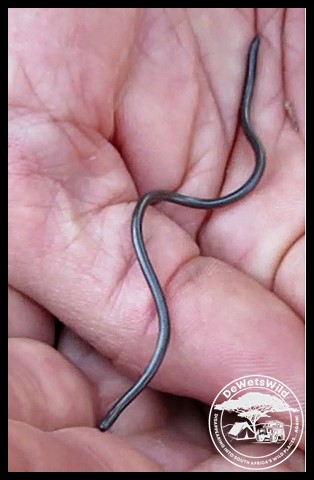
South Africa is home to at least 125 species of antlions, ranging in size from 3 to 16cm wingspan in their adult stages and appearing nothing like the alien-looking larvae that trap unwary insects – usually ants, hence the name – in their delicately constructed pits.

Actually, only a few of the local antlion species use the conical pits we associate with this group of insects to capture their prey. Most species’ larvae are free-living in sand or leaf litter where they wait for a passing insect to ambush with a quick rush. The captured insect is injected with venom and enzymes and its insides are then sucked out. The larvae is superbly adapted to surviving long periods – months in fact – without food, and may take several years to mature. When ready to metamorphose antlion larvae spin themselves a cocoon in the sand and then dig themselves out as fully-formed adults about a month later. Adults are lazy flyers, almost seeming to struggle to keep airborne, are attracted to artificial lights at night, and rarely live for more than a month after their metamorphosis.

Tigerfish

Hydrocynus vittatus

Without a doubt the most fearsome freshwater fish in South Africa, the Tigerfish is certainly well deserving of its scientific name – “Hydrocynus” being derived from the Greek for “Water Dog“.

Tigerfish live in schools in large, warm rivers and lakes. In South Africa they are found in the Phongolo River in northern Kwazulu-Natal, as well as the rivers of the Lowveld that are tributaries of the Komati and Limpopo river systems. The species is also found in almost all the major river systems of sub-Saharan Africa beyond our borders and in the Nile.

Tigerfish breed in summer, spawning on seasonally flooded alluvial plains along rivers and lakes. Fully grown females, at more than 70cm (tail excluded) in length and up to 15kg in weight, are considerably bigger than mature males who seldom grow longer than 50cm.

Tigerfish are predators throughout their lives; newly hatched fry feeding on plankton and invertebrates until they’ve grown to about 9cm in length by which time they have an entirely fish-based diet. Their ferocious teeth are continuously replaced throughout their life, which may span about 9 years. Tigerfish often fall prey to the African Fish Eagle owing to the fish’s habit of cruising close to the surface in open water searching for prey.

Tigerfish are a popular target species for recreational anglers and an important source of protein for many African communities.