Category Archives: Memorable sightings

Pondering again the allure of the waterhole

September is generally regarded as the start of the spring season in South Africa, but with the rainy season still weeks away and temperatures starting to climb higher as the days grow longer, it is a very dry period of the year in most of the northern parts of the country. In our wild places, like the Kruger National Park, animals are seen congregating at or near the few remaining sources of water. The Mopani area of the Park is well served by several reliable waterholes and here visitors to the Park can expect interesting sightings of birds and animals taking turns at the water’s edge.

Mopani is situated on a hill overlooking the large Pioneer Dam, making this the most prominent of the area’s water sources. Visitors can get close to the water along the trail through the camp or at the Pioneer Hide.

Another large body of water in this section of the Kruger Park is Grootvlei Dam, more distantly located from Mopani along the S50 gravel road to Shingwedzi.

Watch this short video of a big Elephant bull drinking from Grootvlei Dam on a hot September morning:

On the way to Grootvlei visitors can make a detour first to the Mooiplaas waterhole, where a drinking trough is fed by a windpump and reservoir, and then along the Nshawu Marsh where several springs provide water even in drought years. Both these places are also well frequented by large predators waiting for thirsty herbivores to ambush.

Because Mooiplaas (meaning “pretty farm”) is so close to Mopani, we love whiling away the last few minutes before the gates close there, and that’s exactly what we did when this herd of Elephants were having their sundowners.


A memorable encounter with Elephant bulls near Tihongonyeni

South Africa’s Kruger National Park is renowned for wonderful encounters with African Elephants, and our quick visit last week proved no exception. We were based in the Mopani region of the Park, where mopane shrubs and trees dominate the plains and elephants congregate in their numbers near permanent water sources, like the Tihongonyeni waterhole. It was on our way to Tihongonyeni late one morning that these two bulls decided to make use of a flimsy shadow cast over the road by a big tree to rest their tired legs. Every time we ventured closer to try and sneak past on the verge of the road, the bull nearer to us would give a warning step or two in our direction, trunk outstretched, and so I’d back up again. Eventually we waited half-an-hour before the two eventually allowed us, with a shake of the head and a toss of the trunk as if they’d grown tired of our meekness and just wanted to be rid of us, to pass them.

Here’s a short video of an encounter we’ll remember fondly when passing that way again in future.

If you love Elephants…

… as much as we do, then the Kruger National Park with its large population of African Elephants really is a must visit destination! This is just a few of the hundreds of elephant photos we took during our visit to the Park in June 2023, with a short video as bonus (and don’t miss the cute little baby trying to drink from the river alongside his mom around the middle of the video!).


Kruger’s Big Buffalo Herds

African Buffaloes are social animals that may congregate in herds many hundreds strong. Several such exceptionally large herds roam the Kruger National Park and we were fortunate to encounter some of them during our visit in June ’23. We also came across many lone bulls with their very intimidating attitudes – usually older ones that have been evicted from the breeding herds.

This short video will give you a sense of the immenseness of these special buffalo herds:

Buffalo lend themselves beautifully to monochrome photography, and the slow passing of the huge herds gave us ample opportunity to play around with our cameras.

Leopards, leopards and more leopards!

Of all the “Big 5” animals none are as difficult to find as the Leopard. Seeing one is usually the highlight of a visit to a nature reserve in South Africa. Having six sightings of these beautiful cats – of which four were on one day! – will mean our latest visit to the Kruger National Park will not soon be forgotten!

Our first sighting, near Lower Sabie late afternoon just minutes before the gates closed, was not very awe-inspiring, even by Leopard standards. Being as lazy as only cats can be this individual did not even deign to show us its face.

Lazy Leopard near Lower Sabie

Early one morning while travelling along the S56 Mphongolo Loop north of Shingwedzi we came across a pair of Leopards in a tall tree – a smaller individual very high up in the tree and visually afraid of the bigger one below guarding the remains of a kill. Visitors who were on the scene before us later shared how the male stole the female’s kill and chased her to the top of the tree where he was too heavy to get to her.

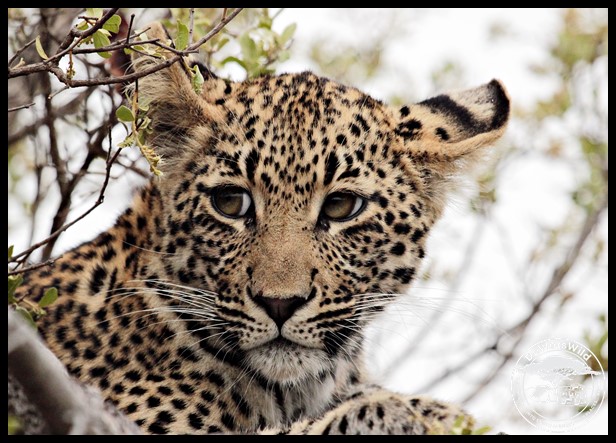
After spending quite some time at the Leopards in the tree we decided to move on to breakfast at Babalala Picnic Spot when, only 4km further along the same road, we found a young and curiously calm Leopard next to the road at the turnoff to Sirheni Bushveld Camp. She posed beautifully for all the photographers in the car, not fazed in the least by our proximity! Having been treated with such grace by the young princess we slowly backed away from her so that she could repose in tranquility.

Mere minutes later, still sauntering along the S56 towards Babalala, we found our third Leopard encounter for the morning where it was using a small outcrop of rocks as a vantage point and being particularly interested in a huge kudu bull lying nearby. The kudu soon saw the Leopard and did not even think the cat enough of a threat to stand up. Knowing it was outgunned, the Leopard gave the kudu a wide berth and disappeared into the dense shrubbery next to the Shisha stream.

That same afternoon, still extremely excited about our morning, which by then also included sightings of other charismatic or rare species of wildlife including lions, roan antelope, tsessebes, buffaloes and elephants we found our fourth Leopard sighting of the day along the S50 Kanniedood Road southeast of Shingwedzi. The apparently heavily pregnant female was in a hunting mood and stalking a mixed herd of impala, kudu and waterbuck mingling on the bank of the river. She was soon discovered however and slinked back across the road and out of sight.

Our final Leopard sighting of the trip (and I am sure we missed more than we saw thanks to their exceptional camouflage!) was before sunrise as we left Shingwedzi for a morning drive. This was a shy individual, trying to hide behind a palm frond for a minute or two and then deciding to retreat into the riverine vegetation lining the Shingwedzi.

I made a little compilation video of some of the Leopard encounters I told you about.


Join us on a night drive at Lower Sabie

During the hours of darkness visitors to the Kruger National Park are not permitted to drive themselves around the reserve, both for their own safety and that of the Park’s wildlife. Nighttime in wild Africa is a fascinating time, however, with nocturnal creatures roaming the dark, and for this reason the Park offers visitors night drives of two to three hours in duration and under the guidance of skilled guides, with spotlights being used to seek out animals and birds that might otherwise be hard to see during daylight. We undertook one such excursion from Lower Sabie Rest Camp during our visit to the Kruger Park last week.

With Joubert and his friend Erlo manning the cameras I could take a few video snippets of our drive. Hop on and come along!

Remember that DeWetsWild can also assist you with bookings for guided activities, like night drives, in the Kruger National Park when you make use of our reservation services for your holiday accommodation.

Kruger Holiday 2023: 1 July / Day 7

Yesterday I lamented the fact that we’d be leaving the Kruger National Park today and heading back home to Pretoria. Well, as is often the case, the Kruger still had one present in store for us before we left. This morning, just a kilometer from Shingwedzi Rest Camp, that gift took the form of a buffalo carcass, two bloody lionesses and the smallest pair of lion cubs we’ve seen in a long time!

Here’s a little video compilation of the cubs as they walked along the road with their mother:

Winter in Mokala: Sable Antelope Mating Ritual

Early one morning during our recent visit we found a sizable herd of Sable Antelope on the Kniekie Loop in the Mokala National Park. The dominant bull was particularly interested in one cow and we had a front-row seat as he turned on the romance.

Here’s a short video showing the Sable bull courting his mate.

We’ll soon be announcing a very exciting spring-time tour to the Mokala National Park – do keep an eye on DeWetsWild’s facebook page so that you don’t miss out!

Winter in Mokala: Familiar Pririt

This female Pririt Batis was also a regular visitor to Chalet #1 in Mokala National Park’s Lilydale Rest Camp when I visited along with Hannes Rossouw last week, but she was a lot more demure than the Chestnut-vented Warbler I showed you two days ago.

We’ll soon be announcing a very exciting spring-time tour to the Mokala National Park – do keep an eye on DeWetsWild’s facebook page so that you don’t miss out!

Winter in Mokala: Peeping Tom Gecko

On the last night of our visit to Mokala National Park last week I found this Bibron’s Thick-toed Gecko on the floor of the bathroom in Lilydale Rest Camp’s Chalet #1. I didn’t question it about its intentions but I did carry it outside to more suitable habitat. The towel was a very necessary precaution; she’s a biter!

We’ll soon be announcing a very exciting spring-time tour to the Mokala National Park – do keep an eye on DeWetsWild’s facebook page so that you don’t miss out!