Category Archives: iSimangaliso Wetland Park

Our experiences in the iSimangaliso Wetland Park, South Africa

Stork Buffet at uMkhuze

While driving around the uMkhuze Game Reserve one afternoon in March, we happened upon a seemingly insatiable Woolly-Necked Stork catching juvenile catfish in a drying mudpool. We watched the stork gorge itself on one fish after another, amazed at the ease with which it could grab its slippery, squirming quarry from the “all you can eat buffet table”, until there was no more splashing from the pool at his approach…

African Bullfrog

Pyxicephalus edulis

While I doubt it reached proportions that would convince the Pharaoh to allow the Israelites to leave Egypt, the “eruption” of little froglets we saw at uMkhuze Game Reserve during our recent visit was quite fascinating. Rain or shine, literally hundreds (if not more) of tiny frogs could be seen jumping around on the roads all over the reserve, making driving quite tricky if you didn’t want to squash them under the vehicle’s wheels.

Thanks to the help of the iSimangaliso Wetland Park the little ones were identified as juvenile African Bullfrogs (also known as Edible or Lesser Bullfrogs), a species that occurs over wide areas of Eastern, Central and Southern Africa, and indeed is eaten by humans in many countries where they occur. Though these newly metamorphosed juveniles were only about the size of a thumbnail, the African Bullfrog can grow to 12cm in length.

African Bullfrog

They can be found in seasonally flooded savannas and grassy woodlands, remaining dormant underground for most of the year (up to 10 months) and emerging only when sufficient rain has fallen for breeding to commence. During the breeding season males act very aggressively towards one another and will even kill each other. Eggs are laid in well vegetated, shallow, seasonal bodies of water where the males guard the eggs and tadpoles against other males and predators. Interestingly, when the tadpoles’ pools start drying up the males will dig channels to deeper pools. African Bullfrogs feed on a variety of invertebrates and small vertebrates, including other frogs, and feature in turn in the diets of various species of birds, reptiles and mammals (humans included).

During a visit to the Kruger National Park in December 2019 we witnessed the breeding habits of the African Bullfrog following a few days of continuous rain.


Fresh out of the bush

We’re fresh back from visits to the Kruger National Park and uMkhuze Game Reserve (part of the iSimangaliso Wetland Park) and of course we have lots of photos and stories to share – so stay tuned!

We’ll also be catching up with all the comments you’ve left for us while we were away in the coming days, I promise!

Our 2015 in pictures

Looking back at the marvelous places we stayed at while exploring South Africa’s wild places in 2015 😀


> Glen Reenen, Golden Gate Highlands National Park, January 2015

> Forever Resorts Loskop Dam, Loskop Dam Nature Reserve, April 2015

> Glen Reenen, Golden Gate Highlands National Park, April 2015

> Kamberg Nature Reserve, uKhahlamba Drakensberg Park, May 2015

> Kgaswane Mountain Reserve, May 2015

> Cape Vidal, iSimangaliso Wetland Park, June 2015

> Mpila, Hluhluwe-Imfolozi Park, July 2015

> Lower Sabie, Kruger National Park, July 2015

> Sweni Wilderness Trail, Kruger National Park, July 2015

> Thendele, Royal Natal National Park, uKhahlamba Drakensberg Park, August 2015

> Ntshondwe, Ithala Game Reserve, September 2015

> Mopani Rest Camp, Kruger National Park, October 2015

> Pafuri Border Camp, Kruger National Park, October 2015

> Lower Sabie, Olifants and Shingwedzi, Kruger National Park, December 2015 (trip reports to follow soon!)

________________________

If you enjoy de Wets Wild as much as we enjoy sharing our love for South Africa’s wild places and their denizens with you, please vote for us in the 2015 South African Blog Awards.

We’ve entered the categories for “Best Travel Blog” and “Best Environmental Blog”, and you are allowed to vote for us in both. Clicking on the badge below will bring you to the voting site.

SA Blog Awards Badge

Thank you very much for your support!

Monochromatic

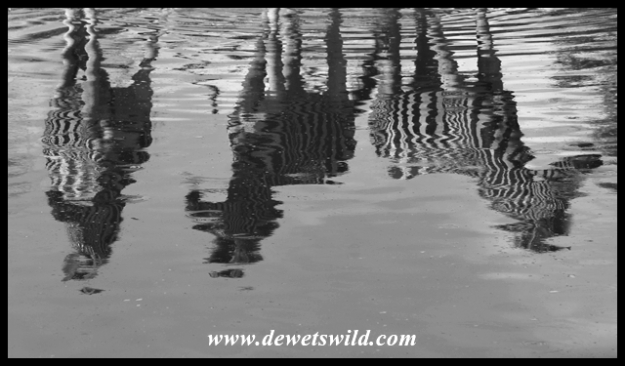
Zebras reflecting in the water of the Kumasinga Pan, on a hot December day at uMkhuze Game Reserve.

Monochromatic


Monochromatic” is the theme for this week’s WordPress Photo Challenge.

Close Up

This toad was waiting for us at the back door of our cottage in Mantuma Rest Camp at uMkhuze Game Reserve, in the iSimangaliso Wetland Park, when we visited in December 2014.

Close Up

Close Up” is the theme for this week’s WordPress Photo Challenge.

A winter exploration of St. Lucia’s Eastern Shores

iSimangaliso Wetland Park, South Africa’s first World Heritage Site, is named after the isiZulu word meaning “Miracle” and “Wonder”. Our recent visit to the Park just reminded us again what an appropriate name that is.

Having visited the Western Shores in December last year, we focused our attention during our June visit on the Eastern Shores section of the Park, a diverse area lying between the Indian Ocean in the east, Lake Saint Lucia in the west, St. Lucia town and the lake’s estuary to the south and incorporating the popular destinations of Mission Rocks and Cape Vidal, where we stayed for three nights. The sunrises and sunsets alone made the trip worthwhile!

As always, the game and bird-viewing on the Eastern Shores could only be described as splendid, but the Park is clearly not escaping the ravages of the drought that has Kwazulu-Natal Province in a firm choke hold, and none of the pans close to the roads held any water. Indeed a stark contrast to the lush oases of reeds and waterlilies these waterholes normally are, complete with hippos, crocodiles and wading birds in residence. Even the Mfazana Pans, where there’s a brilliant photographic hide, was little more than an almost-dry puddle of mud.

We seem to have extraordinary luck with finding leopards here and this trip was no exception, with no less than four sightings of these beautiful cats. A late afternoon sighting of a serval, a much smaller but also spotted cat, being chased by a group of lapwings as it crossed a burnt field, was a very pleasant surprise. Unfortunately we didn’t see anything more than a footprint of iSimangaliso’s spotted hyenas during this visit. On the other side of the scale, a tiny snake, the variegated slug eater, was a first-ever encounter for us and one we’ll remember just as long as any of the leopard sightings.

We can never spend enough time at this wonderful place, and you’ll understand that we were not at all pleased that our long weekend flew past in the blink of an eye. Time to start making plans for the next visit then…
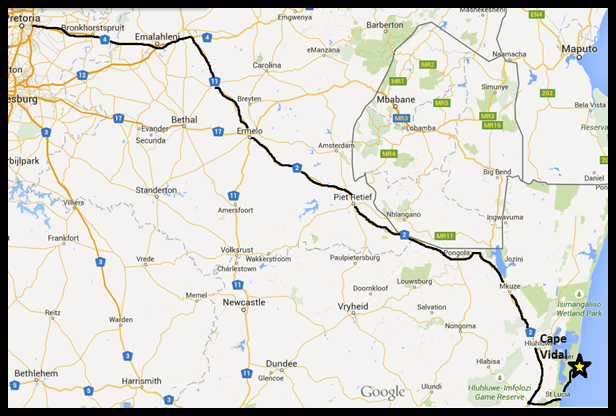
The Bhangazi gate into the Eastern Shores of Lake Saint Lucia lies roughly 640km South-East of Pretoria. (Drawn using Google Maps)

The Bhangazi gate into the Eastern Shores of Lake Saint Lucia lies roughly 640km South-East of Pretoria.
(Drawn using Google Maps)

Cape Vidal, the most beautiful beach

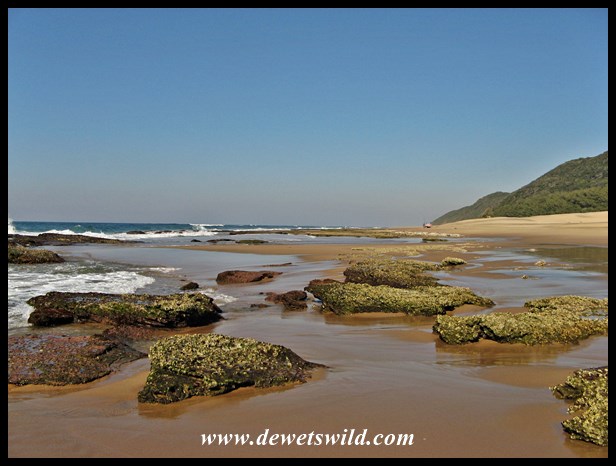
To us, there is no more beautiful a beach in this country than Cape Vidal. Miles of sand stretching as far as the eye can see, lined between densely forested dunes and the warm blue water of the Indian Ocean (in the waves of which dolphins and whales can often be seen), with rock pools harbouring fascinating marine life exposed at low tide.

Cape Vidal is named after Alexander Thomas Emeric Vidal, captain of the British surveying ship HMS Leven, that mapped this coastline in 1822. Today, this pristine area falls within the iSimangaliso Wetland Park, is one of the most popular destinations in the reserve and an excellent base from which to explore the Eastern Shores of Lake Saint Lucia. The accommodation and campsite is managed by Ezemvelo KZN Wildlife and often booked out months in advance. There’s a fuel station and a small shop selling only basic essentials, so it is best to stock-up on your groceries at St. Lucia town before entering through Bhangazi Gate 35km to the south of Cape Vidal. Apart from all the activities that the beach caters for, Cape Vidal is also one of the best spots in the country to easily see a wide variety of otherwise very shy forest birds and animals (like Samango Monkeys and Red Duiker).

The rugged beauty of Mission Rocks

Today a very popular picnic and fishing spot north of St. Lucia Town in the iSimangaliso Wetland Park, Mission Rocks is named for a Catholic mission station established in the area in 1888. The path leading from the parking area to the beach opens onto a scene of rugged, rocky beauty, revealing rock pools teeming with life at low tide and impressing with the thundering of crashing waves at high tide. There’s a sandy, open beach 500m northwards of the rocks, with a sea-cave where thousands of bats roost.

On the way to Mission Rocks, the uMziki viewpoints and picnic site, set right in the coastal forest, is a worthwhile stop. From atop the dune there’s views over Lake Saint Lucia to the west and the Indian Ocean to the east, and down below in the forested picnic site there’s an astounding variety of birds that would normally be very shy but here seems quite habituated to having humans around. There’s also usually a couple of red duiker to be seen.


St. Lucia’s Crocodile Centre

Lake Saint Lucia is the core of a vast ecosystem, rightfully included in South Africa’s first designated World Heritage Site, the iSimangaliso Wetland Park. The Crocodile Centre, managed by Ezemvelo KZN Wildlife at the Bhangazi Gate into the Park, and the self-guided trails in the adjacent game park, offers an excellent introduction to this Park of “miracles and wonders” (the English meaning of the isiZulu word iSimangaliso). It also has the best stocked curio shop in town and a lovely tea garden.

Of course the crocodiles, an integral part of the lake’s ecological functioning, are the star attractions. On display are not only specimens of our indigenous Nile Crocodiles ranging in size from newly hatched babies to “monsters” over 4m in length, but the centre also houses Dwarf and Slender-Snouted Crocodiles from tropical Africa and a couple of American Alligators. You can also try your hand at spotting another of iSimangaliso’s very secretive inhabitants, the extremely venomous and expertly camouflaged Gaboon Adder.

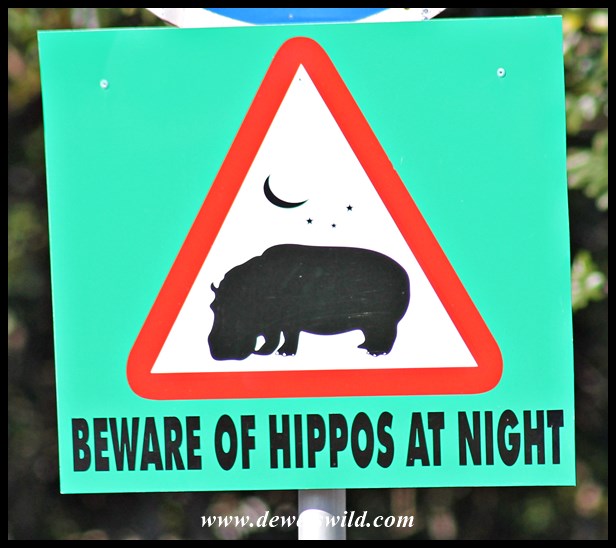
The centre’s beautiful gardens are a magnet for other wildlife, and we always get a kick from the humorous signs (to us, anyway).

Saint Lucia is a unique town, located on a wedge of land at the mouth of Lake St. Lucia, between the lake and the Indian Ocean, and entirely surrounded by the iSimangaliso Wetland Park. All kinds of wildlife roam the town, including hippopotamus and leopard. Right in town, a magnificent piece of coastal forest can be explored along the Gwalagwala Trail. A number of private operators offer guided tours of the area, and several launch-tours operate on the estuary. Two camping areas and a host of privately run establishments offers overnight accommodation, and the town has most of the facilities you’d expect (shops, restaurants, doctor, fuel station, boat club, picnic sites), making St. Lucia an excellent base for a bush-and-beach holiday.

Crocodile Centre (23)