In celebration of World Wildlife Day we take a look back at the 53 species of Southern African wildlife we featured in detail here at DeWetsWild through the past twelve months.
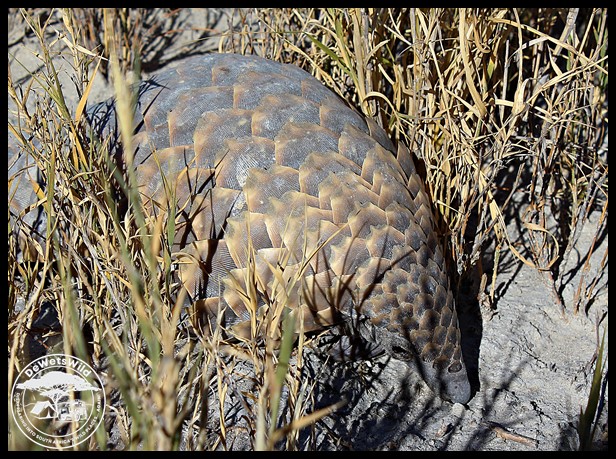
Last month, while travelling between Elephant Sands Lodge and the Sua Pan in Botswana during Gospel on Safari, a life-long dream of mine was realised when I finally had the chance to see a Pangolin in the wild!
Sadly, the Ground Pangolin is being threatened with extinction and is currently listed as vulnerable by the IUCN. Like other kinds of pangolin their populations are being driven downward by illegal trade for mainly superstitious medicinal uses and as a high-end delicacy. Farming practices, electric fences and road deaths are further threats to these enigmatic animals. In South Africa today they’re found mainly in the Northern Cape, North West, Limpopo, Mpumalanga and northern KZN, with populations in the Eastern Cape and Free State now feared extinct, while their natural distribution stretches beyond our borders as far north as Chad and Sudan.
Fully grown Ground Pangolins measure between 70 and 110cm in length, stand about 30cm high on all fours and weigh between 5 and 18kg, with males being considerably bigger than females. They feed on ants and termites, breaking open their nests with the powerful claws on their front feet and lapping the insects up with a tongue that is longer than the Pangolin’s body! They inhabit any habitat that has an ample supply of their favoured food items, being found from semi-deserts to the edge of forests. They do not need to drink.
As their name suggests, Ground Pangolins are strictly earthbound. They rest in tunnels that they dig themselves or take over from other animals. They plug the entrance to the tunnel from inside when using it. If caught outside they will roll up into a tight ball, their hard, sharp scales serving as excellent protection. Pangolins have wonderful senses of hearing and smell, but poor eyesight, and are solitary animals except when mating or when a mother is with her offspring. Females give birth to a single baby at a time, which she carries around with her on her tail for much of the first months of its life. They live to about 12 years of age in the wild.
Early in June I had the enormous privilege of spending 9 days at and around Elephant Sands Lodge, located near Nata in north-eastern Botswana, participating in Gospel on Safari where I and eleven other believers spent time with our Creator and His Word in the most amazingly unspoiled natural surroundings. Without a question it was one of the most impactful experiences of my life and I am immensely grateful for and humbled by all that was revealed to us, both physically and spiritually.
One of our nights was spent sleeping out in the open under the stars on the enormously empty expanse of Sua (sometimes spelt Sowa) Pan. The next day we explored more of the pan and its surroundings, making it as far as Kubu Island, a rocky outcrop covered by baobab trees and surrounded by a sea of salty emptiness.
One of the biggest highlights of the trip was an encounter with an enigmatic animal that I’ve longed to see my whole life. More about that soon!
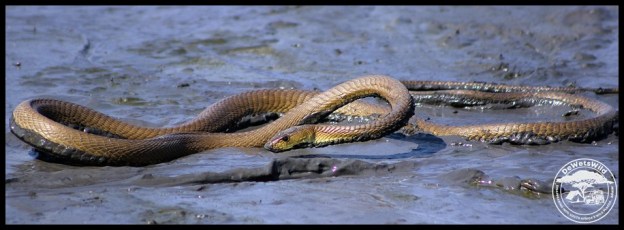
While camping near Domtshetshu Pan in Botswana recently, as part of Gospel on Safari, I took a stroll towards a muddy part of the waterhole, where I found two Black Mambas – one of the deadliest species of snake on the planet – wallowing in the mud, drinking from little pools and being very coy with each other. The snakes paid me no notice at all, making me think that they probably have never seen a human before – what an amazing thought! Later, one of my fellow campers joined me at the sighting and still the snakes acted as if we weren’t even there.
Early in June I had the enormous privilege of spending 9 days at and around Elephant Sands Lodge, located near Nata in north-eastern Botswana, participating in Gospel on Safari where I and eleven other believers spent time with our Creator and His Word in the most amazingly unspoiled natural surroundings. Without a question it was one of the most impactful experiences of my life and I am immensely grateful for and humbled by all that was revealed to us, both physically and spiritually.
For three nights, with special permission granted by Botswana’s Department of Wildlife and National Parks, our group camped out in the wild at a waterhole called Domtshetshu Pan. The sense of freedom, space and wonderment was amazing!
Domtshetshu Pan was the site of one of my most memorable wildlife encounters ever, and I will tell you more about it in the next installment!
Early in June I had the enormous privilege of spending 9 days at and around Elephant Sands Lodge, located near Nata in north-eastern Botswana, participating in Gospel on Safari where I and eleven other believers spent time with our Creator and His Word in the most amazingly unspoiled natural surroundings. Without a question it was one of the most impactful experiences of my life and I am immensely grateful for and humbled by all that was revealed to us, both physically and spiritually.
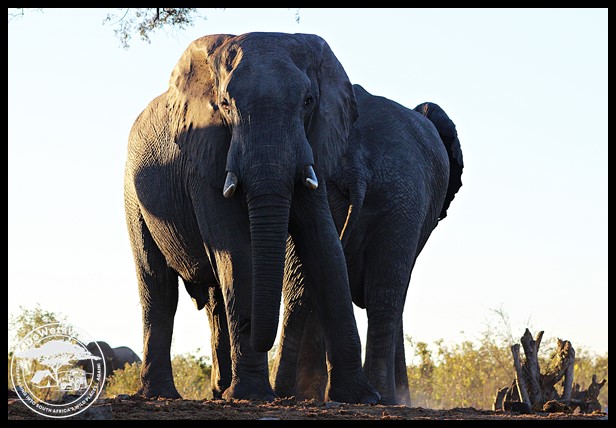
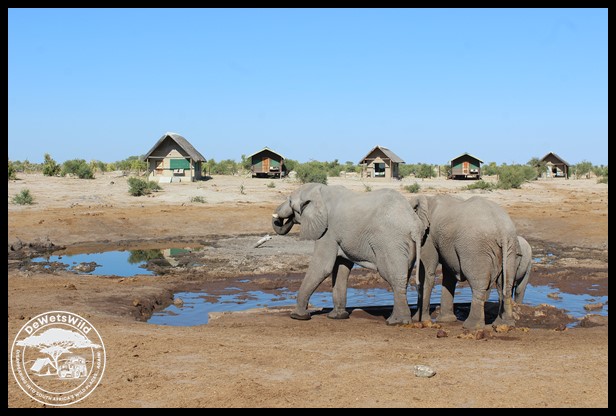
Located just off the A33 main road linking Nata and Kasane, Elephant Sands offers accommodation and camping at the main lodge as well as a very comfortable bushcamp a few kilometers deeper into the bush. Both are unfenced and frequented by a wide range of wildlife day and night. The main lodge’s campsites and units, as well as the main building housing the swimming pool, restaurant, bar and curio shop, surrounds a waterhole that is supplied with pumped water and is a real magnet to elephants and a wide variety of birds. The bushcamp – Eco Lodge – has a plunge pool and 12 comfortable two-sleeper tents serviced from a large kitchen and open plan dining area that also overlooks a pump-fed waterhole.
Elephant Sands serves as an excellent base from which to explore the immense wilderness that surrounds it in all directions, and wildlife viewing is especially rewarding at and around many of the waterholes that are currently being provided with pumped water, seeing as Botswana is being hard hit by one of the worst droughts ever recorded in the country.
Our group spent three nights “wild camping” at one such waterhole, called Domtshetshu Pan, and I will tell you more about that experience in the next installment!
In celebration of World Wildlife Day we take a look back at the 75 species of South African wildlife we featured in detail here at DeWetsWild through the past twelve months.
Today is World Rhino Day. The ongoing war against rhino poaching still features in the headlines all over the world and unfortunately it is seldom good news. As the numbers continue to dwindle sightings of these enigmatic creatures in our wild places are getting ever more scarce. That’s probably the reason why this wonderful encounter we had with a White Rhino bull in the Manyeleti Nature Reserve when we visited earlier in September is so precious and memorable.
Don’t miss the chance to visit Manyeleti along with DeWetsWild and Hannes Rossouw Photography!

In celebration of World Wildlife Day we take a look back at the 67 species of South African wildlife we featured in detail here at de Wets Wild through the past twelve months.
Today marks the tenth anniversary of de Wets Wild‘s “birth”.
We’re grateful for the very many friends we made along the way and for all your kindness and encouragement. Thank you.
What better way to celebrate this milestone than taking a quick tour through the wild places of the beautiful country that inspired this blog to begin with!?