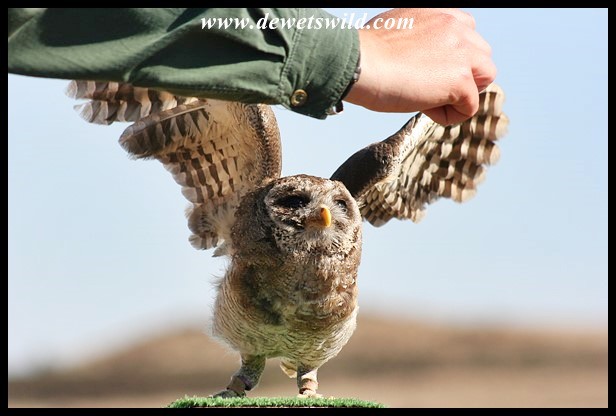
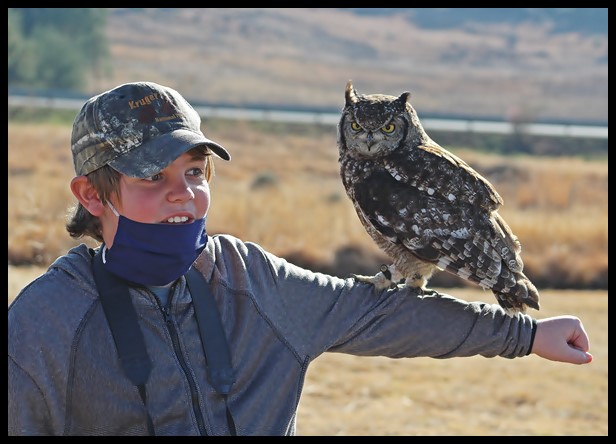
Dullstroom Bird Of Prey and Rehabilitation Centre

This past Sunday Joubert and I had the immense privilege of visiting the Bird of Prey and Rehabilitation Centre a stone’s throw away from the small and historic town of Dullstroom on the Mpumalanga Highveld. Tripadvisor rates it as the foremost attraction in Dullstroom – no small feat considering Dullstroom’s fame among local and international visitors alike as a mecca for outdoor enthusiasts where visitors are spoiled for choice.

With tourism being the lifeblood of the picturesque town, restrictions on travel imposed in recent months, however necessary to curb the spread of COVID-19, had a devastating effect on the local economy. As a registered NGO receiving no government support, the Dullstroom Bird of Prey and Rehabilitation Centre relies heavily on donors, sponsors and the visiting public to fund their very important work. Their tiny staff compliment is responsible for the rehabilitation of between 80 and 200 birds of prey every year, all of them injured by or negatively impacted in another way by humans, and then releasing them back into the wild when they’ve recovered sufficiently. Only non-indigenous birds, those whose injuries are too severe to permit a fully self-sufficient life in the wild or those that are hopelessly imprinted on humans remain at the centre permanently. The love and passion these people have for their job is absolutely inspiring. If you can’t visit them in person, please visit their website and, if you are able to, assist them in their efforts by making a donation (monetary or in kind). The way Libra, an immature Bateleur that was severely injured by a vehicle a year ago, seeks comfort from handler Magdali Theron in the picture below will leave you in no doubt just how vital the work of the Dullstroom Bird of Prey and Rehabilitation Centre is.
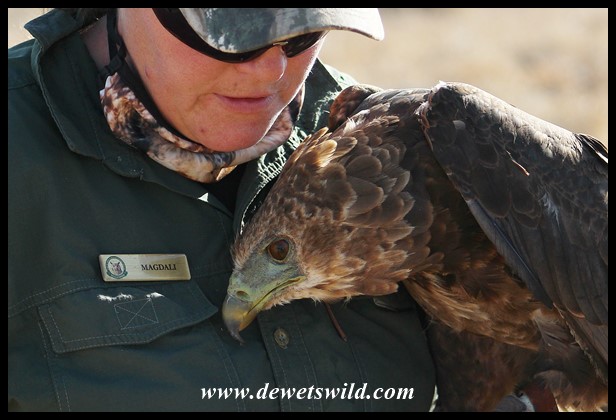
Libra and Magdali

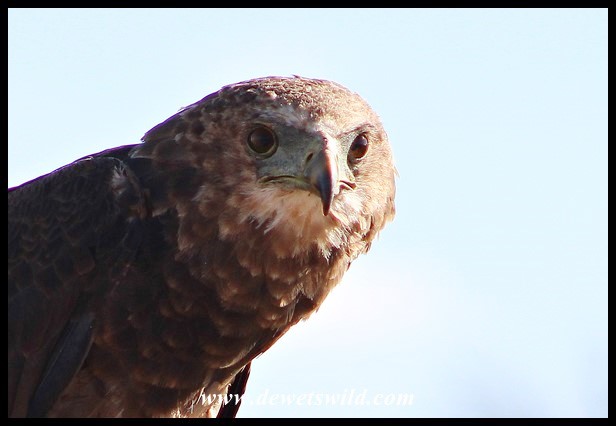
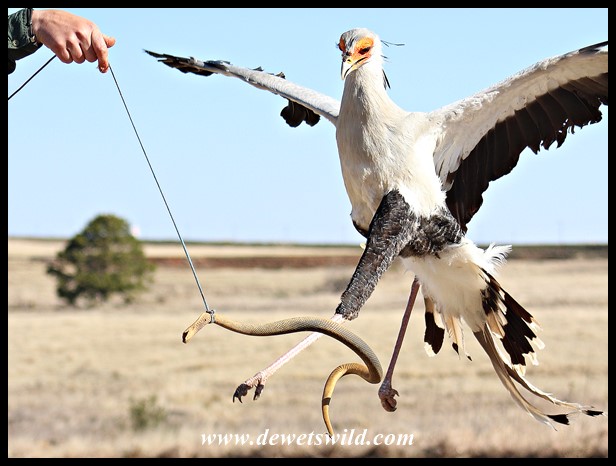
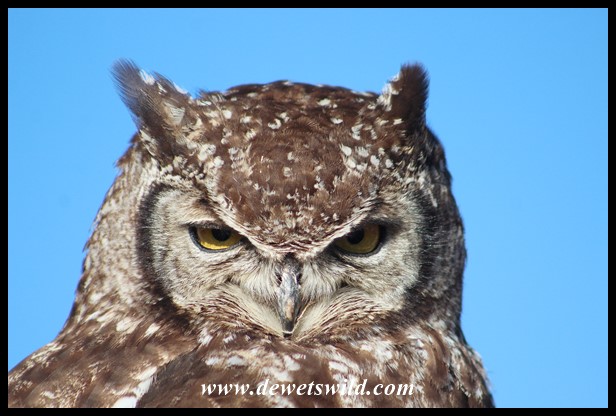
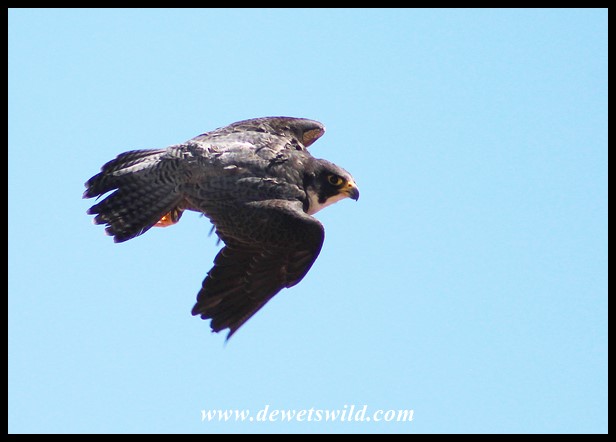
Apart from the fact that it was our first chance to escape from South Africa’s heavily industrialised Gauteng Province in almost six months or that we were able to marvel at the most majestic birds of prey from close quarters, the trip was both long-awaited and memorable for another reason: being tutored by accomplished wildlife photographer Hannes Rossouw in the art of taking photographs of birds in flight. Thanks to Hannes’ unending patience and skill as an educator we hope we’ll be able to have many more images like these gracing the pages of de Wets Wild in future.

As you can imagine, after spending most of the daylight hours at the centre, we came back to Pretoria with hundreds of photo’s. In the coming days we will be using those images to tell you the stories of ten of the Dullstroom Bird of Prey and Rehabilitation Centre’s most charismatic residents. And be sure to look out for Joubert’s images in the mix; under Hannes’ expert tutelage his photographic skills have become even more impressive (I know, I am biased).

Black-crowned Tchagra

Tchagra senegalus

The Black-crowned Tchagra is a shy bird of the shrike-family that inhabits wetter savanna and woodland-type habitats and feeds mainly on insects and other small prey, which occasionally includes lizards, snakes and frogs. They are also quick to utilise well-planted parks and gardens.

Black-crowned Tchagras form monogamous, territorial pairs, nesting in cup-shaped constructions they build together in bushes and trees during an extended breeding season that spans most of spring, summer and autumn. The female takes most of the responsibility for incubating the clutch of 1-4 eggs over a two-week period, with the chicks fledging when only two weeks old but staying with their parents for quite some time after. Fully grown Black-crowned Tchagras weigh around 50g and measure about 21cm in length.

In South Africa, Black-crowned Tchagras are found from the Eastern Cape, through most of Kwazulu-Natal and into Mpumalanga, Limpopo, Gauteng and North West. They’re also widely distributed over sub-Saharan Africa, with isolated populations along the Barbary Coast of North Africa and the southern reaches of the Arabian Peninsula. The IUCN lists the species as being of least concern.

You might enjoy this short video of a Black-crowned Tchagra singing its melodious song:

Variable Skink

Trachylepis varia

The Variable Skink is a lizard found in grassland and savanna habitats, and especially rocky areas there-in, and distributed (in South Africa) from the coastal Eastern Cape through Kwazulu-Natal, the Free State and Gauteng to the North West, Mpumalanga and Limpopo. They feed on insects and other invertebrates. Females give birth to as many as 10 babies in the summer months. They grow quickly; maturing at about 8 months of age (when they measure around 6cm in length, tail excluded) with a life expectancy of only about two years, or even less.

Green Wood-Hoopoe

Phoeniculus purpureus

The Green Wood-Hoopoe, also known as the Red-billed Wood-Hoopoe, is a bird renowned in these parts for their “crazy cackling” call, often given in a choir by the whole group. They occur widely in South Africa, being absent only from most of the Northern and Western Cape Provinces, and are also widely distributed over much of sub-Saharan Africa with the exception of the equatorial forestsThe IUCN lists the Green Wood-Hoopoe as being of least concern, whilst noting that the loss of prime habitat is causing a decline in certain populations. Some introduced starlings compete with the Green Wood-Hoopoe for nests, especially in urban settings where these exotics flourish.

Green Wood-Hoopoes are common in suburban gardens and parks, but their natural habitat preference ranges from open savannas to dense woodlands and riverine forests. Green Wood-Hoopoes mostly forage in the trees and occasionally on the ground or termite mounds, poking behind loose bark and inside crevices for insects and small reptiles or amphibians and, irregularly, snacking on nectar, seeds and fruits.

Moving around in territorial family groups of up to 14 consisting of a dominant pair and several helpers, Green Wood-Hoopoes breed in holes in trees (usually abandoned by other birds and never created by themselves) at any time of year, with the dominant female incubating a clutch of 2 to 5 eggs over a 3 week period. Both she and the chicks are provided food by the rest of the group, who is also very protective of the nest and will fearlessly attack any intruders. The hatchlings leave the nest when they’re about a month old but are cared for with great dedication by the other group members until they’re about four or five months old. Adult Green Wood-Hoopoes measure around 35cm in length and weigh about 80g.

Tree Creeper Scorpion

Opisthacanthus asper

The large and strikingly coloured Tree Creeper Scorpion occurs in savanna habitats in northern Kwazulu-Natal, through the Lowveld and along the Limpopo Valley into the Bushveld, where they live in trees (being especially fond of the Knobthorn), bushes and fallen logs. By day they hide in the crevices in trees and behind bark and by night they use these hide-outs to ambush passing prey or actively go hunting in and near their home trees. For this reason hanging clothes and shoes from trees where the Tree Creeper occurs is not to be advised – while they are quite docile in nature and their venom is too weak to be medically significant a sting from these 10cm long scorpions, half of which is the tail, can be quite painful (so I hear). Male Tree Creepers tap their pincers on the bark to warn a female that he is not prey and won’t approach closer until it is clear that the female will not attack when they want to mate.

Red-backed Shrike

Lanius collurio

Red-backed Shrikes visit South Africa in our summer months, arriving from late October with the last individuals leaving again by April. While here, they can be seen in all our provinces, though they’re much more common on the eastern side of the country than the arid west. Apart from South Africa, they also spend their non-breeding season over much of the rest of southern, central and eastern Africa, departing back to their northern breeding grounds in Europe and Asia with the onset of warmer weather there. The IUCN considers this species to be of least concern, estimating a total population of at least 24-million.

In our southern climes the Red-backed Shrike inhabits more open habitats ranging from open scrublands and grassveld to a variety of savanna and woodland associations. They are mainly insectivorous in their diet, though they will also prey on smaller birds, rodents and lizards if the opportunity presents itself. Such larger prey is often impaled on a thorn or barbed wire, which is why the Red-backed Shrike (like several others of its family) are also known as “butcher birds”.

Males are more conspicuous than females thanks to their more colourful plumage and preference for more open areas. Adults measure about 18cm in length.


Long-tailed Paradise Whydah

Vidua paradisaea

If it wasn’t for the male’s conspicuous tale, which they wear only in the breeding season, it would be very easy to overlook the Long-tailed Paradise Whydah. Females, and non-breeding males, measure about 12cm in length and are decidedly drab, blending perfectly with their environment. But in the breeding season, which spans the summer and autumn months, males sport high contrast colours and a very fancy tail that can measure more than 20cm in length, which certainly makes them stand out even from a distance.

Long-tailed Paradise Whydahs are seed-eaters, supplementing their diet with only the occasional insect, and inhabit grasslands, savannas and open woodland, also venturing into adjacent agricultural fields and villages.

Male Long-tailed Whydahs are territorial and attempt to mate with as many females as possible in a breeding season. Being brood-parasites the females then lie between 1 and 3 eggs in the nests of, especially, the Green-winged Pytilia, The chicks hatch after 11 days and look almost identical to the chicks of the host birds with which they leave the nest about two weeks after hatching, becoming fully independent at about a month old.

In South Africa, the Long-tailed Paradise Whydah occurs from Kwazulu-Natal through Mpumalanga, Limpopo, Gauteng, North West and the Free State to the extreme eastern-most districts of the Northern Cape. Their distribution further stretches from Namibia to Ethiopia and Somalia. According to the IUCN the Long-tailed Paradise Whydah’s conservation status is of least concern.

Sycomore Fig

Ficus sycomorus

The Sycomore Fig, or Cluster Fig, is one of our most striking indigenous trees. They grow to an enormous size – up to 25m high with an equally impressive yellowish trunk supporting a widely spread canopy – in the alluvial soils along rivers and streams. Sycomore Figs flower and fruit throughout the year, bearing figs in huge quantities that sustain an incredible variety of insects, birds and mammals, humans included, and this is solely reliant on pollination by wasps of the genus Ceratosolon, which spend most of its life-cycle inside the fruit.

Apart from the obvious use of the figs, and less so the young leaves, as food, humans also use the bark and latex of the Sycomore Fig medicinally. And although the wood is soft, the Sycomore Fig was held in such regard that some Egyptian mummies were even interred in caskets made of the wood!

In South Africa, Sycomore Figs occur naturally in the north of Kwazulu-Natal, Mpumalanga and Limpopo, and beyond our borders throughout central, east and west Africa to Senegal. They’re also found on the Arabian Peninsula and from Egypt to Syria – presumably being the fig tree that is mentioned in several chapters of the Bible. The IUCN lists it as being of least concern.

Lesser Striped Swallow

Cecropis abyssinica

One of the most abundant swallows in Africa, the Lesser Striped Swallow visits most of South Africa during our warmer months (though some birds remain year-round in the warmer Lowveld and northern reaches of Kwazulu-Natal). The majority of the local population arrives from July and August and head back northwards between February and May.

The Lesser Striped Swallow is a bird of mesic woodlands and savannas, often being seen close to open water, but have adapted to cultivated land and thrives in urbanised environments. Insects and other invertebrates, caught on the wing, make up the majority of their food intake though they will also settle on branches to feed on seeds and small berries on occasion.

Lesser Striped Swallows construct bowl-shaped nests of mud under rock overhangs, horizontal branches, culverts, bridges and the eaves of roofs. These nests are often used for several consecutive years, and not always by the same pair of birds. Pairs are monogamous. Their breeding season stretch over several months from early spring to autumn. Clutches of 2-4 eggs are incubated by the female for 3 weeks. While the hatchlings start flying when they’re less than 3 weeks old, they still remain dependent on their parents for the shelter of their nest and food for about a month after taking to the air for the first time.

Although it is only a summer visitor to most of South Africa, where it can be commonly seen in all provinces with the exception of the Free State, Western and Northern Cape, the Lesser Striped Swallow has a wide distribution over most of Sub-Saharan Africa and is considered to be of least concern by the IUCN, which also states that their populations are growing.

Lesser Striped Swallows often occur alongside the Greater Striped Swallow with which it can easily be confused.

Bats roosting beneath the thatch at Mooiplaas' ablutions

Free-tailed Bats

Family Molossidae

All bats from the family Molossidae share a unique feature, in that their tails are not fully enclosed by the membrane between the hind legs as in other carnivorous bats (clearly shown in the pictures below). Identifying them down to species level in the field is exceedingly difficult, and even experts often have to rely on a close examination of teeth structure and genetic analysis to achieve that. The familial name comes from these bats’ resemblance to the Molossus dogs,  forebears of today’s mastiffs, kept by the ancient Greeks.

Nine species of Free-tailed Bats occur in South Africa, with the Egyptian Free-tailed Bat (Tadarida aegyptiaca) the most common and widespread, being found in virtually every corner of the country, while the other species all have much more limited distributions within our borders. At least one species, the Large-eared Free-tailed Bat (aka Large-eared Giant Mastiff Bat, Otomops martiensseni) is considered vulnerable to extirpation from the country as it occurs in only a handful of colonies in and around the city of Durban.

The South African representatives of this large bat-family range widely in size, weighing between 10 and 50g with wingspans ranging from 25 to 45cm depending on the species.

The Free-tailed Bats are among the fastest and high-flying of all bats. Most of the species occur in woodland and riverine forests, others prefer rocky terrain while a few others have a very wide habitat tolerance. Only a few species have adapted to using buildings, and especially roofs, as shelter; most prefer natural roosts like caves, crevices and hollow trees. The Free-tailed Bats are gregarious, often congregating in groups several hundred strong, and entirely insectivorous (different species often have a preference for different kinds of insects, preferring for instance mosquitoes, moths or beetles over other options).

Female Free-tailed Bats give birth to a single baby at a time, some species breeding at any time of year while others have birthing peaks in the summer months.