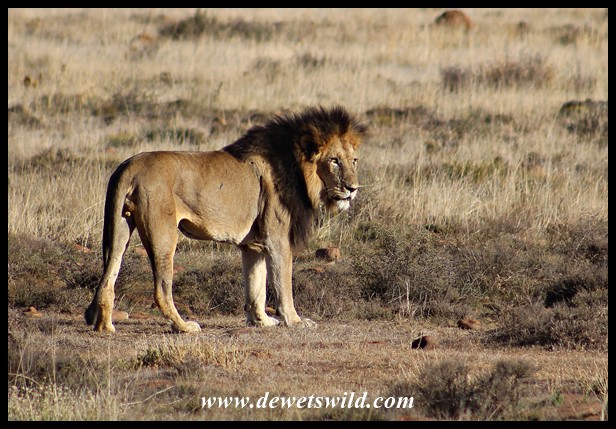
Brown Hyena

Parahyaena brunnea

Brown Hyenas are found in a wide selection of habitats, occurring from moist mountain grasslands to desert coastlines (earning them their old Afrikaans name “Strandwolf”, translating as “Beach Wolf”). They’re often found near rocky hills, these providing shelter in the form of dense vegetation and caves, but where this isn’t available they will use burrows dug by themselves or other animals as dens. Brown Hyenas feed mainly on carrion, ostrich eggs and wild fruits, with prey they catch themselves making up only a very small percentage of their total dietary intake. They are not dependent on surface water but will drink where and when it is available.

Territorial family groups, known as clans, are the principal social grouping in Brown Hyena society. These number up to 18 individuals, though around 7 is more usual. Adult males are nomadic and move from one clan to the next, mating with receptive females. Territories are marked with dung and scent glands and neighbouring clans will get involved in serious fights over territory. Brown Hyenas are mostly nocturnal and most active just after sunset and just before sunrise. They may cover enormous distances on their nightly excursions in search of food.

Female Brown Hyenas give birth to 1-5 tiny cubs at any time, approximately 3 months after mating. Females look after the cubs by themselves for the first 2 to 3 months after birth, before introducing them to the rest of the clan. While they start eating solid food from 3 months old, the cubs are only weaned at about a year of age. At about 15 months old the cubs are big enough to fend for themselves. Fully grown Brown Hyenas weigh around 45kg and stand about 80cm high at the shoulder, males being only slightly larger than females. Brown Hyenas have a life expectancy of up to 25 years in the wild, though larger predators are a considerable threat.

Much rarer and less well known than the larger Spotted Hyena, the Brown Hyena is also the hyena species with the most limited distribution. The IUCN estimates that there’s a total of between 4,300 and 10,100 adult Brown Hyenas left in the wild (half of which in Botswana), and evaluates its conservation status as being near threatened. The biggest threats to their continued survival is persecution by livestock farmers and habitat loss. While they occur at low densities almost all over South Africa, with a population estimated at probably no higher than 2,200 within our borders, the best places to go looking for Brown Hyenas in South Africa in our experience is the Kgalagadi Transfrontier Park and Pilanesberg National Park. Apart from South Africa and Botswana, Brown Hyenas are also found in Angola, Namibia and Zimbabwe, while it is doubtful any remain in Lesotho, eSwatini (Swaziland) and Mozambique.

Little Sparrowhawk

Accipiter minullus

It might be the smallest member of the genus Accipiter (comprising 51 species of sparrow- and goshawks)  but the Little Sparrowhawk isn’t a raptor that ought to be underestimated, especially if you are a small bird (up to the size of doves), rodent, bat, lizard or frog – small vertebrates making up the bulk of their diet. They hunt by ambushing prey from dense foliage, striking swiftly and acrobatically. Due to their small size and adeptness at hiding, the Little Sparrowhawk is easily overlooked. They prefer dense habitats, inhabiting a range of forest, thicket, woodland and riverine plant communities.

Little Sparrowhawks are monogamous and pairs defend a territory. The female builds the nest, which is little more than a platform of sticks and leaves, high in the fork of a large tree. They breed mainly in the spring season, laying 1-3 eggs that are incubated by both parents in turns for approximately a month. The chicks grow quickly and leave the nest by the time they’re a month old, but they remain in their parents’ territory until the next breeding season before they disperse. Fully grown, female Little Sparrowhawk weighs just 100g (males are about a quarter smaller still) and measure 25cm in length.

The Little Sparrowhawk occurs from Ethiopia and Eritrea southwards through most of central and eastern Africa all the way to South Africa, and its conservation status is listed as “least concern” by the IUCN. In our country they can be found from the coastal Eastern Cape, through most of Kwazulu-Natal and into Mpumalanga, Limpopo, Gauteng and North West Province.

Squacco Heron

Ardeola ralloides

A shy inhabitant of the densely grown verges of freshwater habitats, the Squacco Heron feeds on a variety of small vertebrate and invertebrate aquatic animals. Squacco Herons’ movements are often dictated by the rains, following recent showers to suitable habitat. Adults weigh around 300g and measure approximately 43cm tip-to-tip.

Though they mostly forage singly, Squacco Herons form monogamous pairs when breeding and build their stick-platform nests in mixed colonies together with other Squacco Herons and other waterbirds in reedbeds or trees growing in and over the water. Their breeding season spans almost the whole year, peaking in spring and summer. The parents take turns to incubate the clutch of 2-4 eggs over a 3-4 week period. The chicks are cared for by both parents and, while they leave the nest when they’re about 5 weeks old, they won’t start to fly for another 3 weeks more thereafter.

The Squacco Heron is listed as being of least concern, with a stable population estimated at as many as 780,000 occuring over most of the African continent, southern Europe and western Asia. The species is patchily distributed in South Africa, with the biggest concentrations occurring in Gauteng and adjacent portions of neighbouring provinces, the Lowveld and coastal Kwazulu-Natal.

Guttural Toad

Sclerophrys (Bufo) gutturalis

Many South Africans in the northern and eastern parts of the country will be well familiar with the deep croaking of the Guttural Toad piping up in their gardens around sunset during spring and summer. They’ve also been introduced unintentionally to parts of the Western Cape. Naturally these very adaptable amphibians are found in the vicinity of permanent or ephemeral bodies of water in grassland and savanna habitats, feeding on a wide range of invertebrates and smaller reptiles and frogs. Apart from South Africa, the Guttural Toad is also widely distributed over eastern and central Africa.

During the cool, dry winter months in their South African distribution range, Guttural Toads remain dormant under rocks, in holes and burrows, even gutters and drain pipes.  Their breeding season commences as soon as temperatures start increasing in August where permanent water is available or as soon as the first spring rains arrive otherwise. Females may produce as many as 25,000 eggs (for a photograph of the eggs, please do visit this terrific recent post on the fabulous blog “Letting Nature Back In). The tadpoles grow quickly and complete their metamorphosis within 6 weeks. Their thickset bodies grow to 12cm in length, with females being the bigger sex.

The IUCN considers the conservation status of the Guttural Toad to be of least concern. Sadly many are killed crossing roads at night. Where their ranges overlap the Guttural Toad is known to hibridise with the closely related and similar-looking Raucous Toad.

Red-faced Mousebird

Urocolius indicus

The Red-faced Mousebird inhabits a wide range of habitats, from thickets in arid scrublands to mature riverine woodland, though they’re most commonly encountered in savanna-type vegetation. Ready access to drinking water is an important habitat requirement. They’re also common in orchards, suburban parks and gardens. It feeds on leaves, flowers, nectar, fruits and seeds, clambering about the branches of trees and shrubs in a rodent-like fashion, showcasing how this ancient family of uniquely African birds got their name. They love taking dustbaths and lazing on the ground in the full glare of the sun.

Usually moving around in small groups of up to a dozen birds outside of the breeding season, Red-faced Mousebirds form monogamous pairs during the spring and summer breeding season. Both partners work on the construction of the nest, an untidy cup-shaped collection of twigs, grass and leaves, in which a clutch of 1-7 eggs are incubated by both parents for a two week duration. The chicks grow very quickly, leaving the nest when they’re only 2-3 weeks old and becoming independent soon after. Fully grown, and including their tails, Red-faced Mousebirds measure around 32cm in length and weigh approximately 56g.

As it is a widespread and common species the IUCN considers the Red-faced Mousebird to be of least concern. They occur in all South Africa’s provinces, and beyond our borders as far north as Angola and southern Tanzania.

Fulvous Whistling Duck

Dendrocygna bicolor

Probably as is to be expected, the long-legged Fulvous Whistling Duck is usually found at or near bodies of fresh water, usually with well vegetated verges where it follows a mainly herbivorous diet that includes algae, grasses, water lilies, seeds and flowers and only occasionally taking in insects and other invertebrates. They are quite nomadic waterfowl, ranging widely in search of suitable habitat, and often found in association with the closely-related White-faced Whistling Duck. The Fulvous Whistling Duck is not often found in large flocks, usually moving around and feeding in fairly small groups. They are active both day and night.

Fulvous Whistling Ducks may breed at anytime of year, though most often shortly after good rains. Their nests are simple scrapes in the ground, usually in dense cover very near water and lined with fine plant materials. Pairs are monogamous and may mate for life. Both parents contribute to the building of the nest and the incubation of the clutch of 6-13 eggs, which hatch after about four weeks. The ducklings can fly before they’re 2 months old.

The Fulvous Whistling Duck is widely distributed over parts of Africa, Asia, North and South America, and is considered to be of least concern; the IUCN estimating the total population at as much as 1.5-million though noting that most populations are declining due to hunting and farming practices. In South Africa they are commonly found on the Highveld (mainly Gauteng) but only occasionally seen in the wild elsewhere in our country.

Forest Beauty

Paralethe dendrophilus

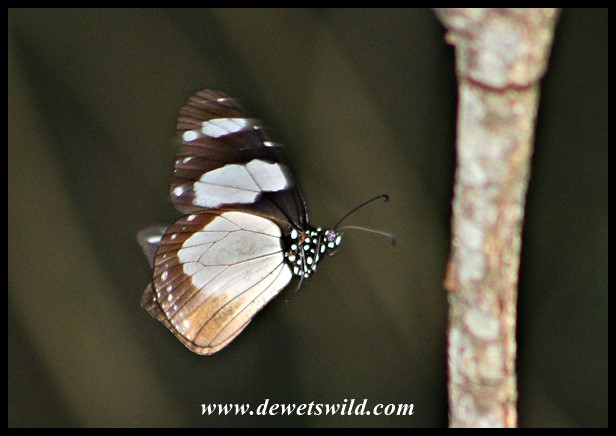
The Forest Beauty or Forest Pride is, as its name suggests, a beautiful butterfly inhabiting temperate coastal and mountain forests in eastern South Africa, from the Eastern Cape to the escarpment of Mpumalanga and Limpopo. It is a shy butterfly that flies low and fast and hides in the shade, usually against a tree trunk, when at rest or threatened. With a wingspan of up to 7cm the females of this species is a little larger than the males. Forest Beauties have a single generation annually, with adults only seen between December and May when the females scatter their fertilised eggs among grass on the forest floor. The larvae feed on various grasses and is slow growing; the full life-cycle from egg to adult takes a whole year.

Brown-crowned Tchagra

Tchagra australis

An adaptable member of the shrike family, the Brown-crowned Tchagra occurs in a wide range of savanna and woodland associations where it forages mainly low to the ground in the undergrowth. It feeds primarily on insects and other invertebrates and only very occasionally on small reptiles.

Brown-crowned Tchagras form monogamous pairs with the male being fiercely protective of their territory. The female takes most of the responsibility for the incubation of the clutch of 2-4 eggs over a 2 week period in the spring-summer nesting season. The chicks leave the nest around two weeks after hatching but stay with the parents for 5 months or more. Healthy adults weigh approximately 33g.

The Brown-crowned Tchagra is widely distributed over much of sub-Saharan Africa. In South Africa this species is found in all our provinces with the exclusion of the Eastern and Western Cape. The IUCN considers it to be of least concern.

Ashy Flycatcher

Fraseria (Muscicapa) caerulescens

The Ashy Flycatcher, or Blue-grey Flycatcher, is a very active little bird of dense habitats – forests, mature woodland, riverine thickets and densely planted gardens – where it feeds mainly on insects and other invertebrates, often moving around in mixed flocks with other small insectivorous birds.

Ashy Flycatchers from monogamous, territorial pairs. At the start of the breeding season, which spans most of spring and summer, the partners work together to build their cup-shaped nest, using fine materials, in forks, crevices or cavities in large trees. Clutches of 2-4 eggs are incubated for a period of about two weeks, with the chicks, attentively cared for by both parents, leaving the nest about the same length of time after hatching. Adults measure around 15cm in length and weigh only 18g.

In South Africa they occur along the coast of the Eastern Cape, through the bushveld regions of Kwazulu-Natal, into the Lowveld and escarpment of Mpumalanga and through most of the Limpopo Province. To our north this species is widespread through west, central and east Africa. In conservation terms it is considered to be of least concern.

Matabele Ants

Megaponera analis

Matabele Ants take their name from the Ndebele-people of South Africa and Zimbabwe. Historically known as the Matabeles and led by their fearsome chief Mzilikazi, they broke away from Shaka‘s Zulu-kingdom in the early 1800’s, warring their way through most of northern South Africa with spectacular results.

Matabele Ants are widely distributed over sub-Saharan Africa and live in subterranean nests, often more than half a meter deep and usually with multiple entrances but a single chamber in which the queen, eggs and larvae are cared for by the workers. At up to 2.5cm in length, they’re among the largest ants in the world.

Matabele Ants feed solely on termites, and the way in which they attack their quarry with military precision in regiments between 200 and 500 strong is a sight to behold. First, scout ants go out in search of termites, and when successful quickly return to the nest to get reinforcements without the termites being any the wiser. The scout then leads the army, following in a column-formation, back to the site. The army stops a foot or so from the termites, waiting for the back of the column to catch up. As soon as they are all in place, the army of ants then rush on the termites, breaking open their tunnels and killing as many termites as they can. After the raid the army assembles in the same spot where they waited to attack earlier, now with their bounty in their jaws, before setting off back to the nest in their familiar column-formation again. Even more astoundingly, Matabele Ants are known to rescue compatriots injured during the raid and carry them back to the nest to recuperate.