
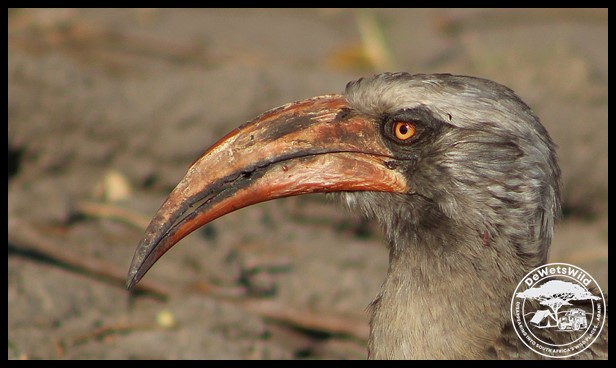
Today is Birding Big Day in South Africa, so in a clever twist of irony we’re showcasing a bird that none of the participants in the event is at all likely to encounter! 😀
Lophoceros (Tockus) bradfieldi
Bradfield’s Hornbill is found in only five Southern African countries: Botswana, Namibia, Angola, Zambia and Zimbabwe. According to the IUCN it is not in any imminent danger of extinction though it does note that the population is probably in decline due to habitat loss as a result of logging operations. They occur in savanna-woodland and feed mainly on invertebrates, small vertebrates, seeds and berries. They’re usually seen in pairs or small flocks.
Typical of most hornbills, Bradfield’s Hornbill also breeds in holes in trees in which the female is plastered inside with the (usually) three eggs for the 4 week incubation period while the male feeds her through a slit. She leaves the nest a few days after the chicks hatched to help the male feed them until they’re ready to leave the nest at almost 2 months old. The parents take care of the chicks for another month of so thereafter.


 DeWetsWild
They look like a dodo to me 🙂 Never seen it before. Again, magic of the internet 🙂
They are very interesting birds!
It’s interesting to me that they haven’t spread across the entire continent.
Isn’t it amazing how each species have adapted so wonderfully to their niche, John. Africa is home to at least 30 kinds of hornbills and the diversity of habitats they’ve chosen is remarkable!
Tipiese Bosveld voël. Liewers, sonder die Neushoring is die Bosveld nie meer Bosveld nie.(Ek oordryf nou ‘n bietjie.)
Hierdie spesifieke soort kom nou wel nie in SA voor nie, Ineke, maar ek stem met jou saam dat mens sommer vinnig agterkom wanneer jy n plek in die noorde van ons land besoek waar daar nie neushoringvoels voorkom nie.
He looks almost disproportionate with that long bill and his short little legs. Shame though about the decline in population.
It certainly is an unusual look, Lois, but he pulls it off!