
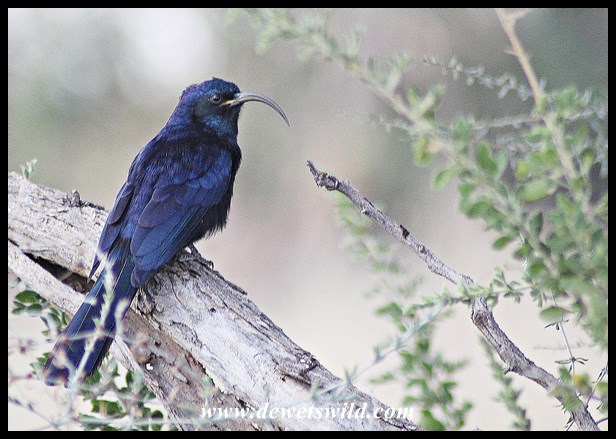
Rhinopomastus cyanomelas
The Common Scimitarbill feeds almost entirely on insects and other invertebrates scrounged from behind the bark of trees, a task that its characteristic bill is well adapted to perform. These restless birds inhabit open, dry woodlands and are usually encountered singly, in pairs or small family groups.
Common Scimitarbills form territorial pairs and breed in spring and summer, nesting in cavities in tree trunks and often using the same nest for several consecutive years. The female is solely responsible for incubating the clutch of 2-4 eggs for a 2 week period, with the male providing her with food on the nest , and the chicks take their first short flights around 3 weeks after hatching. The chicks may remain with their parents for up to 6 months. Adults weigh about 35g and measure approximately 26cm in length.
In South Africa the Common Scimitarbill is found in all provinces with the exception of the Western Cape. They’re also found as far north as Angola on the African west coast and up to Kenya and Somalia on the eastern seaboard of the continent. Despite suspecting their populations to be decreasing due to habitat loss (and in particular the removal of trees with holes for breeding) the IUCN lists the Common Scimitarbill as being of least concern.


 DeWetsWild
A few years ago I had fun watching a pair of them in the camping area of the MZNP.
What a wonderful opportunity, Anne – they’re normally quite skittish and especially so when you point a camera at them!
That beak is most impressive. I don’t think I have ever seen one curved like that.
Such an impressive tool when they’re searching for food under the bark of trees, Lois!