
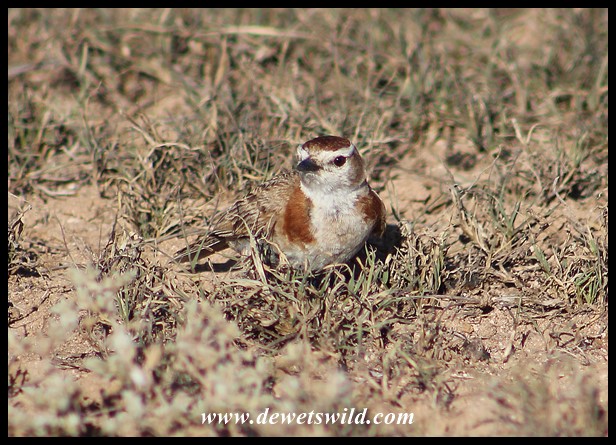
Calandrella cinerea
The Red-capped Lark is a common bird species that occurs throughout South Africa, with greatest population densities on the Highveld, in the Karoo and in the Fynbos-biome, indicating their preference for open grasslands and shrublands. They’ll also utilise recently burned or ploughed fields to search for food, which consists mainly of seeds and insects. Beyond our borders they occur over most of the continent south of the equator.
Red-capped Larks breed on the ground, usually just before the first spring or summer rains, using natural hollows – often hoofprints – lined with soft plant material gathered mostly by the female as a nest. The female incubates a clutch of 2-4 eggs for around 2 weeks, with the male providing her with food. Once hatched the chicks are reared by both parents and leave the nest before they’re 3 weeks old. Outside of the breeding season they may form flocks of up to 30 individuals.
Citing a widespread and increasing population, the IUCN considers the Red-capped Lark as being of least concern.


 DeWetsWild
Parmantige ou kuifie wat hy so oplig. Is mos hulle wat so vroeg oggend lekker sing?
Om jou die eerlike waarheid te vertel, Ineke, kan ek glad nie onthou dat ek hierdie lewerikkies al ooit hoor roep het nie!
Huldoen dit mos maar veral baie vroeg oggend of laat namiddag as dit begin donker word.
Quit cute, although the cap looks more brown than red to me. 😉
Now this colour-blind author doesn’t feel so bad, thanks Janet!
😁
You are my lark man 🙂 When I see photographs, such as these, of a single lark, I think ‘of course I will remember that – it is easy to identify’. Out in the field it is quite another matter!
They’re very tricky birds indeed, Anne. Luckily this one’s cap is quite noticeable, though as Janet’s mentioned whether it is indeed red is up for debate!