
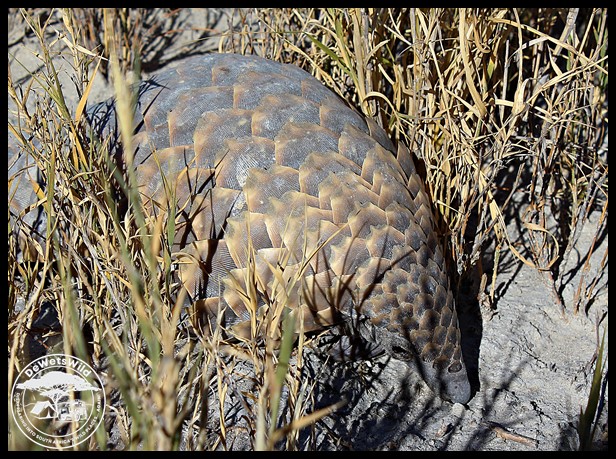
Last month, while travelling between Elephant Sands Lodge and the Sua Pan in Botswana during Gospel on Safari, a life-long dream of mine was realised when I finally had the chance to see a Pangolin in the wild!


Smutsia temminckii – The Ground Pangolin
Sadly, the Ground Pangolin is being threatened with extinction and is currently listed as vulnerable by the IUCN. Like other kinds of pangolin their populations are being driven downward by illegal trade for mainly superstitious medicinal uses and as a high-end delicacy. Farming practices, electric fences and road deaths are further threats to these enigmatic animals. In South Africa today they’re found mainly in the Northern Cape, North West, Limpopo, Mpumalanga and northern KZN, with populations in the Eastern Cape and Free State now feared extinct, while their natural distribution stretches beyond our borders as far north as Chad and Sudan.
Fully grown Ground Pangolins measure between 70 and 110cm in length, stand about 30cm high on all fours and weigh between 5 and 18kg, with males being considerably bigger than females. They feed on ants and termites, breaking open their nests with the powerful claws on their front feet and lapping the insects up with a tongue that is longer than the Pangolin’s body! They inhabit any habitat that has an ample supply of their favoured food items, being found from semi-deserts to the edge of forests. They do not need to drink.
As their name suggests, Ground Pangolins are strictly earthbound. They rest in tunnels that they dig themselves or take over from other animals. They plug the entrance to the tunnel from inside when using it. If caught outside they will roll up into a tight ball, their hard, sharp scales serving as excellent protection. Pangolins have wonderful senses of hearing and smell, but poor eyesight, and are solitary animals except when mating or when a mother is with her offspring. Females give birth to a single baby at a time, which she carries around with her on her tail for much of the first months of its life. They live to about 12 years of age in the wild.
 DeWetsWild
Such unique creatures! Sorry they are considered vulnerable.
Sad that us humans are behind their decline again…
I wondered if they were real? I’ve been playing as the Pangolin avatar for the last two weeks on wordscapes. Thanks for saving me a trip to Google
They’re very real, Scott, though even when you see one they’re still pretty enigmatic creatures!
Jealous!
😀
Seeing a pangolin was amazing, Alanna. I hope you’ll see one someday too!
Wow!
My sentiments exactly, Ann-Christine!
DeWet, ek wil so vreeslik graag ñ Ietermago hier by ons raakloop. Hulle word deur die plaaslike bevolking gevang en uitgeroei, maar eendag is eendag gaan ek nog een red. Ek is so bly jy het een te siene gekry!
Ek hou duim vas vir jou, Una!
How exciting, Dries!
Very, very, very exciting, Janet!
Marvelous sighting, Dries.
I was elated to the brink of tears, Tish!
I can so imagine!
That’s a true experience.
Indeed a blessing, Michael!
Dis ‘n nuwe belewenis om’n ietermagog in die veld te sien. Ek het jare terug altyd met honde in buitewyke van Potties vroeg soggens gaan loop. Gereeld spore gesien wat na ‘n gat/tonnel gegaan het. Een vroeë oggend het ek wraggies die ietermagog sien loop na die “nes” en daarin verdwyn.
Wat n spesiale ervaring en herinnering is dit nie, Ineke! Dankie dat jy daarvan vertel het!
Jou vertellings en beskrywings bring baie mooi herinneringe terug. Baie dankie dat jy so positief en mooi fotos en beskrywings gee.
You are blessed.
Most certainly, Anne, and very grateful!
Jy is baie gelukkig om die eienaardige dier te kon sien, Dries! Dis wonderlik 😊
Dit was n geskenk so reg uit die hemel, Aletta!
you lucky person. I’ve always wanted to see a Pangolin
I certainly felt blessed beyond measure when we came across this special creature!