
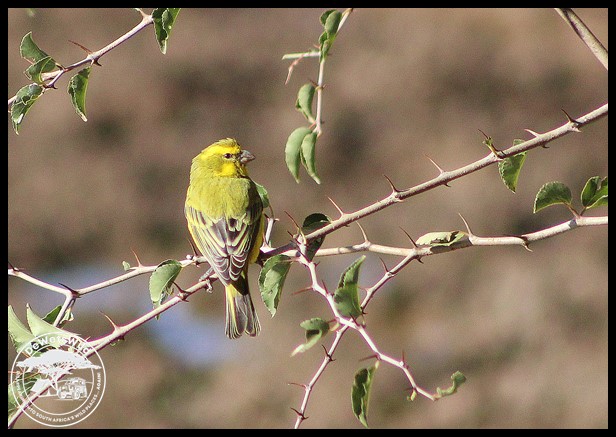
Crithagra flaviventris
The Yellow Canary inhabits heathland, arid scrubland and dry grasslands and savannas, where it feeds mainly on seeds and, to a lesser extent, small invertebrates, nectar and flowers. During periods of drought they may be quite nomadic. They’re social birds found in sizable flocks and often in association with other species of seed-eating birds. In South Africa, the Yellow Canary occurs mainly in the drier western and central parts of the country and is absent from most of Mpumalanga and Kwazulu-Natal. Beyond our borders they’re also found in Lesotho, Namibia, Botswana and small pockets of Angola and have been introduced to the island of St. Helena in the Atlantic Ocean.
Yellow Canaries may breed at anytime of year, peaking during periods of highest rainfall. They form monogamous pairs, with the dull-coloured female responsible for the building of the cup-shaped nest in a shrub or small tree while the bright male defends the nesting territory. She is also solely responsible for incubating the clutch of 2-5 eggs, which takes about two weeks. Both parents provide food to the growing chicks, which leave the nest about a fortnight after hatching. Fully grown they weigh around 17g and measure approximately 13cm in length.
The IUCN considers the Yellow Canary to be of least concern.


 DeWetsWild
Ag, die vaal ou wyfietjie … foei tog! Die laaste foto is pragtig (mens kan amper sy gesigsuitdrukking sien 🙂).
Baie dankie, Corna! Mens kan nooit te veel van hierdie mooi voeltjies sien nie. Die ou vaal wyfietjies is so skaam, amper asof hulle n swak selfbeeld het.
Ja, ons (mens) vrouens kan ons nog bietjie optooi met ‘n hoed en krale, maar wat moet die ou vaal wyfie voëltjie dan nou doen 😉.
They are a delight to come across – but not all that easy to photograph, I find. Well done to you.
Thanks a lot, Anne. I would love to get more images of the females, but they really are tricky to see and photograph!
I have a fondness for canaries, Dries. Such busy little birds.
I find it wonderful that there are so many kinds of them, Tracy!