Monthly Archives: October 2023

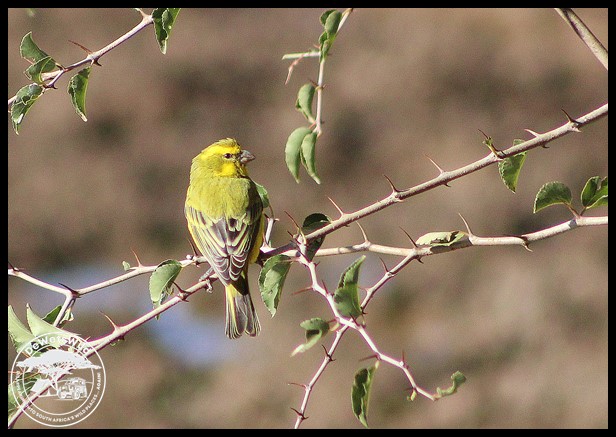
Yellow Canary

Crithagra flaviventris

The Yellow Canary inhabits heathland, arid scrubland and dry grasslands and savannas, where it feeds mainly on seeds and, to a lesser extent, small invertebrates, nectar and flowers. During periods of drought they may be quite nomadic. They’re social birds found in sizable flocks and often in association with other species of seed-eating birds. In South Africa, the Yellow Canary occurs mainly in the drier western and central parts of the country and is absent from most of Mpumalanga and Kwazulu-Natal. Beyond our borders they’re also found in Lesotho, Namibia, Botswana and small pockets of Angola and have been introduced to the island of St. Helena in the Atlantic Ocean.

Yellow Canaries may breed at anytime of year, peaking during periods of highest rainfall. They form monogamous pairs, with the dull-coloured female responsible for the building of the cup-shaped nest in a shrub or small tree while the bright male defends the nesting territory. She is also solely responsible for incubating the clutch of 2-5 eggs, which takes about two weeks. Both parents provide food to the growing chicks, which leave the nest about a fortnight after hatching. Fully grown they weigh around 17g and measure approximately 13cm in length.

The IUCN considers the Yellow Canary to be of least concern.

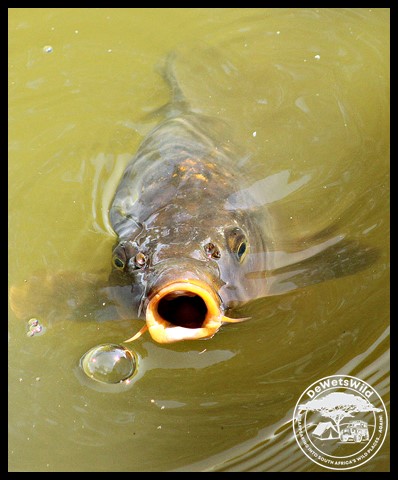
Common Carp

Cyprinus carpio

The Common Carp, also known as the European or Eurasian Carp, is native to freshwater in Europe and Central Asia, and was introduced to South Africa in the 1700’s. It is valued in aquaculture and recreational angling but is considered to be one of the 100 worst invading species in the world and now occurs in almost all rivers and impoundments in our country. Common Carp negatively impacts local aquatic ecosystems due to their indelicate feeding habits; uprooting plants and churning up the sediment making the water unsuitable for indigenous species.

Common Carp can adapt to almost any water conditions but prefer slow-flowing rivers and standing water, such as in ponds, dams and lakes. They are also quite catholic in their omnivorous diet, consuming anything it finds while poking around the soft silt. European Carp has been cultivated as food for humans since Roman times.

Common Carp breed in spring and summer, and large females may lay more than 300,000 eggs at a time and more than a million in a breeding season. The fry hatch within a week and grow rapidly. They can grow to over a meter in length and more than 30kg in weight – the world angling record stands at over 45kg! Common Carp can live for up to 20 years in the wild.

Forest Num-num

Carissa bispinosa

Despite its name, the Forest Num-num occurs in a wide variety of habitats, ranging from savannas and woodlands to forests. It grows mostly as an evergreen shrub, usually multi-stemmed and often scrambling in growth form, or rarely a small tree of up to 5m tall, covered by sharp, forked spines. The Forest Num-num flowers in Spring and Summer and the berries ripen on the tree from March to October.

The fruit of the Forest Num-num is eaten by humans (even as a jam), primates and birds, and the root is used in traditional medicine as a treatment for toothache. It is a beautiful addition to a garden in frost-free areas, attracting lots of insects and birds, and can be used as a hedge.

In South Africa, the Forest Num-num grows from Cape Town all along the southern coast of the Western and Eastern Cape Provinces, throughout Kwazulu-Natal and the eastern Free State, over most of  Gauteng, Mpumalanga and Limpopo. Beyond our borders the Forest Num-num grows as far north as Kenya.

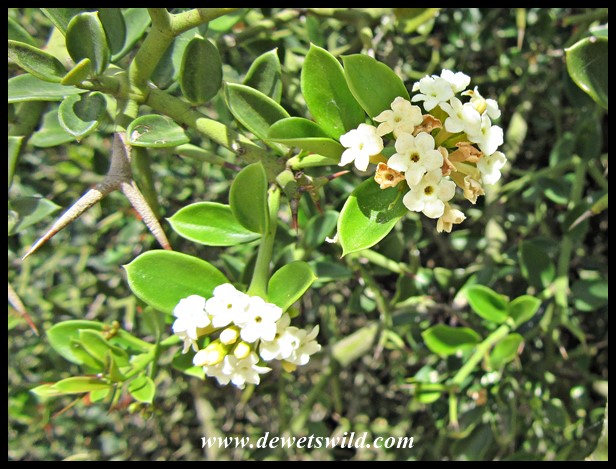
Karoo Num-num

Carissa haematocarpa

The Karoo Num-num is an evergreen, multi-stemmed and densely branched shrub or small tree growing up to 2m high, covered by multitudes of pronged spines that may be up to 4-5cm long, growing in the Little and Great Karoo and along the lower reaches of the Orange River and its tributaries. The tiny flowers, borne in Spring and Summer, are carried in clusters at the end of the branches. The fruit are similarly tiny – about 5mm in diameter – and are purple to black when ripe (while edible, they will stain your teeth the same colour!).

The Karoo Num-num is used as a fodder plant by game and livestock, especially during periods of drought. Though a slow grower, the plant is a good addition to a water-wise garden due to its drought resistance, and it attracts birds and beneficial insects like bees and butterflies.

Some authorities consider the Karoo Num-num to be the same species as the Forest Num-num, which we’ll be showcasing in the next post on DeWetsWild.

Eyed Pansy Butterfly

Junonia orithya

The Eyed Pansy is a widespread butterfly occurring from South Africa (Eastern Cape, Kwazulu-Natal, northern Free State, Gauteng, North West, Mpumalanga and Limpopo), through most of Africa, southern and south-east Asia all the way to Australia. They inhabit grassland and thorny savanna habitats. Adults may be seen at anytime of year, usually in open areas where they fly low and fast, often settling on the same bare patches – its Afrikaans name of “Padwagtertjie” stems from its habit of sitting on road surfaces. The males are territorial and defend their patch vigorously. The sexes are similar in appearance and adults have a wingspan of 4-5cm. The larvae is sustained on a diverse selection of plants.

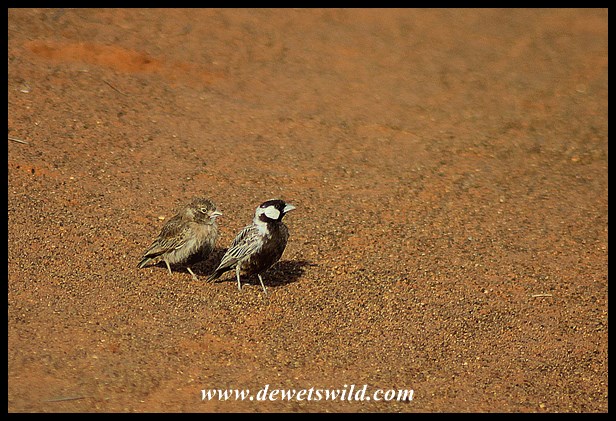
Grey-backed Sparrow-Lark

Eremopterix verticalis

The Grey-backed Sparrow-Lark occurs from Angola and Zambia to South Africa. In our country they’re mostly found in the drier western reaches (Eastern, Western and Northern Cape, Free State and North West Province) but being highly nomadic, following the rains and resultant grass growth, often appears in other parts of the country as well. They prefer arid open, even bare, plains with scattered vegetation and are frequently seen in recently burnt places and fallow fields. Grey-backed Sparrow-Larks feed mainly on seeds and occasionally small invertebrates, like termites and locust nymphs.

Grey-backed Sparrow-Larks are social birds – they may be encountered in flocks numbering several thousand, though usually much smaller – but form monogamous pairs when breeding. There appears to be no set breeding season in this species and it seems they’re rather opportunistic breeders during periods of good grass growth following good rains. Using dry plant material the female builds a cup-shaped nest on the ground, usually at the base of a shady shrub. Both parents incubate the clutch of 1-5 eggs – which hatch within 11 days – and bring food to the chicks at the nest. The chicks leave the nest at around 10 days of age, although it takes about double that before they can fly. Fully grown they weigh around 17g and measure about 13cm in length.

The IUCN considers the Grey-backed Sparrow-Lark to be of least concern.

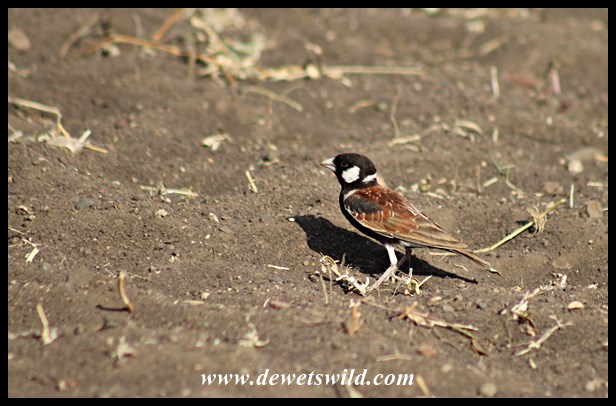
Chestnut-backed Sparrow-Lark

Eremopterix leucotis

The Chestnut-backed Sparrow-Lark is a nomadic bird that inhabits open savannas with short grass and bare patches (especially recently burnt). They feed mainly on seeds, though insects and other invertebrates also feature in their diet and especially so in the breeding season. Chestnut-backed Sparrow-Larks are social and is usually seen in flocks numbering from 5 to 50 and sometimes several hundred individuals. They drink regularly when water is available but also occur far from water.

Chestnut-backed Sparrow-Larks form monogamous pairs in the breeding season, which may be at anytime of year following good rainfall. They build the nest together, using a shallow depression next to a tuft of grass or rock in which to place the cup-shaped nest built with soft plant material. The clutch of 1-3 eggs are incubated by both parents and hatch in less than 2 weeks. The chicks leave the nest when they’re only 2 weeks old and before they’re fully capable of flying. Fully grown they weigh around 22g and measure 13cm in length.

Chestnut-backed Sparrow-Larks occur in northern South Africa (from the Free State and Kwazulu-Natal northwards) and patchily throughout Africa’s savanna regions. The IUCN considers the species to be of least concern.

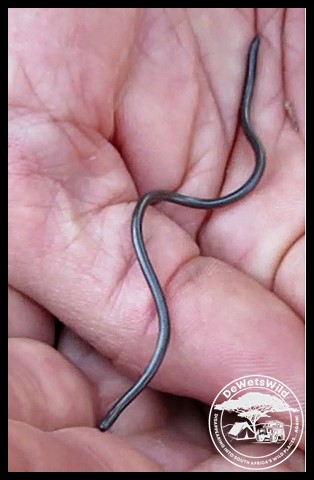
Incognito Thread Snake

Leptotyphlops incognitus

Joubert and I have just returned from a “Dads & Lads” weekend with good friends at the Kudu Private Nature Reserve outside Lydenburg in the Mpumalanga Province. While looking for crickets to use as fishing bait I came across this tiny Incognito Thread Snake underneath a rock.

The Incognito Thread Snake is a harmless and tiny reptile that lives almost exclusively underground, sometimes emerging on the surface during wet weather and then easily confused with an earthworm. They feed on invertebrates, especially termites.

Incognito Thread Snakes grow to about 15cm in length and are thinner than a matchstick. Females lay 3-4 rice-sized eggs that hatch in late summer.

In South Africa the Incognito Thread Snake occurs in Kwazulu-Natal, Mpumalanga and Limpopo Province, and beyond our borders as far as Zambia, Malawi and southern Mozambique. The IUCN considers it to be of least concern.

A few minutes at Austin Roberts Memorial Bird Sanctuary

Earlier this week Joubert and I quickly popped into the hide at the Austin Roberts Memorial Bird Sanctuary while we were whiling away a few minutes before attending to some other (more boring) chores. Despite the cold and overcast weather the little reserve was alive with birds of all description (as it always is!) and again we were amazed that such a precious place still exists inside one of the capital city’s oldest neighbourhoods.

The photographs are all courtesy of Joubert, while I was responsible for the videos.


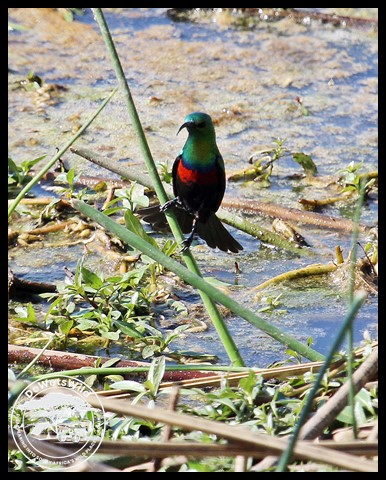
Marico Sunbird

Cinnyris mariquensis

The Marico (or Mariqua) Sunbird is a very active little bird that prefers open savannas dominated by thorn trees, though they’re ever more frequently being seen in parks and suburban gardens. Like other sunbirds their diet consists mainly of nectar and invertebrates.

Marico Sunbirds form monogamous pairs and breed from mid-winter through to late summer. It takes the female about a fortnight to build the pear-shaped nest using spider webs and plant material and then camouflaging it using anything from bark to droppings. She’s also the sole incubator of the clutch, with 1-3 eggs laid and hatched about 2 weeks later. The male only starts helping with the care of the chicks when they fledge, assisting with their feeding for several weeks after the youngsters take to the wing for the first time. Fully grown, Marico Sunbirds weigh around 11g and measure approximately 13cm in length.

In South Africa the Marico Sunbird is found in northern Kwazulu-Natal, most of Mpumalanga and Limpopo, northern Gauteng, the North West Province and much of the Kalahari regions of the Northern Cape. Beyond our borders they also occur patchily to as far north as Eritrea. According to the IUCN the Marico Sunbird is of least concern.