Hystrix africaeaustralis
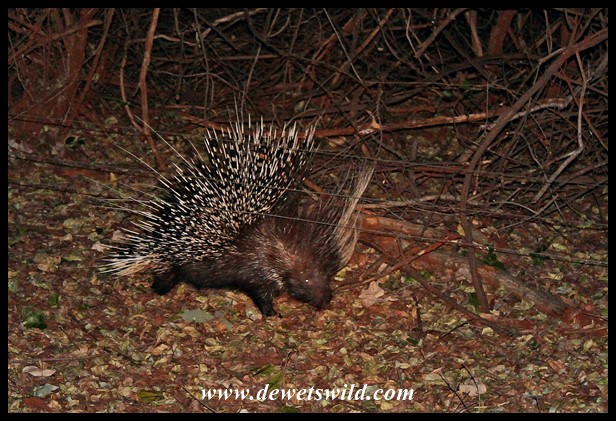
The Cape Porcupine is Africa’s biggest rodent and one of the largest rodents on earth. Females are slightly bigger than males and may weigh up to 24kg.
Cape Porcupines are strictly nocturnal and only very rarely seen during daylight – usually as a result of being molested by predators or humans. They’re commonly encountered singly or in pairs, though families of up to 14 (more usually about 6) may share a tunnel system, which they often also have to share with a wide range of other animals taking shelter there. These other animals often come off the worse for the encounter with the prickly neighbours though. Cape Porcupines may occupy tunnels dug by other animals, like the aardvark, but they are just as adept at digging for themselves. They’ll also hide in caves and in dense vegetation if need be. In a family only the two dominant Porcupines will breed, with the female giving birth just once a year to a litter of 1 or 2 young (sometimes up to 4) after a three month gestation, usually during the period of highest rainfall. They have a life expectancy of up to 20 years.
Porcupines can’t “shoot” their quills as is often believed, but they will rush backwards into an attacker with often horrific consequences. Nevertheless they’re a favourite prey item for all Africa’s large carnivores.
The Cape Porcupine occurs though almost all of Africa south of the equator and can be found in every province of South Africa, which is indicative of their ability to adapt to almost any habitat. They feed mainly on bulbs, roots, tubers and bark and will not shy away from vegetable patches and orchards. The IUCN considers the Cape Porcupine to be of least concern despite being hunted for food and as a pest over much of its range.


 DeWetsWild
Lovely article. I’m already on your mail list. I so enjoy reading the posts.
Thank you very much for the kind words, Dawn. We appreciate the support!
It always amazes me how predators go after an animal like a porcupine. They must be tasty to go to the trouble of avoiding those quills.
I understand that porcupines really are very tasty, though I doubt I will ever try it myself, Siobhan.
That warthog says it all, wow.
Porcupines are not to be handled without caution, that’s for sure!
There used to be a porcupine that regularly visited the campsite at Addo during the night – lovely to see. I once saw a leopard in Kruger with a quill stuck firmly in its cheek.
Welcome back, Anne! I can’t wait to hear all about your visit!
Late night, when most visitors have turned in for the night, you may find porcupines in most campsites in our national parks. They seldom seem to lose their natural inclination to fear humans.
The trip will come in dribs and drabs … I have started with butterflies, which is where I ended before leaving 🙂
Yikes, that warthog sure came up with the short straw. Ouch! Our dog tangled with a regular old porcupine a few years ago…over 100 barbs in his gums, nose, tongue, etc. He was a sad boy and hasn’t done *that* again….😔
That’s a lesson hard but well learned!
Sjoe, ek het nie gedink dat hulle so oud word nie! Jy’s braaf om sulke mooi foto’s van hulle te neem … of was dit met ‘n zoom lens 😉.
Ek sorg maar altyd dat daar iets naby is om agter te skuil! 😀
Dankie, Corna
The porcupines are kind of cute but oh, that poor warthog!!
Yep, I don’t think the warthog would use “cute” to describe porcupines…
Whew. I definitely hurt for that warthog.
I think that was a painful lesson for the warthog to learn!
Hul het ‘n vreemde gesig. Nie vark of bok of wat ook al nie net op sy eie. Waar was die albino enetjie gewees? Lyk of hy in ‘n mensgemaakte plek was.
Die albino ystervark het ons by n rehabilitasiesentrum gesien, Ineke. Ek het tot toe nooit geweet mens kry albinisme ook by hulle nie, hoewel dit seker nie so vreemd is as mens in gedagte hou dat ander knaagdiere, soos troetelrotte en -muise, ook albino’s kan wees nie.
Dis waar van die troetelmuise/rotte wat ons as kinders gehad het. Ons het net nie besef dat van hul albinos is nie. Mens raak net meer daarvan bewus omdat daar deesdae meer geleentheid is vir blootstelling van die diere aan mense.