
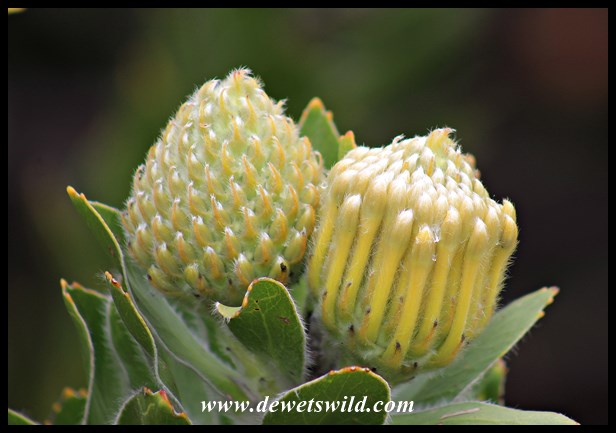
Genus Leucospermum
The Pincushions are a key component of South Africa’s Cape Floristic Region, an area of incredible floral diversity and endemism known as fynbos, the smallest of the world’s six floral kingdoms and a recognised World Heritage Site. Among the 48 currently recognised species in the genus are species that grow prostrate along the ground while others grow as large shrubs up to 5m tall. Most of these species have a limited distribution and 40 of them are threatened to some degree or another by inappropriate land use, incorrect fire management and invading alien plants and ants. Only 5 species occur outside the Cape Floristic Region.
Pincushions are evergreen and grow in relative depleted soil. The flowers are pollinated by nectar-feeding birds and rodents, and once the seeds have been formed these are carried underground by native pugnacious ants (genus Anoplolepis). The seeds remain dormant underground until a fire sweeps through the fynbos above, at which point the seeds germinate and establish a new generation of Pincushion plants.
Pincushions are popular in gardens and in the cut flower trade.


 DeWetsWild
They look so pretty, before and after the flowers open.
Indeed they are, Siobhan. One of the jewels in our fynbos.
Oee, nou’s jy by my gunsteling afdeling – fynbos! Dis altyd lekker om speldekussings in die natuur te sien … wanneer ons stap, is dit een van die min bosse waar ek letterlik in my spore gaan stilstaan om daarna te staan en kyk. En jy het soveel mooi foto’s van hierdie unieke blom – dankie dat jy dit met ons deel.
Jy kan jou dan seker goed indink hoe ons “Vaalies” verstom staan oor die verskeidenheid en skoonheid van die fynbos wanneer ons elke dan en wan daar in die suid-weste kom?
What an interesting variety, Dries!
Seen in the context of the Cape Floral Kingdom this family is but a small piece of a magnificent tapestry!
So beautiful! And that bird perched on the flower?…magnificent!
Thanks a lot, Lori!
Another gorgeous beauty from the fynbos. Are there other ants that threaten these beautiful plants in the wild?
I should’ve been clearer on that aspect, Tracy. The invading ants displace our indigenous pugnacious ants, and as the pincushion seeds are then not carried undergound these exotic ants are an indirect threat to the plants.
I realised that, Dries. Didn’t realise that feral ants were a big problem but it makes sense.
Aren’t we fortunate to have such beautiful flowers growing in the wild here!
Oh absolutely, Anne. The Cape Floral “Kingdom” really deserves that name!
Dis een van my gunsteling blomme Dries en die voels hou net so baie van hulle! Pragtige foto’s!
Baie dankie, Aletta. Hierdie plante vang altyd n mens se oog wanneer ons daar in die Wes Kaap toer.
These are great, Dries. I especially love that shot with the bird. These look like something that might grow around here.
As beautiful as they are, they really are hardy plants, Janet, although I think they’re a bit more thirsty than most of the plants native to your part of the world.