
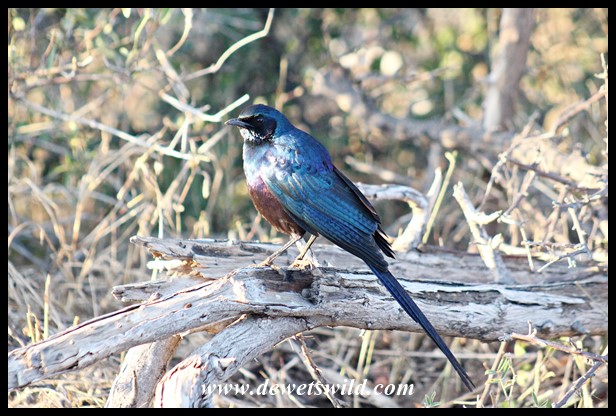
Lamprotornis mevesii
A bird of riverine forests and floodplains with mature woodland, the Meves’s Starling (or Longtailed Starling) subsists on a diet of insects, fruits and flowers, foraged mostly on the ground. Adults measure approximately 34cm long, including the very long tail, and weigh around 75g.
These striking birds breed in spring and summer, building their nests inside cavities in trees – often using the same nest in successive years. The female takes sole responsibility for incubating the clutch of 3-5 eggs, which usually takes just short of 3 weeks, but both parents are involved in rearing the chicks, which fledge when they’re about 3 weeks old.
Meves’s Starling has a limited distribution in southern Africa – from Zambia and Malawi south to the Limpopo Valley on the border of South Africa with Botswana and Zimbabwe, meaning that the Mapungubwe National Park and the Pafuri region of the Kruger National Park is the most accessible locations in our country to go looking for them. The IUCN lists this species as being of least concern.


 DeWetsWild
I enjoyed your photos of these lovely birds. We really enjoyed seeing them in northern parts of Kruger during our visit there last year.
Isn’t it interesting that, even in their very limited South African range, they’re so numerous!?
Yes that is interesting.
What a beauty! The tail reminds me a bit of a European magpie.
This bird certainly has an unusually long tail. Comparatively few African birds sport such long tails – I suppose it would be a liability with so many predators around.
Beautiful bird!
You’ll hear no arguments from us, Amoralegria! The glossy starlings are an eye-catching family, that’s for sure.
So ‘n pragtige kleur!
Mens staan verstom, Aletta!
Hoe pragtig. Van ver sien jy net die blou, maar naby vleg die roesbruin op die rug so in die blou in. Die Skepper is wonderlik… Hy dink buite die boks met kleure.
Jy het heeltemal reg, Elsabe. Alles pas so perfek in hul plekkie in, en dan is dit nog so mooi daarby!
Ek kan sien hoekom hierdie voeltjie ‘n glansspreeu genoem word … daar is wraggies so ‘n glans lagie om hulle!
Die kamera kry dit nie naastenby so goed vasgevang soos wat dit in lewende lywe lyk nie, Corna
That iridescent blue-black is breathtaking!
In real life even more so, Lori!
It is so annoying having to go back to the Reader in order to comment on your posts – no fault of your I am sure WP insists I log in when I already have! Anyhow, I am pleased to see your highlighting of these interesting birds – we only get the Cape Glossy Starling our way 🙂
Thank you very much, Anne.
I also noticed WP acting up when I tried to comment on blogs yesterday morning and suspected we were all afflicted by whatever bug.
You do have the prettiest birds, Dries. That tail reminds me of pheasant feathers–beautiful!
This definitely is one of our more beautiful species (along with all its glossy cousins!)
I love the colors. The tail is amazing too.
You should see them in real life, Meghan!
That would be a treat!! I am glad I found your blog, so I can see some of the great wildlife you experience!