
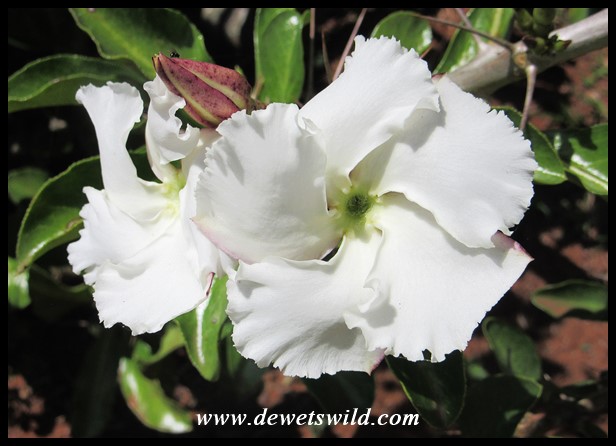
Pachypodium saundersii
The beautiful Kudu Lily has a limited distribution, being restricted to the Lebombo Mountains and surrounds in the north of Kwazulu-Natal and the Lowveld of Mpumalanga and Limpopo, as well as in Eswatini, Mozambique and Zimbabwe. Its natural distribution range reflects its preference for dry, hot and rocky terrain. This shrubby succulent may grow as tall as 1.5m. The extravagant flowers appear in autumn and the sharp spines can inflict serious damage.
The Kudu Lily is available as a garden plant and can be trained into a fascinating bonsai. Like others in the genus the Kudu Lily is poisonous and this is used, with caution, in traditional medicine to treat bacterial infections and cancer, and also as a poison for arrows used in hunting.


This post was scheduled to publish while we are exploring two of South Africa’s national parks during the South African winter holidays. We will respond to comments on our return. Stay safe and well!
 DeWetsWild
Love the way the petals curve – reminds me of a Catherine wheel and I have not thought of them for a very long time!
You’re right, Carol! It also reminded me of those handheld “windmills” we used to get at bazaars and fetes when I was a child.
Oh yes – thanks for reminding of those little ‘windmills’! Perhaps childhood was a bit simpler not even that long ago?
I realise that more with every passing day.
Dis so pragtig , Dries! Ek dink ek het die een daar in KZN gesien!
Jy sou hulle beslis by uMkhuze gesien het, Aletta
Lovely!
Isn’t it just!?
Yes!
Pragtig. Lyk soos ‘n whirlwind blommetjie.
Herinner my ook nogal aan daardie windmeulens wat ons as kinders mee gespeel het.
Die blom blaartjies is so mooi gekartel – Koedoelelie, nog ‘n mooi naam. Oe, julle weer op toer deur ons nasionale parke … ek kan nie wag om te hoor (en te sien) nie!
Ek kon net nie uitpluis wat koedoes met die plant uit te waai het nie!
I am so pleased you have highlighted this beautiful flower!
Thank you, Anne!
Looks like something that would grow around here—spines! Beautiful and unusual. I’m looking forward to the photos you’re taking of these😁 parks. 😉
You are right, Janet. This plant thrives in harsh environments.
Beautiful flowers. We have a somewhat similar flowers. They are called by different names.
https://en.wikipedia.org/wiki/Tabernaemontana_divaricata
What a resemblance, Lakshmi, and that from plants so different!
What stunning blossoms this Lily has!
Especially considering that it is in fact not a lily at all!
Aha weer n naam geleer. Kudu Lilly.
Natuurlik is die eintlik glad nie n lelie nie, maar eerder n vetplant!
Nog meer interessant. Hoekom sou dit ‘n lelie genoem word wonder ek nou.
Al wat ek kan dink is dat die prag van die blomme die mense dit n lelie laat noem het. Die naby familie van hierdie plant word ook “lelies” genoem – Impalalelie en Swazilelie, byvoorbeeld.
Mmmm, ja nou verstaan ek dit ook,
Beautiful lily with medicinal properties, what more can one ask for?
Agreed, Hien. I am of the opinion that a lot of medical breakthroughs are still locked up in traditional knowledge.
Oh this is so very beautiful 😀
You should see them in real life, Cee!