

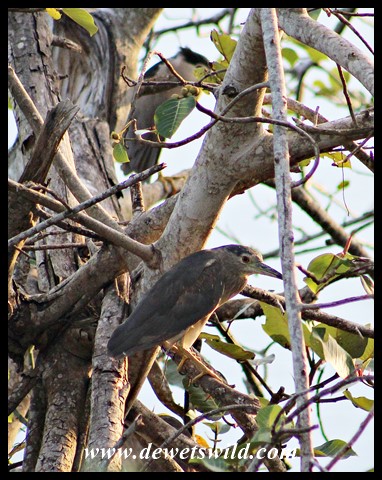
The Black-crowned Night Heron isn’t necessarily a rare bird, but because it is so shy and retiring, and nocturnal, is not seen very often and not very obliging for photographs. During our December 2021 visit to the Kruger National Park, we found a juvenile where the S41-road crosses the Nwanetsi stream. In the early morning it was often quite willing to sit in the open for a photo or two, and one one occasion we even got to see one of its parents flying back home on an overcast morning.


Nycticorax nycticorax
The Black-crowned Night Heron is a nocturnal bird whose habitat requirements are closely linked to slow-moving water with lush growth of emergent vegetation. As these habitats are often fleeting in this part of the world many of our local populations are nomadic in response to rainfall patterns through the region. Their prey ranges from insects and other invertebrates to fish and amphibians and even small reptiles, birds and mammals. As their name suggests these herons are active from dusk to dawn, hiding in dense vegetation by day.
Black-crowned Night Herons often breed colonially, with others of their kind or even other species of water birds. Adults form monogamous pairs with both partners participating in the nest building, incubating the clutch of 2-8 eggs (that take between 3 and 4 weeks to hatch) and rearing the chicks, who fledge at around 7 weeks of age. Breeding can take place at any time of year but reaches a peak in our wetter summer months. Fully grown they measure around 56cm in length and weigh approximately 630g.


Occurring widely but sparsely all over South Africa where there is suitable habitat, the Black-crowned Night Heron’s distribution stretches far beyond our borders to every other continent except Antarctica and Australia. The IUCN considers it to be of least concern.
During a visit to the iSimangaliso Wetland Park in March 2022 we found a slightly older Black-crowned Night Heron and its parents near Cape Vidal.
Black-crowned Night Herons
Another special sighting of this bird was one we saw flying over De Hoop Vlei during broad daylight during a visit to De Hoop Nature Reserve in December 2022.


 DeWetsWild
Ek moes nogal mooi kyk om hulle daar tussen die boom se takke raak te sien. En ek hou van die foto’s waar hulle so mooi vlieg!
Hulle sit so stil en diep onder die takke bedags dat mens hulle baie maklik mis.
We do have the Black-crowned Heron and the Yellow-crrowned Herons in USA. They are great subject to be photographed. Thanks, D. 🙂
Thanks, H.J. I’ve gathered from other bloggers in North America that these birds are easier to see in that part of the world than here. Is that your experience too?
Yes, I have to agree with that.
Amazing photos and beautifully written the bird’s story , nice to read 🙏🌷🙏❤️🌷
Thanks a lot, Thattamma!
Another treasured sighting.
Indeed, Anne! Do you see them from time to time in your part of the country?
Water is in fairly short supply here … actually I haven’t been anywhere near their kind of habitat for a while.
That would be a very limiting factor yes. I should’ve given my question more thought before asking! 😀
Excellent photos as always. These guys can be difficult to spot as I know from my experience here. We have quite a few of these at the Preserve. Must get there again soon and see what it looks like. I haven’t been there for months! Too busy with Mom and Dad.
You’re lucky to have such a reliable spot to find them, Janet. I’d love to get more chances at photographing this bird.
lucky sighting and great pics!
Thanks, Joep! The “driffies” over the Mavumbye, Gudzani and Nwanetsi were very good to us on this visit.
Goed raak gesien veral so in die skemer.
Gelukkig was die jongeling nie so skaam soos sy ouers nie!
Goed gestel. Is jongelinge nie maar almal dieselfde nie?
Party is glad nie op hul bek geval nie!
En hoe! Party dae weet mens nie waar hul aan alles kom nie. Selfs jong voëls is ook baie slimmer as ouers!