

We’ve been bird-watching for quite a while now, and finding a new species for our list does not happen all that often anymore. The 15th of December therefore was a red letter day for us when we encountered this Dwarf Bittern between Lower Sabie and Skukuza in the Kruger National Park, taking our number of South African bird species seen to 588 (of roughly 973 ever recorded in this country).


Ixobrychus sturmii
The Dwarf Bittern is a small species of heron that is mostly nocturnal and found singly or in pairs. It generally occurs around seasonal and permanent water bodies surrounded by dense and emergent vegetation. They feed mainly on insects, crabs, frogs and small fish.
Dwarf Bitterns breed in periods of highest rainfall, often nesting in association with other kinds of heron. Their nests are flimsy platforms of twigs, built in a hurry by both partners. Clutches of 2-5 eggs are incubated for around 3 weeks by both parents. The chicks leave the nest before they’re 2 weeks old, although they can’t fly yet.
The Dwarf Bittern is an uncommon summer visitor to South Africa, with most records from Mpumalanga and Limpopo. It occurs in low densities over much of sub-Saharan Africa and the IUCN considers the Dwarf Bittern to be of least concern.
As luck would have it, just a few months later we found another Dwarf Bittern, this time on the Eastern Shores of Lake St. Lucia.
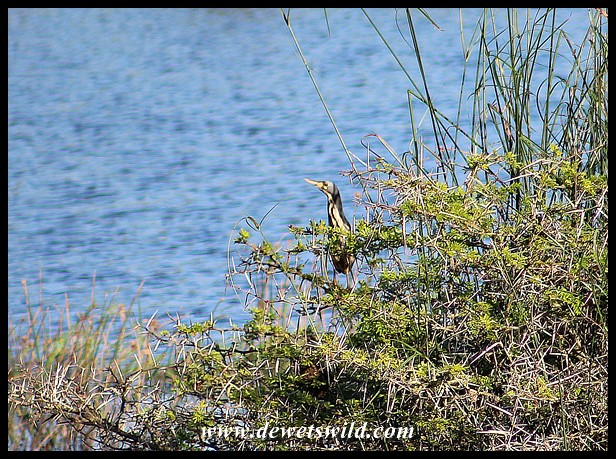
Dwarf Bittern
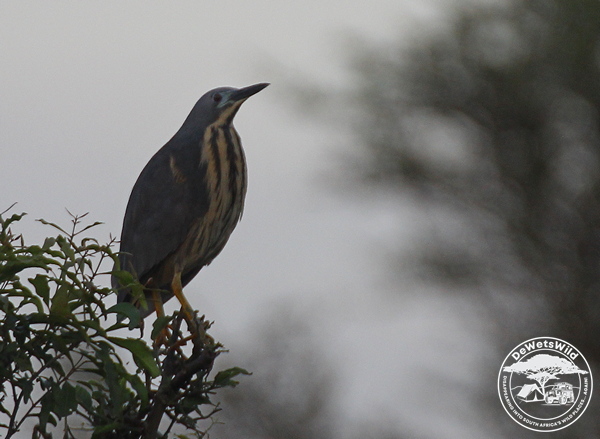
Dwarf Bittern
 DeWetsWild
Sjoe, julle het omtrent al baie voels gesien! ‘n Mooi stel foto’s van hierdie een – is dit ‘n dwergrietreier in Afrikaans?
Inderdaad die Dwergrietreier ja
Congrats! Bitterns are not an easy bird to see. Nice photos of this unique species.
Thank you very much, Siobhan. We were very grateful this one was so obliging (for a few seconds).
What a nice addition to your SA list and great photos! I saw my first Dwarf Bittern in December 2020 just outside Letaba camp and know the thrill of finding this scarce bird
Thank you very much, Don.
Looks like we both got nice Christmas presents, you in 2020 and us in 2021!
I’m sure you’ve been birding for much longer than we have and having to wait so long for your first sighting you must have been elated at the find!
Jul was beslis gelukkig om die outjie te sien en dan nog so duidelik ook.
Dit is beslis so, Ineke!
What a lucky sighting and you got some stunning photos of the lovely bittern,
We were more than pleased with this find, Carol!
Congratulations on adding to your list! Nice capture.
Thank you very much, John!
It looks like an American Bittern, which is of high concern due to their recent decline of as much as 46% between 1966 and 2015.
Is that due to loss of habitat, Hien?
Congrats!
Thanks, Kathy!
Congrats on the new ‘lifer’!
Thanks, Brian! We’re very chuffed.
Dis ongelooflik dat julle die een kon sien Dries! Jammer hulle is so skaars!
Ons was regtig baie bly toe hierdie voeltjie so onverwags opdaag!
Ek kan dit dink😊
Wow! What a tremendous sighting, to see one perched so clearly in the open like that. These are treasured photographs.
Indeed, Anne. We consider ourselves very lucky.
Lovely markings and congratulations on finding so many different birds!!
Thank you very much, Janet!
What a beautiful find, Dries. We’ve never seen a bittern. They are rare and on the odd occasion when they are spotted, that seems to be their cue to move deeper into the reeds.
Same story here, Tracy. Which makes this first sighting of the Dwarf Bittern all the more special for us.
❤
Such pretty markings. It must be wonderful to look up and see him/her flying.
We were very excited when this one came flying in over our heads, Lois!