
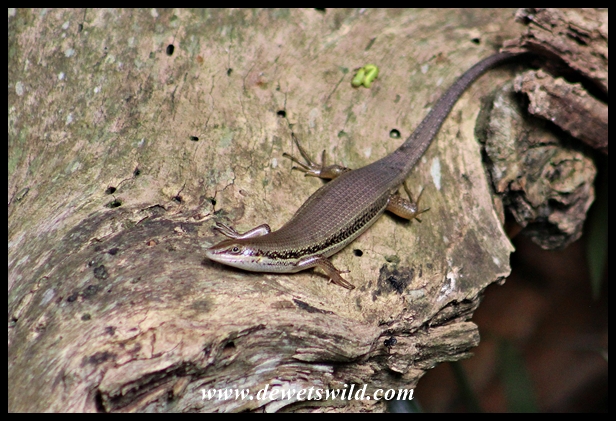
Trachylepis depressa
Largely endemic to southern Mozambique, the distribution of the Eastern Coastal Skink extends only marginally into South Africa, where it is found in the Pafuri region of the Kruger National Park and the north coast of Kwazulu-Natal, being commonly seen in the iSimangaliso Wetland Park. The IUCN hasn’t yet evaluated this species’ conservation status, and little is known of its biology, except that it inhabits dense vegetation on sandy soils and will actually hide from danger by digging itself into the sand. Adults measure around 8cm in length, excluding their tails.

Eastern Coastal Skink

Eastern Coastal Skink

Eastern Coastal Skink

Eastern Coastal Skink

Eastern Coastal Skink

Eastern Coastal Skink

Eastern Coastal Skink
 DeWetsWild
How interesting that they bury themselves in the sand for concealment.
Every creature seems to have at least one quality that makes it utterly fascinating!
At least one, yes!
Hi de Wet. Ek besef ewe skielik ek het lanklaas iets van AJ gesien?
Jy is reg, Una. Hy vat bietjie n breuk na hy die groot mylpaal van 10 jaar se daaglikse plasings gehaal het.
Dankie vir die inligting, de Wet. Hy het toe self ook kontak gemaak.🌺
Cute little reptiles. Thanks for sharing their story!
Glad to, thank you John!
You obviously didn’t appear dangerous to them 🙂
Thank you, Anne. I like to believe that animals too can perceive how cute and cuddly I am… 😀
The skinks we have in Georgia are small and skinny, compared to the ECS. Thanks you, D. 🙂
I love skinks for being so active and interesting, and they are such a diverse family! Do you know which skink exactly is it that frequents Georgia, H.J? I’d like to look it up on Google.
North American worm lizard
Green anole
Brown anole
Eastern glass Lizard
Mimic glass lizard
Island glass lizard
Slender glass lizard
Eastern fence lizard
Texas horned lizard
Little brown skink
Thanks, H.J!
Some pretty markings. 😉
All the better to blend into the ground cover with!