

The iSimangaliso Wetland Park is home to healthy populations of both White and Black Rhinoceros, jealously guarded by the reserve’s rangers and routinely dehorned to deter poachers. Rhino populations all over our country are under severe threat and seeing these animals in the wild, even without their trademark horns, is an experience we’re very grateful for.
Being diurnal in habit and much less skittish, the White Rhino is the easier of the two African species to find while driving around iSimangaliso.


Black Rhinos are solitary, shy, more nocturnal and consequently seen less often than White Rhinos.


This muddy signpost in the park was used by a muddy rhino as a rubbing post. Rolling in mud, leaving it to dry and then rubbing the caked mud off against a sturdy rock, tree or …signpost, is a way for the rhino to rid itself of external parasites like ticks.
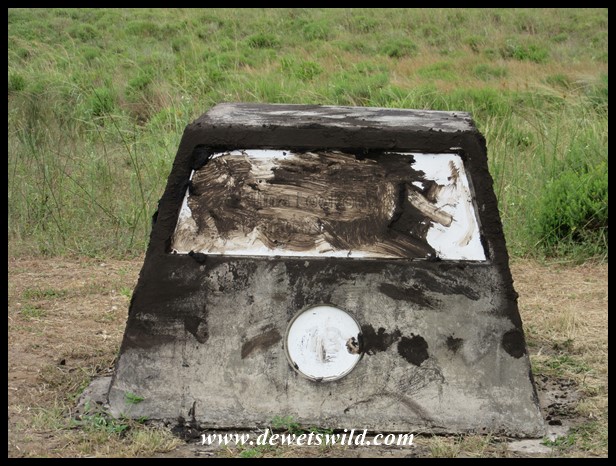
Signpost re-modelled by a muddy rhinoceros
 DeWetsWild
Wow- such a rich and diverse natural history excursion! Very cool that the rhinos create their own “interpretive” signage!
They’re such enigmatic creatures, Jane, and what a privilege to spend time in their home.
Your family sets very good examples for how our species should behave when visiting in those special homes!
Very kind of you, Jane, Thank you.
Just so cool that you have been able to see these in person.
Very special, PJB. We could never tire of them.
Pleased these rhinos are healthy, and guarded
We owe our thanks to the rangers at iSimangaliso and all our other reserves where rhinos are protected.
What magnificent creatures! I am so glad that they have guardians watching over them. I just watched a very troubling documentary the other night about the way that poachers are decimating Africa’s elephant population just to get ivory. It made me heartsick, as I find those gorgeous animals fascinating as well. The film was called ‘Naledi’.
https://www.pbs.org/wnet/nature/naledi-one-little-elephant/15445/
The ruthlessness and mercilessness with which elephants and rhinos and pangolins and countless other species the world over are targeted is absolutely gut-wrenching, Lori, and if I am allowed one wish for our blog it would be that somewhere someone visits dewetswild, sees how beautiful these animals are and how much we love them, and chooses not to buy those truly worthless trinkets. The slaughter will only stop when the buying does.
So true! It seems like efforts are being made to eliminate the ivory trade, but from what I understand much remains to be done.😢
Sadly it seems the syndicates are always one step ahead of law enforcement…
It is heartbreaking…
Rhinos are so very special. What a boon to see so many of them. At a private reserve near here, the rangers count the rhinos every morning and evening to check that all is well. Protecting rhinos these days is an expensive, almost military-like, undertaking.
Being the province where South Africa’s rhino populations were saved in the previous century a visit to a KZN game reserve wouldn’t be the same without seeing rhinos in good numbers. It is so sad that all those gains made in middle of the previous century are now being undone by these ruthless poaching syndicates. We’re really grateful to everyone fighting the battle on our behalf.
They’re certainly impressive. Why is the white rhino called white when it isn’t?
Interesting question, Janet! The Dutch were the first Europeans to settle permanently in South Africa, and the story is that they called it the “Wijde Rhenoster” – Wide Rhino – because of its broad mouth. When the English arrived the “Wijde” became “White”.
And an interesting answer. Thanks.
We had a Southern White Rhino born at one of the local zoos last month. Are they in the same family as your White Rhinos?
One and the same, Lois. The Southern White Rhino is the subspecies occurring naturally here in South Africa and seen in zoos and safari parks all over the world. Sadly the Northern White Rhino is effectively extinct already as there’s only two old females remaining in Kenya.
Oh, that is a shame about the Northern White Rhino…
A terrible shame, Lois, and we need to act to stop more species going the same way.
Have their horns been removed to protect them from poachers?
Sadly yes, Anne.
I like the rhyno black or white, they are needlessly killed by poachers. These powerful animals are not predators nor destroy or damage the environment. Good thing that your Government protect them. Great post, D. Thank you. 🙂
Many people, public and private, are fighting very hard to secure our rhinos against the senseless onslaught, H.J, and we’re most grateful to them.
Great photos and I expect an awesome experience!!
Thank you very much! Indeed, these are special animals and we are grateful every time we find them on our way.