
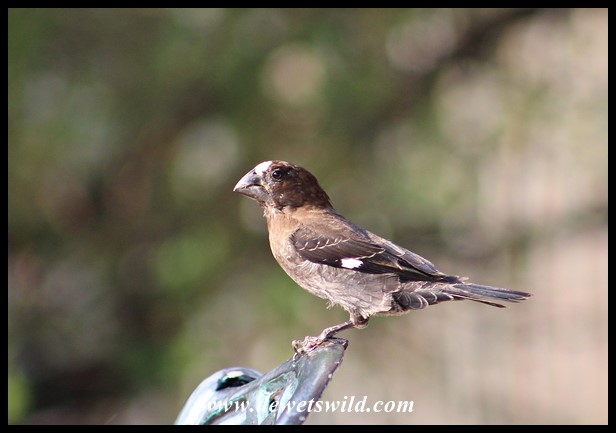
Amblyospiza albifrons
During the breeding season, which extends through spring and summer, Thick-billed Weavers can be found near and in marshes and other wetlands with rank grass and reedbeds, but they roam more widely at other times and are then found from forest edges to suburban parks and gardens. They use their strong bills (ask anyone who’s ever handled a Thick-billed Weaver) to good effect feeding on fruit, pips and seeds. They’re one of the largest species of weaver in South Africa, measuring 18cm in length and weighing up to 50g.
The males alone construct the colony of characteristic dome-shaped nests anchored to two or more reeds or thick-stemmed, tall grasses, while the female, if she accepts the nest, will line the inside with soft materials. Males attempt to attract and mate with as many females as possible. The female lays a clutch of 2-4 eggs which she incubates by herself over a two week period. She’s also the sole caretaker to the chicks, which leave the nest about 3 weeks after hatching.
The Thick-billed Weaver has a very patchy distribution over sub-Saharan Africa and the IUCN considers it to be of least concern, siting a common and apparently stable population. In South Africa they’re found in the wetter eastern and northern provinces, and absent from most of the Free State and the Northern and Western Cape. They’ve actually expanded their distribution considerably in recent years due to the availability of suitably vegetated artificial wetlands, like sewerage treatment installations, being constructed.


 DeWetsWild
A thick billed weaver made a neat input mulberry tree in Brooklyn Pretoria and it’s been a delight to watch. After the female accepts the nest, I noticed that the hole of the nest has been made smaller: is the female enclosed? Or can she still get out?
How lucky you are to be able to watch them.nest so closely, Liezl! The female will still be able to move in and out of the nest, she just closes the opening slightly to deter other birds like cuckoos from seeing and entering the nest.
Saw a thick billed weaver for the first time here in Kleinemonde, Eastern cape
Always nice to add a new species to the list, isn’t it Trish!?
Their beaks look like our grosbeaks. Those nests are so intricate. It must take them a while to weave.
Amazing to think how they accomplish it so easily!
They really are quite strange looking birds when one thinks about it. I really enjoy seeing those that spend their winters in our garden and surrounds. I assume that in the summer they move back to the wetlands.
I would have bet good money on them finding a suitable winter habitat in your beautiful garden!
Ons het baie ander weavers hier in ons omgewing!
En hulle is almal meester-bouers!
Ja, beslis!
Again, you have not disappointed with your beautifully clear photographs. We must get the odd Thick-billed Weaver in our garden when passing through for I record them only once or twice a year. Even then I see only one or two!
It’s only in the past few years that they’ve moved into urban Gauteng as well, Anne. They seem to love the seeds of the White Stinkwood, which have been planted on the pavements in huge numbers in many Highveld suburbs.
It is the White Stinkwood seeds that attracts them to our garden too, I think.
Lekker stewige nes wat die outjies bou.
Ek stem geheel-en-al saam, dankie Ineke.
A great series of images!
Thank you kindly!