
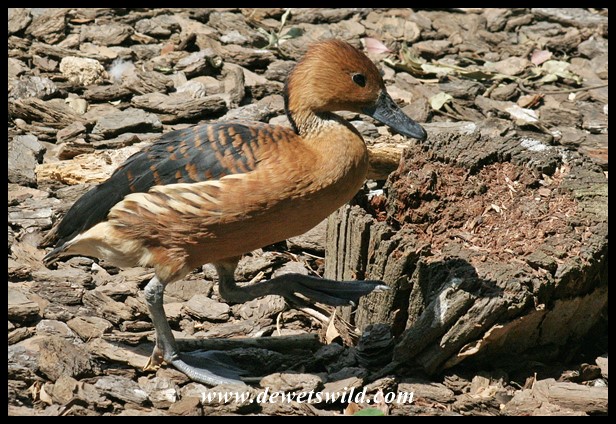
Dendrocygna bicolor
Probably as is to be expected, the long-legged Fulvous Whistling Duck is usually found at or near bodies of fresh water, usually with well vegetated verges where it follows a mainly herbivorous diet that includes algae, grasses, water lilies, seeds and flowers and only occasionally taking in insects and other invertebrates. They are quite nomadic waterfowl, ranging widely in search of suitable habitat, and often found in association with the closely-related White-faced Whistling Duck. The Fulvous Whistling Duck is not often found in large flocks, usually moving around and feeding in fairly small groups. They are active both day and night.
Fulvous Whistling Ducks may breed at anytime of year, though most often shortly after good rains. Their nests are simple scrapes in the ground, usually in dense cover very near water and lined with fine plant materials. Pairs are monogamous and may mate for life. Both parents contribute to the building of the nest and the incubation of the clutch of 6-13 eggs, which hatch after about four weeks. The ducklings can fly before they’re 2 months old.
The Fulvous Whistling Duck is widely distributed over parts of Africa, Asia, North and South America, and is considered to be of least concern; the IUCN estimating the total population at as much as 1.5-million though noting that most populations are declining due to hunting and farming practices. In South Africa they are commonly found on the Highveld (mainly Gauteng) but only occasionally seen in the wild elsewhere in our country.


 DeWetsWild
Definitely a good looking duck – it is such a gorgeous cinnamon colour and I really like the feathery white stripes along the flanks.
I wasn’t familiar with the word “fulvous” prior to putting together this post. Not being an English first language speaker I hope I can be forgiven, but I don’t think it is used very often? I had to google to see that it means “reddish yellow; tawny”. Who knew!? I bet you did though.
I didn’t know actually – it is an interesting word though and it seems it is really only applied to ducks?
I’ve only ever seen it used with this particular species
Hello Dries,
I agree, what a handsome duck. Whistling Ducks do not live here so I am happy to “view” them through your photos. I hope you and your family are staying safe!
They’re a real joy to behold, and hear, Takami.
We’re doing well, thanks, and looking forward to finally take a break at the end of the year. How are you?
Thank you my friend. Unfortunately, COVID-19 cases are continuing to rise in my country, but my husband and I are doing well. I am glad you and all your family are staying safe and healthy!!
Wonderful to hear that the two you are still safe and healthy too, Takami!
He’s such a handsome chap. I wonder who taught him to whistle? My dad taught me and my grandma didn’t approve at all. 🙂
Oh dear, Sylvia! What would the neighbours say? 😀
Exactly so. 😅She has this saying from who knows where, “A whistling woman and a crowing hen are good to neither God nor men.” 😳
Ouch!
Yes…….that along with ”Little girls should be seen but not heard.” 😳
I hope at least Granny had a purse full of sweets to help little girls with that difficult task!?
No, sweets were bad for our teeth. 😦
Handsome duck, one that does not live around where I am. Sigh …
Thankfully you have some real showy ducks of your own there, Hien!
What a bonny duck, Dries.
Beautiful colors and a name that makes me smile. Reminds me of the Frumious Bandersnatch. 😘
Do I dare google “Frumious Bandersnatch”, Janet?
Yes, it’s from “Jabberwocky.” 😉
That’s a relief! 😀
They sport a beautiful colouring. I particularly enjoy the photograph you have used for your header.
Thank you very much, Anne. I love their long-legged walk.
I’m always happy that they breed for life and both contribute to raising their young.
Sadly a lesson some humans struggle to learn.
Isn’t that the truth!
That’s a pretty “duckie”. Well known everywhere. I’ve seen it in South America, however, I don’t have a single photograph of them…It happens! Thanks, D. 🙂
They’re a personal favourite of mine too, H.J.