
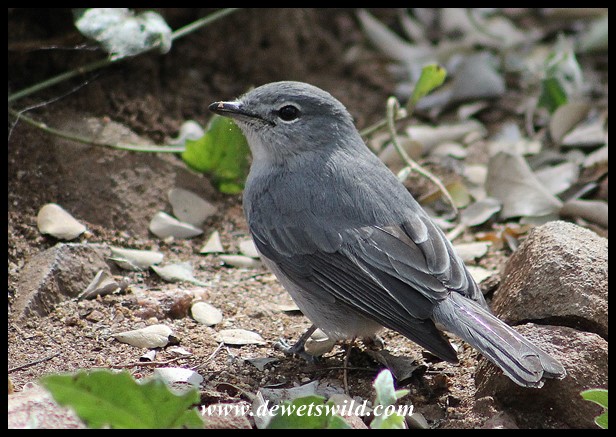
Fraseria (Muscicapa) caerulescens
The Ashy Flycatcher, or Blue-grey Flycatcher, is a very active little bird of dense habitats – forests, mature woodland, riverine thickets and densely planted gardens – where it feeds mainly on insects and other invertebrates, often moving around in mixed flocks with other small insectivorous birds.
Ashy Flycatchers from monogamous, territorial pairs. At the start of the breeding season, which spans most of spring and summer, the partners work together to build their cup-shaped nest, using fine materials, in forks, crevices or cavities in large trees. Clutches of 2-4 eggs are incubated for a period of about two weeks, with the chicks, attentively cared for by both parents, leaving the nest about the same length of time after hatching. Adults measure around 15cm in length and weigh only 18g.
In South Africa they occur along the coast of the Eastern Cape, through the bushveld regions of Kwazulu-Natal, into the Lowveld and escarpment of Mpumalanga and through most of the Limpopo Province. To our north this species is widespread through west, central and east Africa. In conservation terms it is considered to be of least concern.


 DeWetsWild
Flycatchers are fun to watch when they’re “hunting” for food. That’s a cute one. This year we have seen ash-throated flycatchers in our yard. Never seen them here before.
This past year we’ve also recorded a few new species for our garden, Siobhan. I wonder if they really are new residents in the area though or did we just miss them previously while we were at work and school instead of being “locked down” at home?
That’s cool that you’ve seen new species too. In my case, I work from home but I think I’m spending more time looking closer at what exists in our own yard. Many of us are appreciating the natural world in a different way this year. 🙂
It looks ‘similar’ to the strike thrush we have around here… Goolwa south Australia 🙂
I had to go google the shrikethrush, but now that I have I see your point! Isn’t nature amazing!?
I wish we, humans that is, could emulate more of nature aspects. 😄
Absolutely.
They are very cute and seem to be constantly alert.
That’s true, Carol – I think when you’re as busy as they are then you can’t afford to miss any morsel of food nor run into a hungry predator yourself.
Pretty cute!
janet
I’m definitely in agreement with you (again!), Janet!
Very handsome bird. Too bad it only lives in Africa.😉
You really should come visit us Hien!
These are beautiful birds. Your delightful photographs do them justice.
Thank you very much, Anne!
What a little beauty. Such lovely eyes!
I am glad we’re in agreement about this little beauty, thanks Anne!
What a pretty little bird. That grey coloring is beautiful.
We don’t normally equate grey with beautiful, but I agree with you, Lois, that the Ashy Flycatcher pulls it off wonderfully!
Tiny and cute, how does the nest look like?
Their nests are small, cup-shaped and delicately put together, Rudi.
We recently had a nest in a hanging pot plant, the eggs were green with brown blotches and hatched yesterday.
What an endorsement for your home, Angelique!
This bird looks very much like our Blue Gray Gnatcatcher (Polioptila Caerulea)! That’s great! Thank’s a lot, D. 🙂
I bet it’s due to them having similar habitat and dietary requirements!?
A sweet little bird, Dries. Beautiful photos and interesting facts too. 🙂
As kind as always – thanks, Sylvia!